Introduction
Derivatives are one of the most powerful and one of the most misunderstood tools in the financial world. Often associated with high risk and speculation, they are, at their core, contracts whose value is derived from an underlying asset – a stock, index, commodity or currency. Among the many types of derivatives, futures contracts are among the oldest and most popular. They underpin price discovery and risk management in global markets. This blog explains what futures contracts are, how they work and why they are important to hedgers and speculators.
What Is a Derivative?
A derivative is a financial contract between two or more parties whose value is based on an agreed underlying financial asset. The underlying asset is not included in the contract itself. Instead, the derivative price changes in response to changes in the underlying asset price. Common types of derivatives are futures, options, forwards, and swaps. These derivatives are used for a range of purposes including hedging, speculation, and arbitrage.
Derivatives markets exist because they enable participants to transfer risk. Derivatives allow a farmer worried about falling crop prices, an airline worried about rising fuel costs or an exporter worried about currency fluctuations to lock in prices and protect their business from adverse market moves.
What Is a Futures Contract?
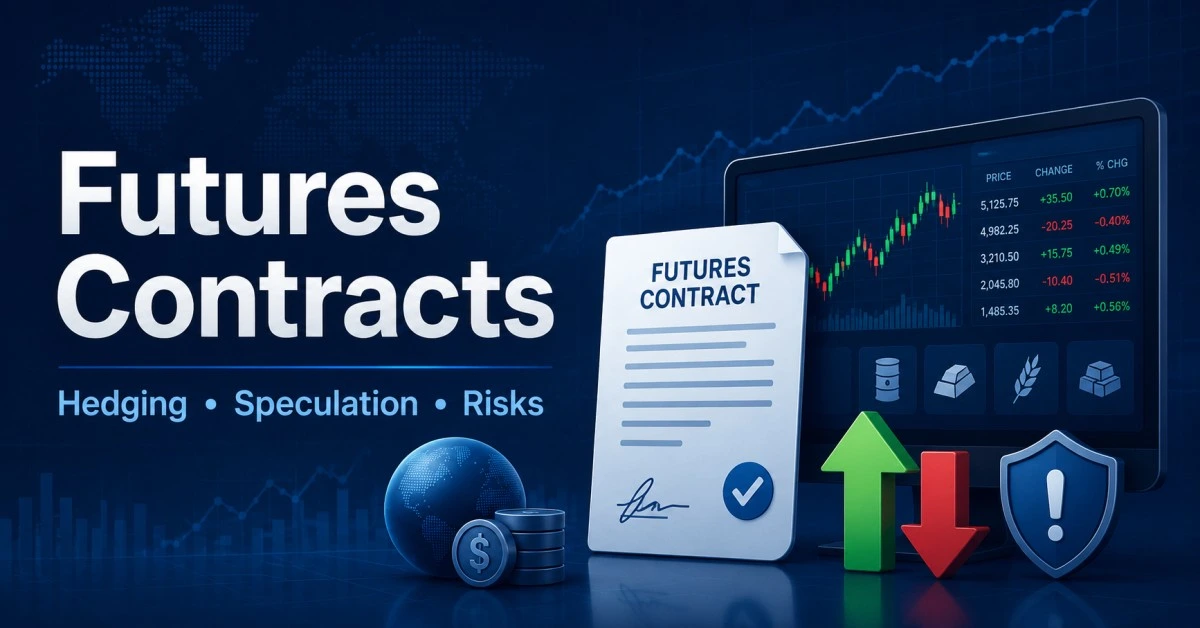
A futures contract is a standardised, legally binding agreement to buy or sell an underlying asset at an agreed-upon price on a specific date in the future. Options, which give the holder a right but not an obligation, differ from futures contracts, which obligate both the buyer and the seller to fulfil the contract terms upon expiration unless the position is closed out beforehand.
Futures are traded on organised exchanges that standardise the contract specifications such as lot size, expiration date and tick size, and provide liquidity and transparency. For example, in India, index futures like Nifty and Bank Nifty and stock and commodity futures are traded on exchanges like NSE and MCX.
Key Features of Futures Contracts
Futures contracts are defined by the fact that they are standardised . Forward contracts are customised contracts between two private parties that are traded over the counter . Futures are standardised and traded on exchanges, so the risk of the counterparty is much lower.
Margin requirements allow traders to control a large contract value with a relatively small upfront deposit known as the initial margin. This is the leverage that makes futures attractive and risky. The gains and losses are calculated on the full contract value, not on the margin deposited, so percentage returns (and losses) are magnified.
Another characteristic is that it is settled on a mark-to-market (MTM) basis. Unlike many other financial instruments, futures settle daily. Traders' profits and losses are calculated and posted to their account at the end of each trading session, using the day's closing price. This daily settlement process reduces the risk of large, unanticipated losses accumulating over time without our knowledge.
In the Indian derivatives market, the futures contracts have an expiry date i.e. a limited life generally on a monthly basis. As expiration approaches, the trader must either close out their position, roll it to the next contract month, or ( for some contracts ) accept physical or cash settlement .
Hedging With Futures
One of the main uses of futures contracts is for hedging, i.e. to protect an existing position against adverse price movements. For example, an investor with a large equity portfolio who is worried about a possible short-term market decline. Instead of selling the whole portfolio which could have tax implications or transaction costs, the investor can sell index futures equivalent to the value of their portfolio. If the market goes down, the loss on the equity portfolio is offset by a gain on the short futures position, effectively neutralising the downside risk for the duration of the hedge.
This hedging function is agnostic to industry: a jewellery manufacturer might hedge gold futures to lock in the cost of raw material, and an importer might hedge currency futures before a payment is due to protect against adverse currency movements. In each case, futures allow businesses to plan more confidently in the face of volatile input costs.
Speculation With Futures
Hedger is risk reduction, speculator is risk taking” Hedgers use futures to reduce risk while speculators use futures to make money off of expected price changes. If a speculator thinks a stock index will rise, he can buy index futures and profit if the index goes up. If a speculator thinks the index will fall, he can sell the futures without even owning the underlying asset. This is known as a "short" position.
Speculators are a vital part of the economy as they provide liquidity to the market allowing hedgers to easily take or get out of positions. Without active speculators willing to take the other side of a hedging trade, futures markets would be far less liquid and hedging would be more costly.
Futures vs. Options: A Quick Comparison
Both are derivatives . The difference is fundamental . Futures have an obligation on both sides . Options have a right without obligation ( for a premium ) to the buyer . That means a futures trader can lose an unlimited amount of money, in theory, if the market moves sharply against them, while an option buyer can lose only the premium they paid. However, options sellers are exposed to obligation-like risk, just like futures traders. It is important to understand this distinction before deciding which instrument is most appropriate for a given level of risk appetite and strategy.
Risks Associated With Futures Trading
Futures are attractive for the same reason they are risky. Because contracts are settled on a daily basis, losses can exceed the initial margin and traders could be subject to margin calls to post additional funds to maintain their positions. Failure to meet the margin call will lead to a forced closing of the position, often at an unfavourable price.
Futures trading also requires close attention to contract expiration and rollover mechanics, as holding a position into expiration without a plan can lead to unintended settlement outcomes. For these reasons futures are more often seen as an instrument for experienced traders and institutions with a good grasp of the principles of risk management, not a place for beginners to enter the market.
Conclusion
Futures contracts are one of the most important instruments of the financial markets for the transfer and assumption of risk. Futures are a standardised, transparent and liquid method for a hedger trying to hedge an existing position or a speculator trying to benefit from an anticipated price move to get exposure to the price move of an underlying asset without actually owning it. Like any leveraged instrument, it's important to understand how it works — margin, mark-to-market settlement and expiration — before you start using it, because the same leverage that creates opportunity can just as quickly turn around and amplify losses on the unprepared.