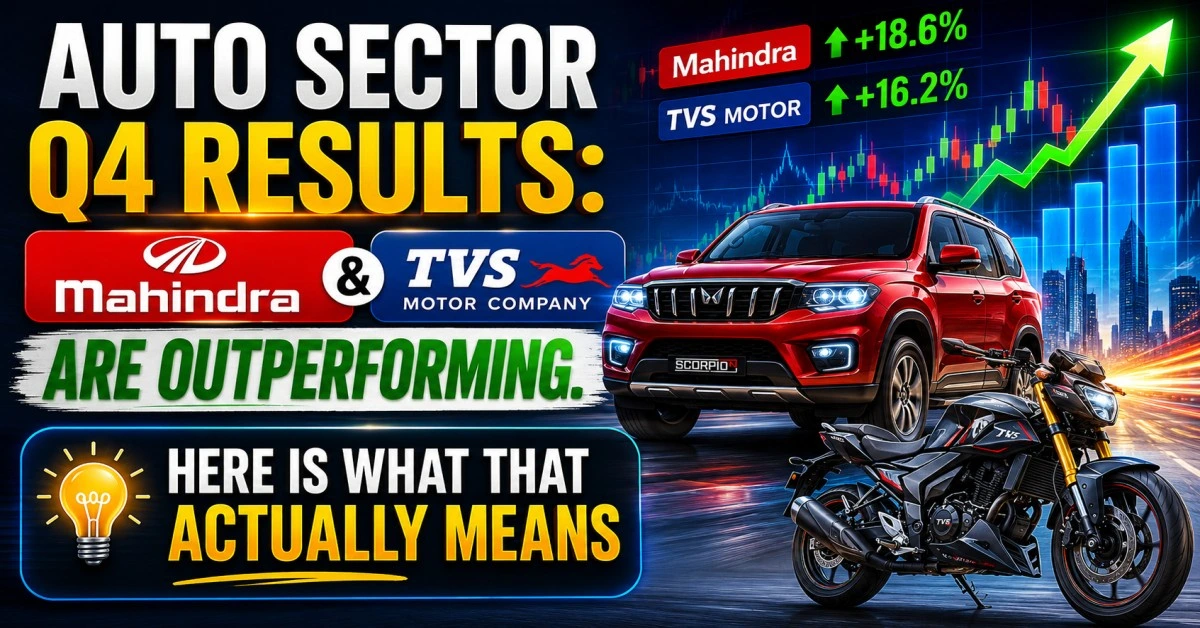
If you have opened any financial news app this week, you have seen the same headline: auto sector beats expectations in Q4 FY26. Brokerages are upgrading stocks. Volume numbers look strong. Mahindra & Mahindra and TVS Motor are on every preferred picks list.
But here is something most of those reports will not tell you directly: a strong quarterly result does not automatically mean you should be buying the stock the next morning.
Let us break down what actually happened, why these two companies are genuinely worth paying attention to, and what you should be watching before you make any decision.
What Actually Happened in Q4 FY26
The auto sector had a strong March quarter, and the important detail here is that the numbers were broad-based. It was not just one or two categories doing well in isolation.
Tractors, two-wheelers, passenger vehicles, commercial vehicles, light commercial vehicles - growth showed up across all of them. That matters because when only one segment grows, you can explain it away as a one-off event. When multiple segments improve together, it tells you something real about the broader economy.
Three factors drove the strong performance:
- Higher volumes sold compared to the same quarter last year. More units sold means higher revenue, and for auto companies, scale also reduces per-unit production costs.
- Selective price hikes by companies dealing with raw material pressure. Steel, aluminium, and rubber costs have been elevated. The fact that customers absorbed these hikes without demand collapsing shows that confidence is holding.
- Lower discounts across many OEMs. This is the factor most retail readers overlook. When companies stop pushing heavy cashback offers to clear inventory, it directly protects their operating margins. It also signals that demand is organic, not artificial.
This combination is what made Q4 FY26 better than what most analysts had pencilled in.
Click NowWhy M&M Is in Focus - and Where the Real Risk Lies
Mahindra and Mahindra is one of the most interesting stories in the Indian auto sector right now. Their SUV portfolio has genuine demand visibility. Products like Scorpio-N, Thar, and XUV 3XO are not just selling on launch hype - they have built waiting periods and consistent order books.
The tractor business adds another layer. Tractor demand is essentially a proxy for rural income and farm sector health. With monsoon expectations looking decent and government support for agriculture continuing, the rural recovery story has not faded. M&M sits at the intersection of both urban premiumisation and rural demand, which is a relatively rare position in Indian equities.
The Q4 profit growth numbers added positive momentum and brought fresh institutional interest to the stock.
Our take: The Q4 results are not the surprise here. The real question investors need to answer for M&M is whether valuations already reflect this growth story. The stock has moved significantly over the past year. Buying a genuinely good company at an expensive price is still a risk. Before acting on any brokerage upgrade, check the PE multiple, EV/EBITDA ratio, and forward earnings estimates. A strong result and a good entry point are two different things.
Why TVS Motor Is Getting Serious Attention
TVS Motor Company is one of those businesses that quietly keeps delivering, which is actually one of the more valuable traits in the Indian two-wheeler market. Two-wheelers serve everyone from daily urban commuters to rural households - the addressable market is enormous.
What has shifted the narrative around TVS recently is that the company is not just growing volumes. It is building a position in three areas at the same time: premium motorcycles and scooters, exports to Africa and South Asia, and electric vehicles through its iQube range.
The EV play is early stage but real. Urban adoption of iQube has been steadily building, and TVS has infrastructure investments and distribution in place to support scale.
Our take: TVS is managing a portfolio transition that most auto companies find genuinely difficult - moving from mass-market volumes toward premium and electric while still growing exports. EV margins are not healthy yet, which is a known drag. The question is execution over FY27. Short-term traders should watch input cost pressure and competitive intensity in the scooter segment. Long-term investors should track EV volume ramp and export market expansion as the two indicators that matter most.
The Risk Nobody Is Talking About Enough
Strong Q4 results deserve attention, but FY27 is genuinely an open question. Here is an honest assessment of what can go wrong.
- Commodity prices are unpredictable. If steel and aluminium costs move sharply upward again, auto company margins face real pressure regardless of how good volumes look.
- Consumer financing conditions matter significantly. A large percentage of Indian vehicle purchases are financed on EMIs. If borrowing costs rise or bank credit tightens, demand softens - and it often happens faster than analysts expect.
- Competition is intensifying. New EV entrants, global OEMs with deeper pockets, and cost pressure from Chinese component suppliers are all in the picture. M&M and TVS are better positioned than most domestic OEMs, but that does not make them immune.
Selectivity is the right approach here. Not every auto stock will perform the same way in FY27. Companies with strong balance sheets, clear product pipelines, and proven execution should be separated from those riding a broad sector tide.
Auto Sector Q4 FY26 at a Glance
Click Now
What This News Is Actually Teaching You
If you have been following this story closely, you have just seen a live example of how quarterly results drive stock price movement. You have seen how brokerage upgrades create momentum and how sector themes - SUVs, tractors, EVs, exports - translate into analyst preferences.
Understanding how to read a quarterly result, evaluate EBITDA margins, track sector rotations, and combine fundamentals with technical signals and risk management is a real skill set. And it is one that separates disciplined market participants from people who react to headlines and get caught on the wrong side.
This kind of structured market thinking does not come from consuming more news faster. It comes from learning how the pieces connect.
Learn to Read the Market Like This - With ICFM India
At ICFM India, this is exactly what the courses are built around. Not tips. Not ready-made calls. Structured market education that teaches you how to read quarterly results, understand financial ratios, track sector themes, apply technical analysis, and manage risk in real market conditions.
ICFM India is based in Laxmi Nagar, East Delhi, and has been training market learners across Delhi NCR for years. Whether you are a complete beginner or someone who has been trading without a proper framework, the courses build real analytical capability step by step.
Courses cover: Technical Analysis | Fundamental Analysis | Derivatives & Options | Risk Management | Live Market Training
Learning does not guarantee profits. Informed decisions and disciplined execution remain your responsibility. Always consult a certified financial advisor before investing.
Disclaimer: This article is for educational and informational purposes only. It does not constitute investment advice, stock recommendation, or a guarantee of any profit or return. Market investments carry risk. Please consult a certified financial advisor before making any investment or trading decision.
Frequently Asked Questions
Why is M&M stock in focus after Q4 results?
Mahindra and Mahindra reported strong Q4 FY26 results driven by SUV volume growth and steady tractor demand from the rural segment. Brokerage upgrades followed, which increased market attention. However, investors should evaluate current valuations and forward earnings before acting on any headline or analyst report.
What does EBITDA margin mean in auto sector results?
EBITDA margin shows the operating profit a company earns as a percentage of revenue, before accounting for interest, tax, depreciation, and amortisation. When EBITDA margin improves in auto sector results, it means the company is converting sales more efficiently into profit - typically through higher volumes, better pricing, or lower discount levels.
Is TVS Motor a good stock to buy after Q4 FY26 results?
TVS Motor delivered strong Q4 FY26 performance across two-wheelers, exports, and its EV segment. Whether it is a suitable investment depends on your individual financial goals, investment horizon, risk capacity, and current entry valuation. This article is educational and does not constitute investment advice. Please consult a certified financial advisor.
What is driving the Indian auto sector growth in 2025?
Indian auto sector growth in FY26 has been supported by urban demand for SUVs and premium vehicles, rural recovery driving tractor and two-wheeler sales, commercial vehicle demand from logistics and infrastructure activity, and early adoption of electric vehicles. The Q4 FY26 broad-based performance reflects several demand tailwinds converging simultaneously.
Which auto stocks are preferred by brokerages for FY27?
After Q4 FY26 results, brokerage preferred picks in the auto sector include Mahindra and Mahindra and TVS Motor among others. Brokerage recommendations are research opinions based on their specific models and assumptions. They are not guaranteed returns and should not be treated as direct buying advice without your own analysis.
How can I learn to analyse quarterly results and auto sector news?
Structured market education teaches you how to read quarterly results, evaluate financial ratios, understand sector cycles, and apply analytical frameworks to real market events. ICFM India offers courses in technical analysis, fundamental analysis, derivatives, and risk management at their Laxmi Nagar centre in East Delhi. Visit icfmindia.com or connect on WhatsApp to learn more. Click Now