
What Is the Latest News on FMCG Stocks?
FMCG stocks are back in market focus after Anand Rathi Research shared a positive outlook for the consumer sector ahead of Q1FY27 earnings. The brokerage expects the sector to report healthy revenue growth in the June quarter, supported by premiumisation, recent price hikes, innovation, GST-related benefits and stronger distribution through modern trade, e-commerce and quick commerce channels.
The report also highlights that lower crude oil and crude derivative prices may help FMCG companies manage input costs better in the coming quarters. This is important because packaging, transportation and several raw material costs are linked directly or indirectly to crude oil prices. If demand remains stable and cost pressure eases, FMCG companies may see better margins during FY27.
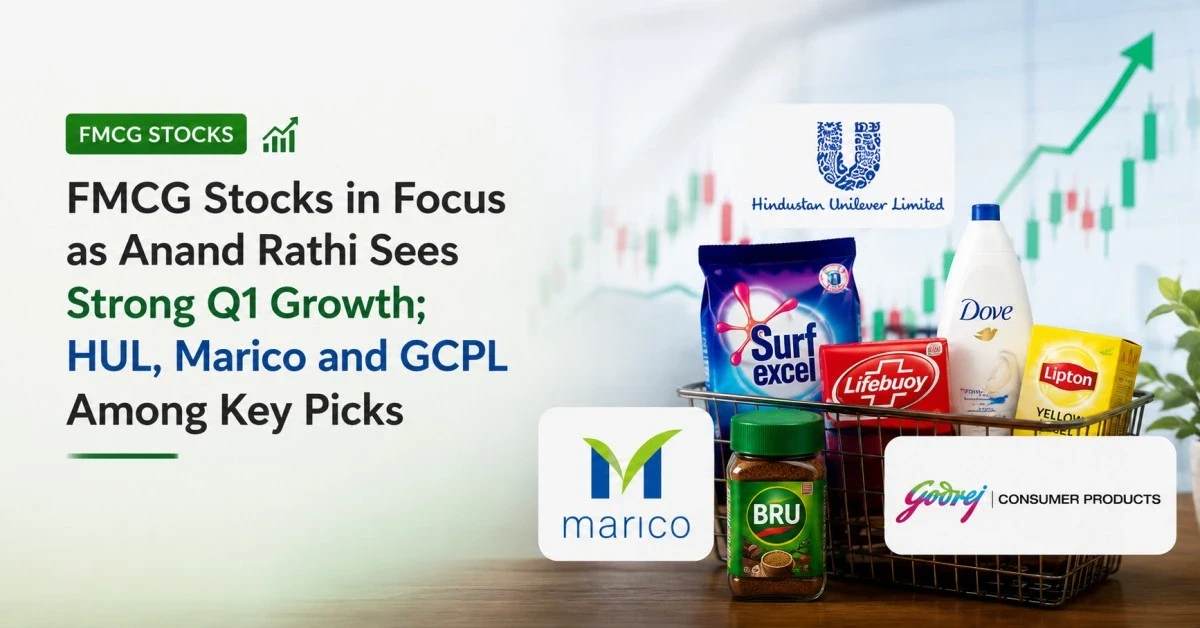
FMCG stocks are in focus because Anand Rathi expects strong Q1FY27 growth and margin support from lower crude oil prices. HUL, Marico and Godrej Consumer Products are among its preferred large-cap picks.
Why Are FMCG Stocks Gaining Market Attention Now?
FMCG stocks are gaining attention because the market is preparing for Q1FY27 earnings season. Investors are looking for sectors where demand stability, pricing power and margin recovery can come together. FMCG is one such sector because it deals with daily-use products such as soaps, detergents, packaged foods, personal care products, health products and household items.
In uncertain market conditions, FMCG companies are often seen as defensive businesses because consumer demand for essential products usually remains more stable than demand in highly cyclical sectors. This makes large FMCG names like Hindustan Unilever, Marico and Godrej Consumer Products important stocks to track when investors look for steady earnings visibility.
How Can Lower Crude Oil Prices Help FMCG Companies?
Lower crude oil prices can help FMCG companies by reducing pressure on packaging, freight, chemicals and crude-linked raw material costs. Many FMCG companies use plastic packaging, transportation networks and petrochemical-based inputs, which can become expensive when crude prices rise.
When crude prices fall, companies may not immediately reduce product prices for consumers. Instead, the benefit can first reflect in better gross margins and operating margins. If companies have already taken price hikes and input costs start cooling, earnings growth may improve over the next few quarters.
Lower crude oil prices can support FMCG margins because they reduce packaging, logistics and raw material cost pressure. This can help companies improve profitability if demand remains stable.
Click NowWho Are Anand Rathi’s Top FMCG and Consumer Picks?
Anand Rathi has highlighted Hindustan Unilever, Marico and Godrej Consumer Products as preferred large-cap FMCG picks. In the mid-cap FMCG space, Mrs. Bector Foods has been included, while Restaurant Brands Asia has been mentioned as a consumer discretionary pick.
| Stock | Segment | Anand Rathi View | Target Price |
| Hindustan Unilever | Large-cap FMCG | Buy | ₹2,700 |
| Marico | Large-cap FMCG | Buy | ₹865 |
| Godrej Consumer Products | Large-cap FMCG | Buy | ₹1,400 |
| Mrs. Bector Foods | Mid-cap FMCG | Buy | ₹250 |
| Restaurant Brands Asia | Consumer Discretionary | Buy | ₹93 |
Hindustan Unilever remains a key defensive FMCG stock because of its strong presence across home care, beauty, personal care and foods. Marico is being tracked for its brand strength, premium portfolio and healthy return profile. Godrej Consumer Products may benefit from its household insecticides, personal care and international business exposure. Mrs. Bector Foods gives investors a mid-cap packaged food opportunity, while Restaurant Brands Asia represents the broader consumption and quick-service restaurant theme.
What Is Driving Growth in the FMCG Sector?
The FMCG sector’s growth is being supported by price-led revenue growth, premiumisation, product innovation and better distribution reach. Premiumisation means consumers are gradually shifting towards higher-value products in categories such as personal care, beauty, packaged foods, hygiene and household care.
This trend is important because premium products usually carry better margins than mass-market products. Even when volume growth is moderate, companies can still report better revenue if consumers move towards premium categories. At the same time, quick commerce, e-commerce and modern trade are helping FMCG brands reach urban customers faster and improve product availability.
How ICFM India Helps Learners Understand Sector-Based Market Moves
Market news like FMCG stocks in focus, lower crude oil prices, margin recovery and Q1FY27 earnings can create strong movement in individual stocks and sector indices. For beginners and active learners, the important part is not just reading the news, but understanding how it affects price action, volume, support-resistance levels and trading decisions.
ICFM India offers practical stock market training where learners can understand concepts such as sector rotation, technical analysis, fundamental triggers, risk management and live market behaviour in a structured way. The goal is to help students read market updates with clarity and avoid emotional decisions based only on headlines.
Why Rural Demand Remains a Key Watchpoint
Rural demand remains one of the most important factors for FMCG companies. A large part of India’s consumption market depends on rural income, monsoon progress, crop output and agricultural sentiment. If rural income improves, demand for daily-use products can strengthen across categories.
However, weather-related risks can create uncertainty. Weak rainfall, delayed monsoon or pressure on farm income can affect rural consumption. That is why investors should not look only at lower crude prices. They should also track monsoon progress, rural volume growth and management commentary during Q1FY27 results.
What Are the Main Risks for FMCG Stocks?
The first major risk is weak rural demand. If rural recovery remains slow, FMCG companies may face pressure on volume growth, especially in mass-market categories. The second risk is valuation. FMCG stocks often trade at premium valuations because of their defensive business model, but high valuations can limit upside if earnings growth disappoints.
The third risk is input-cost volatility. Lower crude prices are positive, but any reversal in crude oil, palm oil, packaging material or freight costs can again affect margins. Competitive intensity is another factor because companies may need higher advertising and promotional spending to protect market share.
What Should Investors Track in Q1FY27 Results?
Investors should track volume growth, margin movement, rural demand, price hikes, advertising spends, crude-linked input costs and management guidance. For HUL, the focus will be on volume recovery and margin commentary. For Marico, investors will watch domestic demand, premium product growth and input-cost benefits. For Godrej Consumer Products, household insecticides, personal care and international business performance will be important.
For mid-cap and discretionary names like Mrs. Bector Foods and Restaurant Brands Asia, investors should track revenue growth, profitability improvement and execution quality. These stocks can offer growth potential, but they may also carry higher volatility compared with large-cap FMCG companies.
How Does This News Affect Market Behaviour?
This news can create short-term interest in FMCG stocks because it connects three strong market themes: Q1 earnings season, lower crude oil prices and defensive sector rotation. Traders may watch FMCG stocks for near-term momentum, while long-term investors may focus on margin recovery and earnings visibility.
Search demand may also rise around terms like FMCG stocks in focus, HUL target price, Marico target price, Godrej Consumer Products share price, lower crude oil impact on FMCG margins and Anand Rathi top picks. This makes the topic useful not only for market readers but also for SEO, AEO and GEO visibility.
Overall Outlook: Can FMCG Stocks Stay in Focus?
FMCG stocks may remain selectively active in the coming days as investors track Q1FY27 earnings, crude oil movement and rural demand trends. The sector has support from premiumisation, innovation, price-led growth and distribution expansion. Lower crude prices can further improve the margin outlook if cost pressure continues to ease.
However, the rally may not be equal across all FMCG stocks. Companies with stronger brands, better volume growth, improving margins and reasonable valuations may attract more attention. Stocks with expensive valuations or weak earnings delivery may remain under pressure despite the positive sector outlook.
Conclusion
Anand Rathi’s positive view has brought FMCG stocks like Hindustan Unilever, Marico, Godrej Consumer Products, Mrs. Bector Foods and Restaurant Brands Asia into focus. The key positives for the sector are strong Q1FY27 revenue expectations, lower crude-linked cost pressure, premiumisation and wider distribution channels.
At the same time, investors should track rural demand, monsoon conditions, valuation comfort and actual earnings performance. FMCG remains an important sector to watch during Q1FY27 earnings season, but stock selection will be critical.
Disclaimer
This article is for educational and informational purposes only. It is based on brokerage views and market-related information. It is not investment advice or a buy or sell recommendation. Investors should consult a qualified financial advisor before making any investment decision.
FAQs on FMCG Stocks and Anand Rathi’s Top Picks
Why are FMCG stocks in focus now?
FMCG stocks are in focus because Anand Rathi expects healthy Q1FY27 growth, supported by price hikes, premiumisation, innovation, GST-related benefits and lower crude-linked input costs.
Which FMCG stocks are Anand Rathi’s top picks?
Anand Rathi’s preferred large-cap FMCG picks include Hindustan Unilever, Marico and Godrej Consumer Products. Mrs. Bector Foods and Restaurant Brands Asia are also part of its broader consumer sector picks.
How do lower crude oil prices help FMCG companies?
Lower crude oil prices can reduce packaging, freight and raw material cost pressure for FMCG companies. This may help improve margins if demand remains stable.
Is HUL a defensive FMCG stock?
Hindustan Unilever is often considered a defensive FMCG stock because it has a wide product portfolio across essential daily-use categories such as home care, personal care, beauty and foods.
What should investors watch in FMCG Q1FY27 results?
Investors should watch volume growth, margin trends, rural demand, price hikes, input costs, advertising spends and management commentary on future demand.
Are FMCG stocks risk-free?
No, FMCG stocks are not risk-free. They can be affected by weak rural demand, expensive valuations, input-cost volatility, competitive pressure and earnings disappointment.