
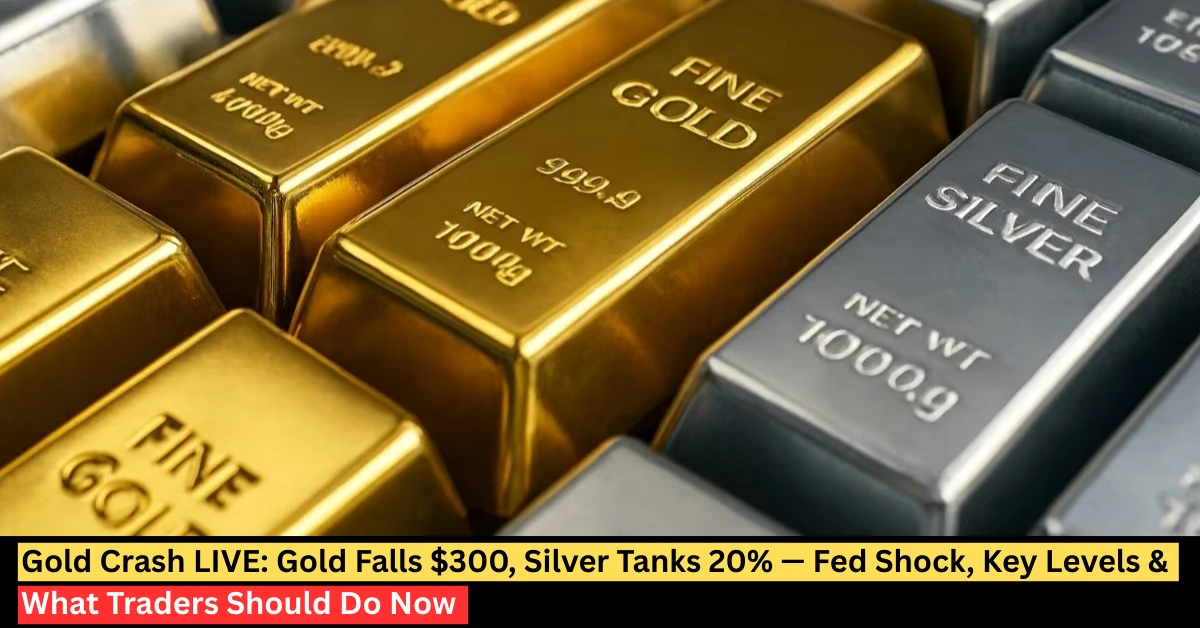
Gold Crash LIVE: Gold Falls $300, Silver Tanks 20% — Fed Shock, Key Levels & What Traders Should Do Now

Gold Crash LIVE: Gold Falls $300, Silver Tanks 20% — Fed Shock, Key Levels & What Traders Should Do Now

Gold Price Today LIVE Update (March 19, 2026): Gold has fallen nearly $300 in 2 days while silver is down over 20% this month, with MCX gold near ₹1.44 lakh and silver around ₹2.22 lakh per kg.


What is happening in gold and silver prices today

Gold and silver prices today have entered a sharp correction phase, creating significant attention across global and Indian markets. In the last two trading sessions, COMEX gold has declined by nearly $300, while silver has fallen more than 20% in March, making it one of the most volatile phases for precious metals in recent months.

On the domestic front, MCX gold has slipped toward ₹1,44,000 per 10 grams, while silver has dropped near ₹2,22,000 per kilogram. These levels are the lowest they've been in weeks and show a clear change in short-term sentiment. The drop happened even though tensions between countries are still high and the price of crude oil is going up, which usually makes gold a safe-haven asset.

Why are gold and silver falling despite geopolitical tensions

The current fall in gold and silver is primarily driven by macroeconomic forces rather than traditional safe-haven demand. The recent stance of the US Federal Reserve has played a key role in shaping market direction. By maintaining interest rates and signaling a “higher-for-longer” policy outlook, the Fed has strengthened the US dollar and pushed bond yields higher.

When the dollar gets stronger, gold becomes more expensive in other currencies, which makes people want it less around the world. At the same time, higher bond yields give you a better return than holding gold, which doesn't pay you interest. This change in how capital is allocated has caused constant selling pressure.

Concerns about inflation have also grown because of rising crude oil prices caused by geopolitical tensions. This has made people think that central banks will keep interest rates high for longer periods of time, which is bad for precious metals in the short term.

How did gold behave in the past during similar conditions

In the past, gold has done well when there were problems with the economy or politics. When there are global wars or financial crises, gold has often been a safe-haven asset that investors want to buy, which drives up prices.

But in more recent cycles, like the way the market acted after 2020, gold has been more closely linked to changes in currency values and real interest rates. Gold tends to be under pressure when interest rates rise or stay high, no matter what happens in the world of politics. This change shows that macroeconomic policy is now the most important thing that affects gold prices.

What are the key price levels and real market signals right now

Traders keep a close eye on important technical and psychological levels, and the current correction is in line with those levels. These levels give us an idea of where the market might be going in the near future.

Real Market Data: Price Structure and Movement

AssetRecent HighCurrent PriceMonth-to-Date ChangeCritical SupportImmediate Resistance
Gold (COMEX)$5,000+~$4,700-9% to -11%$4,700 → $4,650$4,800
Silver (COMEX)$80+~$70-16% to -21%$70 → $63$75
Gold (MCX)₹1,58,000₹1,44,000~-11%₹1,44,000 → ₹1,42,000₹1,50,000
Silver (MCX)₹2,75,000₹2,22,000-20%+₹2,30,000 → ₹2,20,000₹2,40,000

Who is influencing gold and silver prices in the current market

Central banks, institutional investors, and the state of the global economy are all having an effect on the prices of gold and silver right now. The US Federal Reserve is still the most important factor because its policy decisions have a direct impact on interest rates, liquidity, and the strength of the dollar.

Institutional investors and hedge funds are also changing their positions based on changes in macro signals. In times of high volatility, position unwinding and margin-related selling often speed up price drops, as we saw in the recent sharp correction.

Real case study: how gold reacted in a similar macro environment

In 2022, the same thing happened when inflation went up around the world and central banks raised rates quickly. At first, gold held up well because of uncertainty in the world, but it dropped sharply later on as interest rates went up and the US dollar got stronger.

For instance, even though there were still geopolitical tensions, gold dropped from about $2,050 in early 2022 to almost $1,600 later in the year. This showed that in the short term, rising interest rates can make safe-haven demand less important.

The current situation reflects a similar pattern, where inflation concerns and monetary tightening are dominating market behavior.

What are the pros and cons of the current gold market situation

The current drop in gold and silver prices gives market participants both chances and risks, depending on how they look at it and how long they plan to stay in the market.

Market Perspective: Opportunities and Risks

AspectPositive SideRisk Factor
Price CorrectionLower entry levels for long-term investorsPossibility of further downside
VolatilityTrading opportunities for short-term tradersHigh risk due to rapid price swings
Macro TrendsClear signals based on interest rates and dollar movementUncertainty due to geopolitical developments
Silver MovementHigher potential returns due to volatilityLarger drawdowns compared to gold

What should traders do now in gold and silver

Traders should remain cautious as gold and silver are trading near critical support levels. Instead of entering aggressively during a falling market, it is better to wait for confirmation signals around key zones like $4,700 in gold and ₹1,44,000 on MCX. Acting too early in volatile conditions can increase risk, especially when price trends are still weak.

At the same time, traders should pay attention to global factors like US Federal Reserve policy, the strength of the dollar, and bond yields, which are currently affecting prices. Don't try to catch short-term rebounds; instead, stick to a disciplined, data-driven approach. This is because the direction of the market can change quickly based on macroeconomic events.

What could happen next in gold and silver prices

Interest rate expectations, inflation trends, and currency movements will have a big impact on where gold and silver prices go in the future. Gold may face more pressure in the near future if the US Federal Reserve keeps its hawkish stance and the dollar stays strong.

If gold breaks below $4,650, it could go down to the $4,400–$4,500 range. If silver drops below $70, it might move toward $63, which would mean deeper correction levels.

On the other hand, any signs that inflation is going down, the dollar is getting weaker, or expectations for interest rates are changing could help prices go back up. Changes in geopolitics may also affect people's feelings, but only if they have an effect on the overall economy.

How are traders and investors approaching this phase

People who work in the market are now being careful and using data to make decisions. Traders are paying close attention to important support and resistance levels, as well as macroeconomic indicators like interest rates and currency movements.

Many traders are waiting for confirmation signals before entering positions instead of making aggressive directional bets. This shows that people are moving toward making decisions in a more organized way in a very unstable environment.

What should you focus on in this market environment

The current market shows how important it is to know what macroeconomic factors are at play and to plan accordingly. Gold and silver are no longer only reacting to political events; interest rates and liquidity are also having a bigger effect on them.

Traders and investors need to pay attention to important levels, global signals, and strict risk management. Being able to adjust to changes in the market will be very important during this time.

Conclusion: a shift from safe-haven narrative to macro-driven reality

The sharp drop in gold and silver prices shows that macroeconomic factors are now more important than traditional safe-haven demand in the market. Interest rates, inflation expectations, and the strength of the currency are now the main things that affect prices.

As the world changes, gold and silver are likely to stay sensitive to central bank policies and economic data. This means that people who work in the market need to stop relying on old ideas and start using a more analytical method to figure out why prices are changing.

Disclaimer

This article is for informational purposes only and does not constitute financial or investment advice. Market conditions can change rapidly, and readers should conduct their own research or consult a financial advisor before making any trading decisions.


FAQs: Gold Price Today, Silver Crash & Market Outlook

What is the gold price today and why is it falling?

Gold prices have dropped sharply today, losing almost $300 in two days and moving closer to important support levels. The main reason for this drop is that the US Federal Reserve is being hawkish, which has made the dollar stronger and pushed bond yields higher. This has made people less interested in non-yielding assets like gold.

Why is silver falling more than gold today?

Today, the price of silver is dropping more quickly than the price of gold because silver is more volatile and has both industrial and investment demand. When the economy is uncertain, silver prices tend to change more, which is why silver has dropped more than 20% this month, while gold has only dropped a little.

Is it the right time to buy gold or should you wait?

At this point, it's best to wait for confirmation near important support zones before buying gold. Interest rate expectations and the strength of the dollar still have an effect on the market, so going in aggressively without confirmation can raise the risk. It is best to take a careful and planned approach.

Will gold prices fall more from here?

Gold may face further downside if it breaks below critical support levels around $4,650. In such a scenario, prices could move toward the $4,400–$4,500 range. However, any change in interest rate expectations or weakening of the dollar could provide support and stabilize prices.

What are the key levels to watch in gold and silver today?

Gold has strong support around $4,700 and $4,650, and strong resistance around $4,800. There is support on MCX between ₹1,44,000 and ₹1,42,000. For silver, $70 is a key support level. If prices fall below this level, they could drop to $63.

Why is gold falling despite geopolitical tensions?

Even though there are tensions between countries, gold is going down because macroeconomic factors like interest rates, inflation expectations, and currency strength are currently in charge of the market. In the short term, gold is less appealing as a safe-haven asset because the dollar is getting stronger and bond yields are going up.

What should traders do in gold and silver right now?

Traders should remain cautious and wait for confirmation near key support levels instead of entering aggressively. Tracking global cues such as Federal Reserve policy, dollar movement, and bond yields is essential, as these factors are driving price trends.

How does the US Federal Reserve impact gold prices?

The US Federal Reserve affects the price of gold by setting interest rates. When rates are high or likely to stay high, bond yields go up and the dollar gets stronger. This makes gold prices go down. On the other hand, lower rates tend to help gold.

Read by 0 Visitors
Lakshay Jain
About author
Lakshay Jain
From
Delhi

( Submitted News & Articles = 60 )

Search Engine Optimisation Specialist (SEO)


Download ICFM APP

Stock Market courses App