
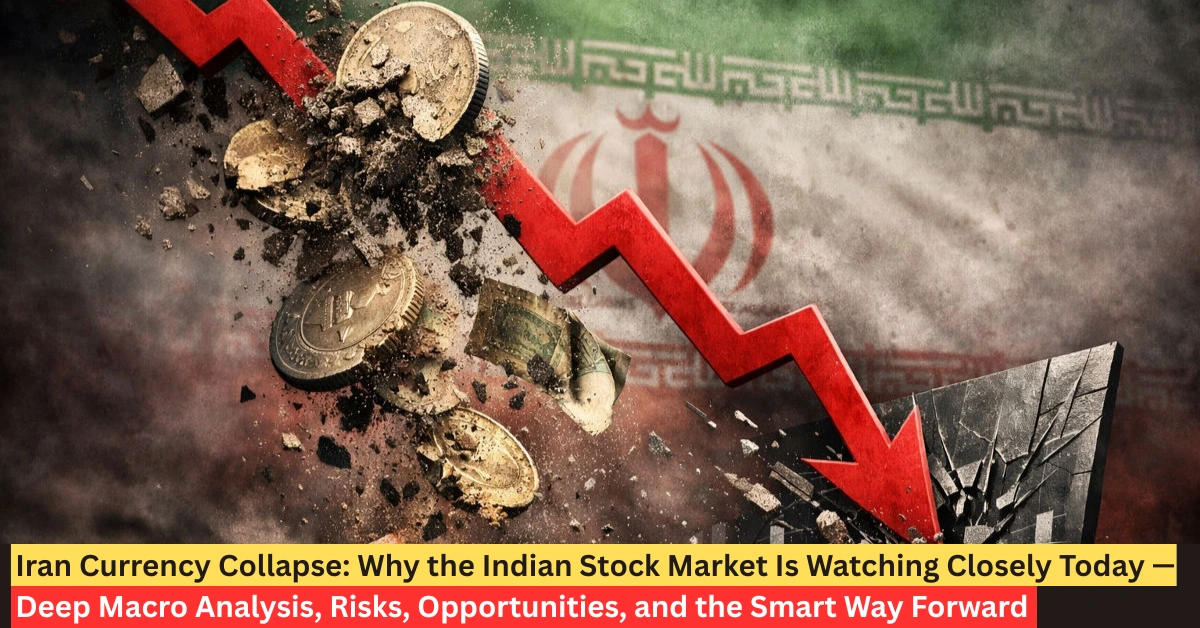
Iran Currency Collapse: Why the Indian Stock Market Is Watching Closely Today — Deep Macro Analysis, Risks, Opportunities, and the Smart Way Forward

Iran Currency Collapse: Why the Indian Stock Market Is Watching Closely Today — Deep Macro Analysis, Risks, Opportunities, and the Smart Way Forward

The Iran currency collapse has quickly become a major topic in global market news, raising fresh questions among Indian investors about its possible impact on the Indian stock market today. As reports of the Iranian rial weakening continue to trend, searches related to the market today, Sensex, and Nifty have risen sharply, reflecting growing curiosity around global risk events and their connection to Indian markets. Although most of Iran's economic problems are local in origin, such currency crises can affect oil pricing, investor sentiment, and short-term market fluctuations, which is valuable for Indian investors in knowing how to prioritize their focus.

Instead of applying fear or speculation to such development, an appropriate approach would be to analyze it from a macroeconomic perspective. Changes in global currency usually have an indirect impact on the markets via commodities, capital flows, and risk.This article explains what the Iran currency collapse really means for the Indian stock market, separating headline noise from actual financial impact, and helping investors, traders, and learners understand how global events filter into Indian markets in a practical, informed way.

What exactly happened in Iran’s currency market, and why is it trending now?

Although Iran’s rial has been depreciating for a long time, this phase can be described as a currency collapse due to the rate and extent of its decline. Rapid decline is a result of increasing inflation, steep economic sanctions, a lack of access to international trade, and dwindling confidence in the Iranian economy. When inflation is persistent, consumers and businesses try to safeguard their purchasing power by exchanging their local money for foreign currency or durable goods. This further drives inflation and depreciation.

The reason this event is trending across global markets is not just the fall in the currency itself, but what it signals. Currency collapses often reflect deeper economic stress and can influence oil prices, emerging-market sentiment, and risk appetite worldwide. That is why Indian investors following Indian stock market news are paying attention, even though the event originates outside India.

Why should Indian investors care about the Iran currency collapse?

Directly looking at finance, India's exposure to Iran is very limited. No Indian bank has Iranian assets, there is no significant Iranian exposure to Indian mutual funds, and the volume of trade is still limited and modest due to longstanding restrictions. Therefore, there is no direct risk of contagion to the Indian economy.

However, financial markets do not operate in isolation. Global investors assess risk across regions, not countries in silos. Events like the Iran currency collapse influence oil prices impact on Indian stock market, global risk sentiment, rupee vs dollar movement, and foreign institutional investor activity in India. These indirect channels explain why such global news becomes relevant when tracking Sensex today or Nifty today.

Who in India is most affected by this global development?

This is mainly relevant to Indian equity investors and derivatives traders, commodity market participants, finance students, oil and currency sensitive businesses, and students of finance. Retail investors searching for the Indian stock market today live, why market is down today, or why Sensex and Nifty are volatile are also part of this audience.

For long-term investors, this news provides macro context rather than a trigger for panic. For traders, it explains short-term volatility. For learners, it offers a real-world case study of how global macro events affect Indian financial markets.

How does the Iran currency collapse connect to the Indian stock market?

The most important connection between Iran’s currency crisis and India comes through crude oil prices. Iran sits in a politically sensitive and energy-dense region. Although there may not be direct supply disruptions, there are always economic and political pressures in oil-supplying regions that increase perceived risk, and that risk gets priced into oil.

For India, the variables that affect the country's oil prices directly involve macroeconomic principles. A large part of India's crude oil needs is still unfulfilled by internal production, which results in the need to import crude oil. In such cases, when the globally priced crude oil increases, the costs to India also increase in terms of imports, which places a greater pressure on the costs of production. This situation, in turn, caused negative deflation in the economy. The Reserve Bank of India also needs to increase the interest rates which has a direct impact on the country's economy, its debt, the overall market sentiment, and the stock prices.

This is why spikes in crude oil prices often coincide with cautious movement in Sensex and Nifty, especially in rate-sensitive sectors.

Beyond oil, the Iran currency collapse also affects global risk appetite. Currency stress in one emerging market can trigger a temporary “risk-off” phase, where investors move toward safer assets such as the US dollar. This does not mean panic selling in India, but it can lead to selective allocation and short-term adjustments in foreign institutional investor flows. Such shifts influence short-term movement in the Sensex and Nifty 50, even when India’s domestic fundamentals remain strong.

Another channel is rupee psychology. The US dollar rises when there is uncertainty in the global markets. This puts slight pressure on emerging market currencies, including the Indian rupee. Nevertheless, given India’s foreign exchange reserves and policy credibility, the country has a good cushion to defend against persistent volatility.

What does real macro data say about Iran versus India?

Economic IndicatorIran (Approx.)India (Approx.)
Inflation Rate40%+~5–6%
Foreign Exchange ReservesSeverely constrained$600+ billion
Global Trade AccessRestrictedOpen and diversified
Banking System StabilityStressedStrong and regulated
Market LiquidityLimitedDeep and liquid
Policy FlexibilityConstrainedHigh

This comparison makes one thing clear. Iran’s currency collapse does not translate into an Indian financial crisis. India’s macroeconomic foundation is fundamentally stronger, diversified, and better protected.

What are the real risks for the Indian stock market today?

The risks associated with this global event are primarily short-term and sentiment-driven. Rising oil prices can pressure margins for oil-dependent sectors such as aviation, logistics, paints, and chemicals. Increased global uncertainty can explain why the market is volatile today in certain sessions. Temporary caution among FIIs can also amplify intraday swings in Sensex and Nifty.

These risks are cyclical, not structural. Indian markets have navigated similar global shocks in the past, including oil price spikes, geopolitical tensions, and emerging-market currency crises.

What supports Indian markets despite global volatility?

India begins this stage with solid internal backing. The domestic investor base has expanded considerably and has aided in volatility absorption during foreign sell-off periods. Corporate balance sheets are in good shape, leverage is at reasonable levels, and the banking sector is sufficiently capitalized.

Compared to many other emerging markets, inflation is largely contained, while the economy maintains policy credibility. Further, as the rupee depreciates, the benefits to the IT and services sectors will help offset the broader negative impacts during times of global stress.

How should Indian investors and traders respond to this news?

The most effective response is data-driven decision-making, not emotional reaction. Investors should focus on oil prices' impact on the Indian stock market, inflation trends, corporate earnings, and policy signals rather than reacting to alarming headlines.

History shows that major geopolitical or global macro events do not destroy wealth by default. Bad decision making does. Investors who understand macro linkages stay calm and disciplined even under extreme volatility.

Why this moment highlights the importance of market education

Events like the Iran currency collapse highlight how interconnected modern financial markets have become. Currency movements, commodities, interest rates, and equities influence each other continuously. Investors who understand why markets move, not just what moved today, are better equipped to navigate volatility.

This is where structured market education becomes essential. At ICFM, learners are trained to interpret global market news through Indian market logic, manage risk effectively, and build disciplined trading and investing frameworks suitable for real-world conditions.

What this means for Indian markets going forward

For Iran, the collapse of the Iranian currency is a major concern, but for India, it is a macro concern that is not a systemic risk. With respect to Indian oil prices, global sentiment, and volatility, and not to India’s financial stability, the collapse is damaging.

Indian markets remain resilient and adaptive. Investors who stay informed, disciplined, and educated continue to find opportunities even during uncertain global phases.

Final takeaway: Understanding always beats fear

Global headlines will continue to create noise. The difference between successful investors and reactive traders lies in interpretation. The Iran currency collapse reinforces one core lesson: context matters more than headlines.

Indian markets have faced global shocks before and emerged stronger. Knowledge, patience, and preparation remain the most reliable tools for long-term success.

Learn How Markets Really Work

If you want to understand the Indian stock market today, how global events affect Sensex and Nifty, and how to trade or invest with clarity instead of confusion, now is the right time to build real market knowledge.

Explore structured stock market learning with ICFM and gain practical insight into global macro trends, Indian market behavior, and disciplined strategies designed for today’s dynamic financial environment.

Frequently Asked Questions: Iran Currency Collapse & Indian Stock Market

Will the Iran currency collapse affect the Indian stock market today?

Directly, the collapse of the Iranian currency does not affect the Indian stock market, as India does not have much financial engagement with Iran. However, the Iranian currency collapse can affect the Indian market indirectly by way of global risk appetite, crude oil prices, and short-term fluctuations in the Sensex and Nifty.

Why are Sensex and Nifty reacting to global news like Iran’s currency crisis?

Sensex and Nifty react to global news because international events impact investor sentiment, oil prices, and foreign institutional investment flows. Even when India’s fundamentals remain strong, global macro developments can create short-term market fluctuations.

Is the Iran currency collapse a risk for Indian investors?

For Indian investors, the Iran currency collapse is not a systemic risk. It is a macroeconomic signal that may cause temporary volatility but does not threaten India’s financial stability or long-term market growth.

Can rising oil prices due to global tensions impact the Indian stock market?

Yes, rising oil prices can impact the Indian stock market by increasing inflationary pressure and input costs for certain sectors. This can influence market sentiment and explain why the market is volatile today during periods of global uncertainty.

Should Indian investors panic or sell due to Iran-related global news?

No, Indian investors should not panic or make emotional decisions based on Iran-related news. Historically, global currency crises have created short-term volatility, not long-term damage, for Indian markets. Data-driven and disciplined investing remains the best approach.

What should Indian traders and investors focus on instead of global headlines?

Instead of reacting to headlines, Indian traders and investors should focus on oil prices, inflation data, corporate earnings, and policy signals. Understanding how global events affect Indian markets helps investors make informed decisions rather than fear-based trades.

Read by 0 Visitors
Lakshay Jain
About author
Lakshay Jain
From
Delhi

( Submitted News & Articles = 51 )

Search Engine Optimisation Specialist (SEO)


Download ICFM APP

Stock Market courses App