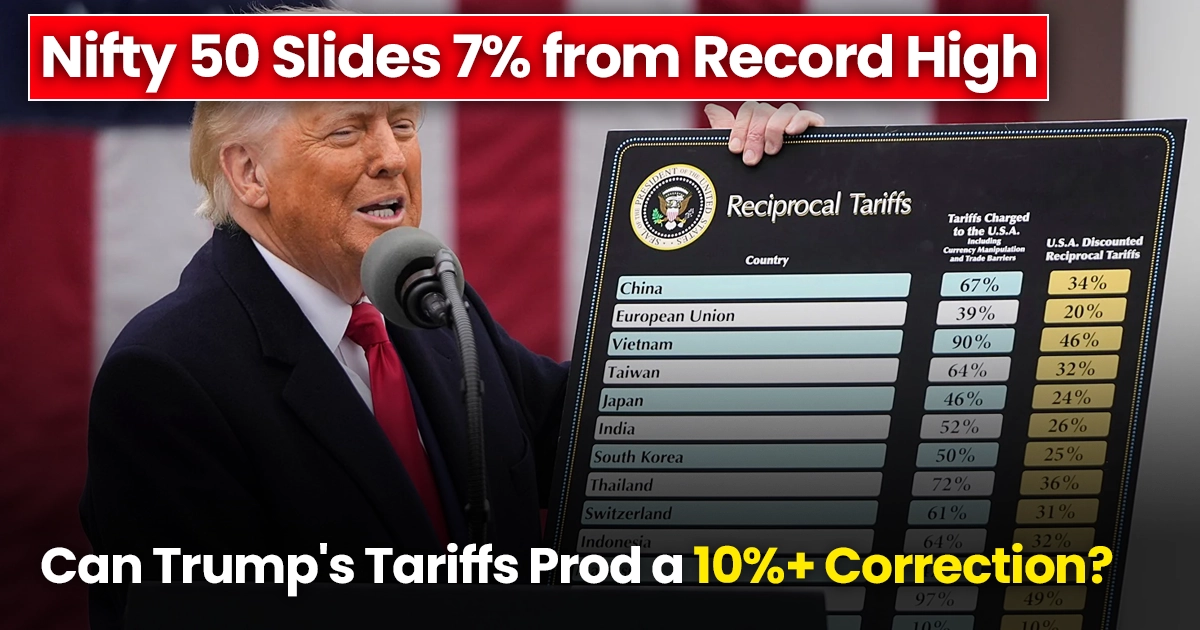
The Indian market is getting scorched as US President Donald Trump's hefty tariffs ring alarm bells for world trade. Already down 7% from its all-time high, the Nifty 50 is poised for a double-digit correction if the war of tariffs intensifies.
Trump's recent action — a 50% import duty on Indian products — is surprisingly greater than that on major rivals such as Bangladesh (20%), Vietnam (20%), and even China (30%). Though New Delhi officials are pinning their hopes on a negotiated resolution, the harm is already visible. Exports in important areas such as gems and jewellery, textiles, and some agricultural commodities have come to a grinding halt.
Markets Struggle with Uncertainty
The actual challenge for investors is not the tariff itself — it's Trump's unpredictability. The Nifty 50 has declined by almost 4% in the past month, with valuations still pricing above 21 times estimated FY26 earnings. With such high levels, Foreign Institutional Investors (FIIs) may keep withdrawing money from India to seek cheaper bet overseas.
VK Vijayakumar, Chief Investment Strategist at Geojit Financial Services, points out:
If US tariffs on Indian imports remain at 50%, the Nifty 50 may witness a cumulative fall of more than 10% from its high, considering the present valuation scenario."
As per Bloomberg Economics, these tariffs have the potential to cut Indian exports to the US by as much as 60% and reduce India's GDP by 1%.
Global Ripples and Inflation Risks
More tariffs aren't only a bruise to exporters — they can also push inflation in the US. Experts say at least 10% of these costs of tariffs will be directly transferred to American consumers. This inflationary thrust can compel the US Federal Reserve to maintain high interest rates for an extended period, increasing the prospect of stagflation — an unusual combination of dwindling growth and inflation.
That would be an unhappy event for emerging markets such as India, which depend on capital inflows from abroad. "The second half of 2025 will witness slower imports into the US, leading to slowing down of growth and sustaining inflation," Vijayakumar predicts.
Bond Market in Focus
The US bond market is already demonstrating signs of stress. Following the April 2 tariff announcement, yields jumped sharply, leading Trump to call for a 90-day moratorium and return to the negotiating table.
There's also a geopolitical angle — if China fails to agree before the August 12 deadline, it could sell off some of its US Treasury holdings. That action would also put more pressure on US bond yields and global financial markets.
Political Timelines Might Define the Trade War
Experts think these "tariff tantrums" may persist through until the 2026 US mid-term elections. With Trump's approval ratings in jeopardy due to creeping inflation, losing control of Congress might restrict his ability to impose trade measures without resistance.
For the time being, investors will have to ride out a phase of elevated volatility, policy uncertainty, and lower earnings visibility. History teaches that markets tend to bounce back smartly once policy clarity is in place — but under the prevailing environment, risk management will prove no less crucial than stock picking.
Disclaimer: This article is informational only and not an investment recommendation. Market conditions may change at any time. Contact a licensed financial advisor prior to making any investments.