
What Happened Before This Market Fall?
Before today’s sharp decline, the Indian stock market had shown signs of recovery. In the previous week, Nifty had gained nearly 5.8%, breaking a multi-week losing streak and indicating improving sentiment. Technical indicators suggested a possible move towards the 24,300–24,500 range, supported by short covering and selective institutional buying.
At the same time, volatility was starting to calm down, as the India VIX fell, and people in the market were slowly regaining their confidence after a period of correction caused by global uncertainties.
But this recovery phase was weak and mostly depended on stability around the world, especially changes in politics and the price of crude oil.
What Triggered Today’s Sharp Stock Market Crash?
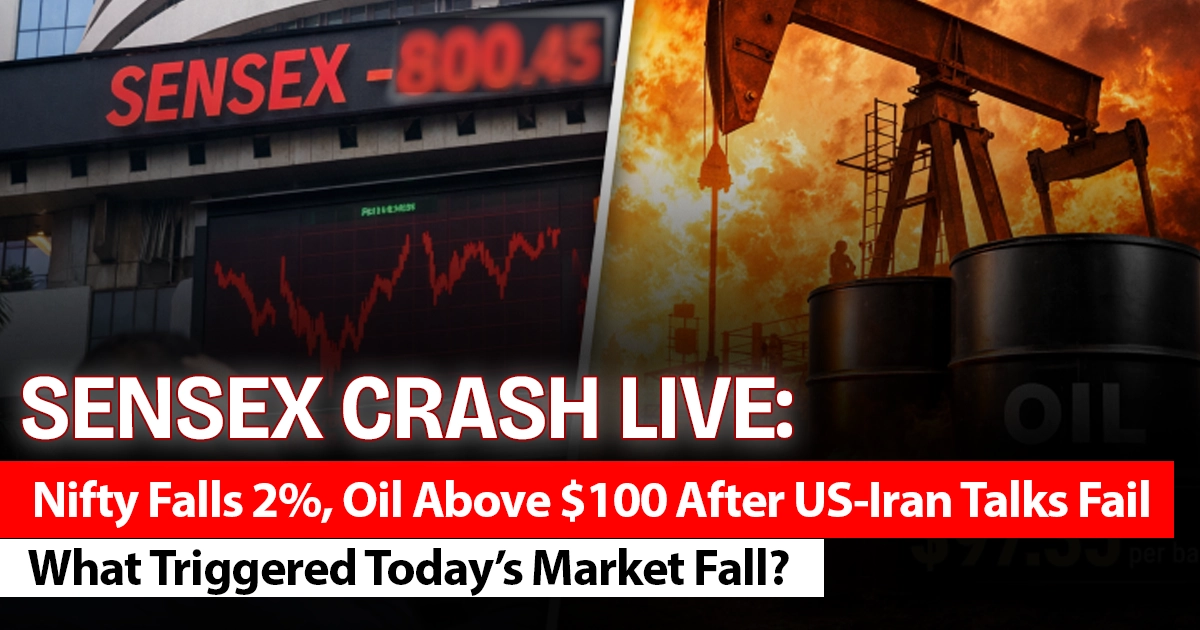
The current market fall was triggered by a sudden escalation in global tensions. The failure of US–Iran ceasefire talks, followed by the announcement of a naval blockade near the Strait of Hormuz, significantly increased uncertainty in global markets.
So, Sensex dropped more than 1,600 points, and Nifty dropped almost 2%, which was a big change from last week's gains. The drop was widespread, with selling seen in many sectors, showing a move toward avoiding risk.
This event has had a direct effect on how people feel around the world because the Strait of Hormuz is an important oil shipping route. Any problems here make people worry about supply shocks and long-term inflation.
What Do Today’s Market Numbers Clearly Show?
The extent of the decline is clearly visible through current market data:
| Market Indicator | Current Level | Change |
| Sensex | 75,868 | -1,682 pts (-2.1%) |
| Nifty 50 | 23,555 | -495 pts (-2.0%) |
| Nifty Midcap 100 | — | -1.8% |
| Nifty Smallcap 100 | — | -2.0% |
This data confirms that the decline is not isolated but broad-based across all segments, which is typical during global risk-driven corrections.
Why Are Crude Oil and Global Cues Driving Market Sentiment?
The most important driver behind today’s fall is the sharp rise in crude oil prices, which moved above $102 per barrel. For India, this creates immediate concerns regarding inflation, fiscal pressure, and currency stability.
The US dollar got stronger, while the Indian rupee got weaker, dropping to about 93.28. Rising bond yields around the world are also making things harder financially and making it harder to buy and sell stocks.
Real Macro Data Snapshot
| Global Factor | Latest Data | Market Impact |
| Brent Crude Oila | ~$102/barrel | Inflation risk increases |
| USD/INR | 93.28 | Currency pressure |
| US Dollar Index | ~99 | Strong dollar impact |
| S&P 500 Futures | -0.7% | Global weakness |
| Gold Price | Down ~0.8% | Yield pressure |
This combination reflects a risk-off environment, where global capital moves away from equities, especially emerging markets.
How Did Sectors and Stocks React to the Market Fall?
The impact of the sell-off was visible across all major sectors, confirming that this is a macro-driven correction rather than a sector-specific event.
Sector-Wise Performance Snapshot
| Sector | % Change |
| PSU Bank | -3.15% |
| Realty | -2.83% |
| Private Bank | -2.24% |
| Financial Services | -2.21% |
| Auto | -2.10% |
| IT | -1.43% |
| Pharma | -0.84% |
Banking and financial stocks led the decline, while heavyweights such as HDFC Bank, Reliance Industries, ICICI Bank, and SBI contributed significantly to index pressure.
This pattern indicates that institutional selling dominated the session, rather than retail-driven panic.
Who Is Driving the Selling Pressure in the Market?
Foreign Institutional Investors (FIIs) continue to play a major role in the current market weakness.
FII Selling Data (2026 Trend)
| Period | Net Selling |
| March 2026 | ₹1,22,182 Cr |
| April 2026 (till date) | ₹48,905 Cr |
| Total 2026 | ₹1,90,046 Cr |
This sustained outflow reflects global capital shifting towards relatively stable or higher-growth markets.
What Are the Pros and Cons of the Current Market Situation?
Pros (Positive Signals Emerging)
The recent correction has brought prices closer to fair levels, which can be good for long-term investors. Even though the market as a whole is weak right now, it still looks like it's recovering from its previous lows. If tensions between countries ease and crude oil prices stay stable, the markets may see a relief rally.
Cons (Key Risks to Watch)
The biggest risk is still high crude oil prices, which can raise inflation and slow down economic growth. Continued selling of FIIs makes liquidity tighter, and a weaker rupee makes imports more expensive. Also, uncertainty about geopolitics can cause the market to move in ways that are hard to predict, making short-term direction very unstable.
This balance of pros and cons suggests that the market is currently in a transition phase rather than a clear trend.
What Do Technical Levels Indicate for Nifty and Sensex?
Key Technical Levels to Watch
| Index | Support | Resistance |
| Nifty 50 | 23,800 | 24,000 – 24,200 |
| Sensex | 75,500 | 77,500 – 78,000 |
A breakdown below 23,800 could lead to further downside towards 23,300 levels, while any recovery may face resistance near 24,000.
Current indicators suggest a high-volatility environment, where markets may move sharply in both directions.
What Can Happen Next in the Stock Market?
The market's direction in the future will depend a lot on what happens around the world, especially the US-Iran situation and the price of crude oil.
If tensions rise and oil prices stay high, the market may keep feeling pressure from inflation worries and a weak currency. But if crude prices start to drop or show signs of de-escalation, that could help a short-term recovery.
In the medium term, stability in the world economy and a slowdown in FII selling will be very important for any upward movement to continue.
In the current environment, markets are likely to remain news-driven, volatile, and sensitive to global cues, rather than purely driven by domestic fundamentals.
Conclusion
The Sensex and Nifty fell sharply because of a combination of rising crude oil prices, currency pressure, and continued FII outflows, as well as global geopolitical tension. There have been signs of recovery in the market before, but right now there is a lot of uncertainty and things are changing quickly around the world.
How these outside factors change will determine which way the market goes in the future. This is why investors need to focus on managing risk, being patient, and making decisions in a disciplined way.
This article is for informational and educational purposes only and should not be considered as financial or investment advice. Stock market investments are subject to market risks. Readers are advised to conduct their own research or consult a qualified financial advisor before making any investment decisions.
FAQs: Sensex Crash Today, Nifty Fall & Market Outlook (April 2026)
Why did the stock market crash today in India?
The stock market dropped a lot today because the US and Iran couldn't agree on a ceasefire, which made global markets more uncertain about politics. This caused the price of crude oil to rise above $100 per barrel, which raised worries about inflation and a slowing economy. At the same time, a stronger US dollar and foreign investors selling more stocks put more pressure on Indian stocks, causing the market to fall across the board.
The stock market dropped a lot today because the US and Iran couldn't agree on a ceasefire, which made global markets more uncertain about politics. This caused the price of crude oil to rise above $100 per barrel, which raised worries about inflation and a slowing economy. At the same time, a stronger US dollar and foreign investors selling more stocks put more pressure on Indian stocks, causing the market to fall across the board.
What caused Sensex to fall over 1,600 points today?
The US and Iran couldn't agree on a ceasefire, which made the stock market drop a lot today. This made global markets less sure about politics. This made the price of crude oil go above $100 per barrel, which made people worry about inflation and a slowing economy. At the same time, Indian stocks fell across the board because the US dollar got stronger and foreign investors sold more stocks.
The US and Iran couldn't agree on a ceasefire, which made the stock market drop a lot today. This made global markets less sure about politics. This made the price of crude oil go above $100 per barrel, which made people worry about inflation and a slowing economy. At the same time, Indian stocks fell across the board because the US dollar got stronger and foreign investors sold more stocks.
Why is crude oil impacting the Indian stock market so strongly?
India's economy depends on crude oil because the country gets a lot of its energy from other countries. When oil prices go up, inflation goes up, the rupee gets weaker, and companies have to pay more for their inputs. This has a direct effect on how much money companies make and how investors feel, which is why stock markets go down when crude oil prices go up quickly.
India's economy depends on crude oil because the country gets a lot of its energy from other countries. When oil prices go up, inflation goes up, the rupee gets weaker, and companies have to pay more for their inputs. This has a direct effect on how much money companies make and how investors feel, which is why stock markets go down when crude oil prices go up quickly.
Why are FIIs continuously selling in the Indian market in 2026?
Foreign institutional investors have been selling steadily because of uncertainty in the world, rising interest rates in developed economies, and better growth opportunities in other markets. In 2026, India's market has been under a lot of pressure because of ongoing geopolitical tensions, a weak currency, and low expectations for earnings growth.
Foreign institutional investors have been selling steadily because of uncertainty in the world, rising interest rates in developed economies, and better growth opportunities in other markets. In 2026, India's market has been under a lot of pressure because of ongoing geopolitical tensions, a weak currency, and low expectations for earnings growth.
Is today’s market fall a crash or a temporary correction?
Right now, it looks like the market movement is a sharp correction caused by events around the world, not a structural breakdown. Even though the drop is big, the overall trend in the market still depends on how things change around the world. The market could bounce back if tensions between countries ease and crude oil prices stay stable. But if the uncertainty lasts for a long time, the correction phase could last longer.
Right now, it looks like the market movement is a sharp correction caused by events around the world, not a structural breakdown. Even though the drop is big, the overall trend in the market still depends on how things change around the world. The market could bounce back if tensions between countries ease and crude oil prices stay stable. But if the uncertainty lasts for a long time, the correction phase could last longer.
What are the key levels to watch for Nifty and Sensex now?
From a technical point of view, Nifty is currently getting immediate support near the 23,800 level. If it breaks below this level, it could go down even more, all the way to 23,300. On the bright side, there should be resistance between 24,000 and 24,200. Support for the Sensex is around 75,500, and resistance is between 77,500 and 78,000. These levels will be very important in deciding where the market will go next.
From a technical point of view, Nifty is currently getting immediate support near the 23,800 level. If it breaks below this level, it could go down even more, all the way to 23,300. On the bright side, there should be resistance between 24,000 and 24,200. Support for the Sensex is around 75,500, and resistance is between 77,500 and 78,000. These levels will be very important in deciding where the market will go next.
How are global markets reacting to the US-Iran conflict?
After tensions rose, global markets have become more cautious. Asian markets have gone down, US futures are trading lower, and bond yields have gone up. The US dollar has also gotten stronger as investors move their money into safer assets. This synchronised reaction across different asset classes shows that people around the world are feeling less risky.
After tensions rose, global markets have become more cautious. Asian markets have gone down, US futures are trading lower, and bond yields have gone up. The US dollar has also gotten stronger as investors move their money into safer assets. This synchronised reaction across different asset classes shows that people around the world are feeling less risky.
What sectors are most affected in today’s market fall?
The banking, financial services, auto, and real estate sectors have been hit the hardest by today's drop. These areas are very sensitive to changes in interest rates, liquidity, and expectations for economic growth. The big drop in these sectors shows that institutional investors are cutting back on stocks that are sensitive to the economy when things are uncertain.
The banking, financial services, auto, and real estate sectors have been hit the hardest by today's drop. These areas are very sensitive to changes in interest rates, liquidity, and expectations for economic growth. The big drop in these sectors shows that institutional investors are cutting back on stocks that are sensitive to the economy when things are uncertain.
What are the risks for the Indian stock market going forward?
High crude oil prices that last a long time, FII selling that doesn't stop, currency depreciation, and geopolitical tensions that last a long time are some of the biggest risks. Inflation, economic growth, and corporate profits can all be affected by these things, which can make the market unstable in the short term.
High crude oil prices that last a long time, FII selling that doesn't stop, currency depreciation, and geopolitical tensions that last a long time are some of the biggest risks. Inflation, economic growth, and corporate profits can all be affected by these things, which can make the market unstable in the short term.
Are there any positive signs in the current market correction?
Even though the price dropped sharply, the correction has made valuations better, which could be good news for long-term investors. Markets might see a relief rally if tensions around the world ease and crude oil prices stay stable. The underlying market structure also shows signs of recovery from previous lows, which suggests that the long-term trend may stay the same.
Even though the price dropped sharply, the correction has made valuations better, which could be good news for long-term investors. Markets might see a relief rally if tensions around the world ease and crude oil prices stay stable. The underlying market structure also shows signs of recovery from previous lows, which suggests that the long-term trend may stay the same.
What should investors do in this volatile market?
Investors should not react to short-term market changes right now. Instead, they should focus on making smart decisions and managing risk. The market is affected by events around the world, so it may stay volatile. When things are so uncertain, it's usually best to be careful and think about the long term.
Investors should not react to short-term market changes right now. Instead, they should focus on making smart decisions and managing risk. The market is affected by events around the world, so it may stay volatile. When things are so uncertain, it's usually best to be careful and think about the long term.