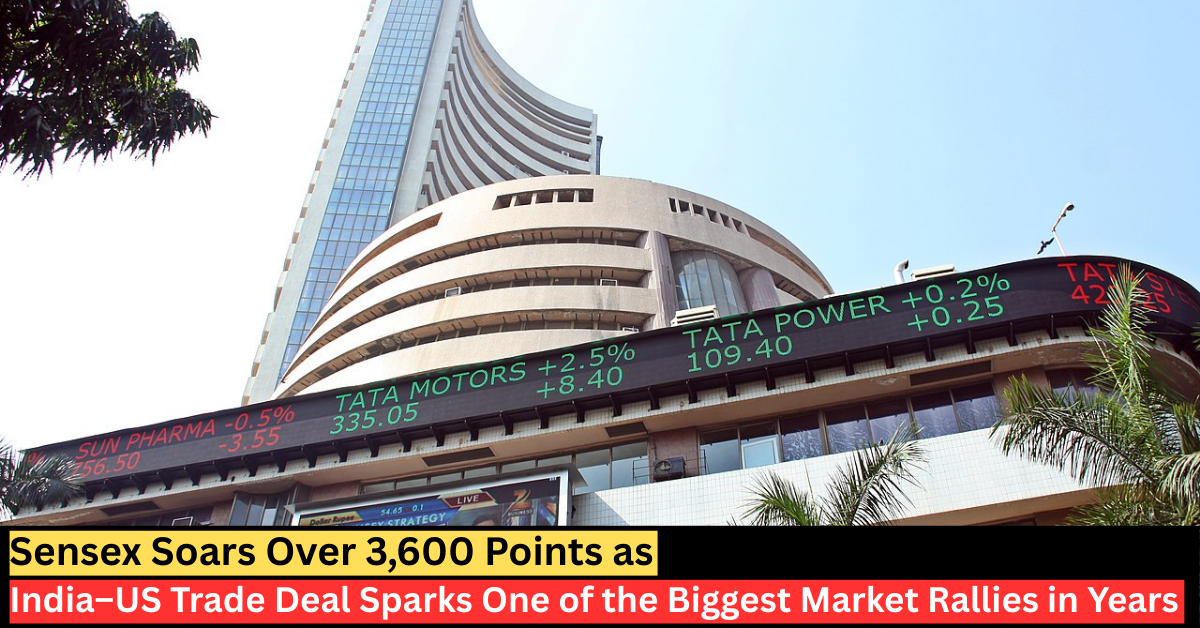
Indian equity markets opened Tuesday with a decisive surge, as Sensex Today and Nifty 50 Today registered one of their strongest gap-up starts in recent years. The rally followed confirmation of a comprehensive India–US trade deal, which reduced tariff uncertainty, revived foreign investor confidence, and triggered a sharp re-pricing across equities, currency, and bond markets.
Positive overnight momentum was more than an initial hope. Strong pre-market indications combined with global risk-on sentiment and clarity on the trade terms provided a firmly optimistic move across multiple asset classes. This degree of synchronicity suggests a more structural change as opposed to a temporary uplift.
What drove the sharp opening surge in the Indian stock market today
Markets reacted swiftly after the United States confirmed a reduction in reciprocal tariffs on Indian goods to 18%, while India agreed to remove several tariff and non-tariff barriers on US imports. This reset addressed one of the biggest external risks facing Indian markets over the past year.
At the opening bell, the Nifty 50 surged above 26,300, while the Sensex vaulted past 85,300, reflecting aggressive short covering and renewed institutional positioning. The rally extended across sectors, underlining the breadth of investor participation.
Why Gift Nifty and global cues signalled a rare gap-up opening
Pre-market indicators had already pointed to an exceptional start. Gift Nifty was trading near 26,086, implying a premium of roughly 945 points over the previous Nifty futures close — a level typically associated with major macro or policy shifts.
Global indicators reinforced this outlook. While US equities, backed by technology stocks, ended the previous session on a positive note, Asian markets traded sharply higher. A positive rally on all global indices reinforced the Indian stock market live to expect a gap-up opening.
How the India–US trade deal changed the market’s risk perception
Beyond headline gains, the trade agreement altered India’s relative positioning among export-oriented economies. With tariffs lowered to 18%, India now enjoys a more competitive footing compared with several regional peers, improving prospects for labour-intensive and manufacturing sectors.
The agreement also had commitments on trade volumes and energy sourcing, which the markets interpreted as supportive for the stability of the currency and the interest rate. Consequently, investors quickly priced in enhanced earnings visibility and lower macroeconomic risks.
Who led the rally as buying spread across sectors and stocks
The rally was broad-based, with leadership emerging from trade-sensitive and cyclically exposed sectors. Ports, logistics, auto components, textiles, gems and jewellery, and select industrial names attracted strong buying interest.
Concurrently, the financials and consumption-linked stocks advanced as the stronger rupee and moderating bond yields were expected to bolster domestic demand. Updates on corporate earnings added to the positive sentiment as some companies reported solid growth despite the recent fluctuations.
What the early market data reveals about the strength of the move
The scale and quality of the rally are evident when viewed across asset classes.
| Market Indicator | Early Session Reading |
| Sensex level | 85,323 |
| Sensex change | +3,656 points (+4.48%) |
| Nifty 50 level | 26,308 |
| Nifty 50 change | +1,219 points (+4.86%) |
| Gift Nifty premium | ~945 points |
| USD/INR | ₹90.30 (119 paise gain) |
| 10-year bond yield | ~6.73% |
Such alignment across equities, currency, and bonds typically reflects institutional conviction rather than speculative activity.
Why currency and bond markets confirmed the equity rally
The Indian rupee today recorded its strongest gain in more than three years, benefiting from expectations of higher foreign inflows and reduced external vulnerability. A firmer currency eased concerns around imported inflation and external financing costs.
The yield on government bonds dropped as demand increased due to the pricing of macroeconomic stability and low pressure on domestic interest rates. This further reinforced the outlook that the rally was due to fundamentals rather than sentiment.
How sectoral moves reflected changing economic expectations
There was strong buying across all sectoral indices with buying interest particularly concentrated in pharma, auto, metals, textiles and consumer stocks. Export-driven sectors positively responded to the improved accessibility in the US market whereas domestic sectors improved, on buying expectations of steady consumption and liquidity support.
Commodities echoed the broader optimism, with gold and silver prices rising on MCX, reflecting both currency movements and improved global risk appetite.
When volatility could return despite the strong start
Although the initial move was decisive, markets will continue to be sensitive to upcoming earnings and policy moves. Many companies are about to announce quarterly results, creating potential for stock-specific volatility to accompany an otherwise positive trending market.
Investors will also track central bank commentary closely. While expectations of immediate rate cuts have moderated, liquidity guidance and macro projections will be critical in shaping the next phase of the rally.
What the medium-term outlook suggests after the breakout
From a broader perspective, the rally represents a potential inflection point rather than an endpoint. The trade agreement improves export visibility, supports the currency, and strengthens India’s appeal to global investors.
If earnings growth continues to be strong and global conditions remain supportive, benchmark indices may consolidate at higher levels before further attempts to increase. The focus now shifts from headlines to sustained compounding of earnings and how that will direct capital.
Where market participants should focus from here
In the sessions ahead, attention will remain on:
- Follow-through buying from foreign institutional investors
- Stability in USD/INR
- Corporate earnings guidance
- Liquidity and policy signals
For those tracking Sensex live, Nifty 50 live, and global cues, disciplined interpretation of data will be essential as markets adjust to a recalibrated trade and growth landscape.
At ICFM INDIA, such market transitions are analysed in real time to help traders and investors understand not only what the market is doing, but why it is moving — and how to prepare for what comes next.
Frequently Asked Questions: Sensex, Nifty 50 & India–US Trade Deal
1. Why did the Indian stock market rise sharply today?
The Indian stock market rose sharply after confirmation of the India–US trade deal, which reduced US tariffs on Indian goods to 18%. This development removed a major macro uncertainty, improved export competitiveness, and triggered strong buying interest across equities.
2. Why did Sensex jump more than 3,600 points in one session?
Sensex surged due to a combination of positive global cues, short covering by traders, and fresh institutional inflows. The trade agreement improved earnings visibility and risk appetite, leading to one of the strongest opening rallies seen in recent years.
3. Why was there a massive gap-up opening in Nifty 50 today?
Nifty 50 opened sharply higher after Gift Nifty signalled a premium of nearly 900–950 points ahead of market opening. This indicated strong overseas sentiment, which translated into aggressive buying as soon as domestic markets opened.
4. How does the India–US trade deal affect Indian stock markets?
The trade deal reduces tariff-related pressure on Indian exports, supports the Indian rupee, improves corporate profitability, and eases concerns around interest rates. Together, these factors create a more stable macro environment for equities.
5. Which sectors benefited the most from today’s market rally?
Sectors that benefited the most were those with higher exposure to exports and global demand, including textiles, gems and jewellery, auto components, metals, and select infrastructure-linked stocks.
6. Why did the Indian rupee strengthen after the trade deal announcement?
The rupee strengthened as the trade deal improved India’s external outlook by supporting exports and attracting foreign capital flows. Reduced tariff pressure and expectations of stable foreign inflows helped the currency appreciate sharply.
7. Does today’s rally indicate a long-term trend change in the market?
Today’s rally signals a shift in short-term sentiment, but long-term sustainability will depend on earnings growth, global market conditions, and policy follow-through. Markets may consolidate after sharp moves before establishing a clear trend.
8. What are the key levels to watch for Sensex and Nifty 50 now?
For Nifty 50, the 25,400–25,500 zone acts as an important support area after the gap-up move, while resistance lies near the record-high zone around 26,300–26,400. Sensex levels will mirror these technical zones proportionally.
9. How does this rally impact investors and traders?
For investors, the rally reinforces confidence in India’s medium-term growth outlook. For traders, increased volatility following a sharp gap-up means risk management is critical, as markets may see profit booking after the initial surge.