
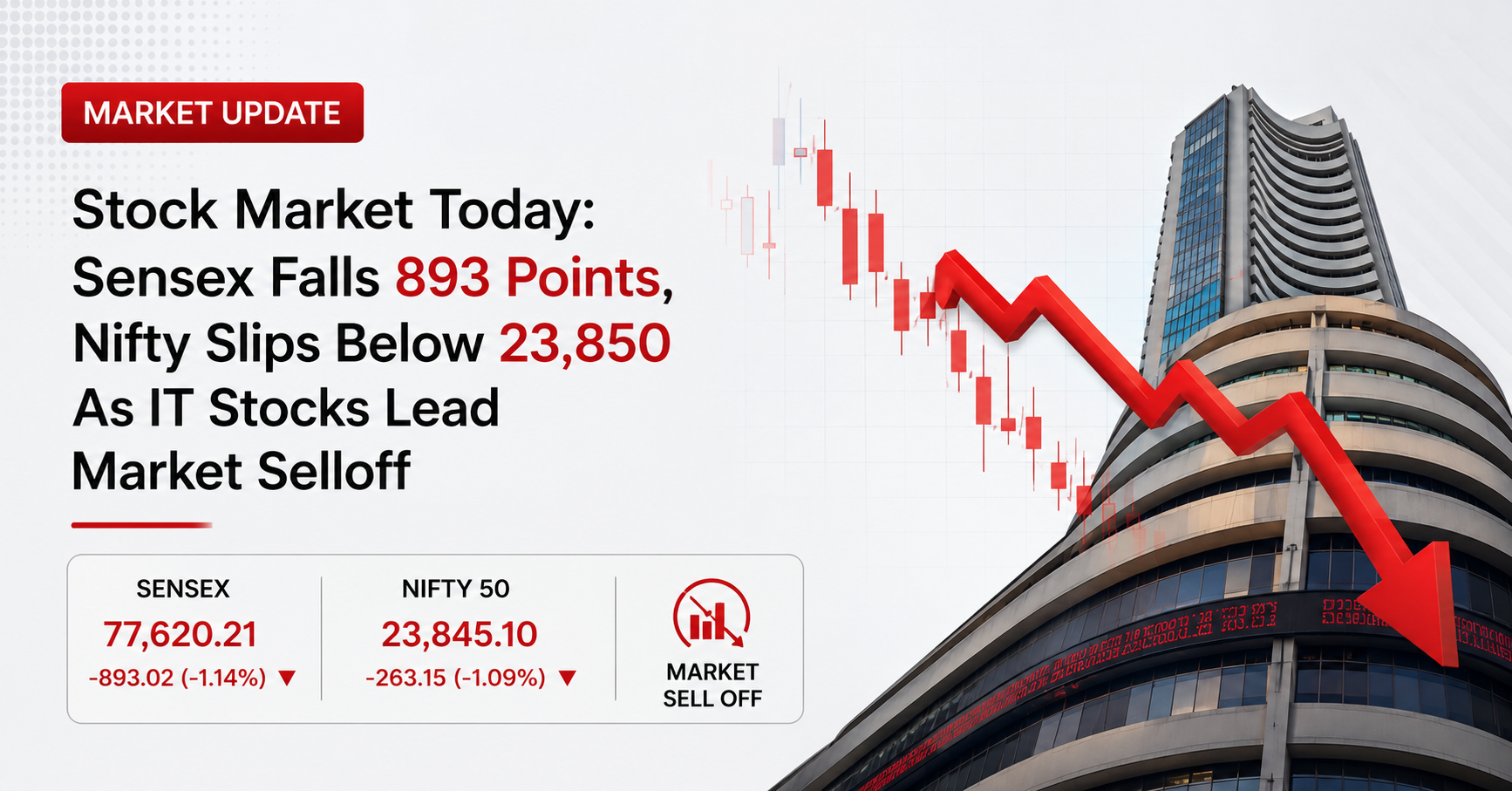
Indian stock markets experienced significant declines during the most recent trading session, with the Sensex and Nifty dropping by more than 1%. The Sensex closed at 76,200.68, a decline of 893.39 points, and the Nifty 50 closed at 23,824.10, a decline of 278.80 points.
For Traders and market participants, this represented more than the usual ordinary decline. This decline occurred during a period associated with pressure on global technology stocks and weakness in IT shares, along with pressure on the rupee, and a cautious stance held by market participants in relation to signals from the U.S. Federal Reserve regarding interest rates. This combination contributed to a risk averse sentiment in the markets.
Why This Market Fall Matters
A one-day fall in the stock market does not always mean panic. But when Sensex falls nearly 900 points and Nifty slips below an important psychological level, traders start asking one simple question: is this just profit booking or the beginning of a deeper correction?
The latest fall is important because it was not limited to one stock or one sector. Selling pressure was visible across several sectors, with IT and metal stocks among the biggest drags. Broader market sentiment also turned weak as investors preferred to reduce risk after the recent market recovery.
Stock Market Today: What Exactly Happened?
The Indian market opened under pressure and remained weak through most of the session. Selling intensified as global cues stayed negative and investors reacted to weakness in technology stocks worldwide.
IT stocks came under strong pressure because global technology shares were already facing correction. Metal stocks also declined due to weak global commodity sentiment. At the same time, profit booking after the recent rally added more pressure on benchmark indices.
| Market Indicator | Latest Update |
| Sensex Closing | 76,200.68 |
| Sensex Change | -893.39 points / -1.16% |
| Nifty 50 Closing | 23,824.10 |
| Nifty Change | -278.80 points / -1.16% |
| Major Weak Sectors | IT, Metals |
| Market Mood | Cautious and risk-off |
| Key Nifty Zone | 23,800–23,750 support |
Why Did Sensex And Nifty Fall?
The first major reason was the global tech selloff. When global technology stocks fall sharply, Indian IT companies also come under pressure because their business depends heavily on global clients, especially from the U.S. and Europe.
The second reason was concern around U.S. Federal Reserve policy. If interest rates remain higher for longer, global investors usually become more cautious. This can reduce risk appetite in equity markets and put pressure on emerging markets like India.
The third reason was profit booking. The market had already seen recovery in previous sessions. When fresh negative cues arrived, short-term traders preferred to book profits instead of adding fresh positions.
The fourth reason was sector weakness. IT and metal stocks dragged the market lower, while broader sentiment remained weak across several sectors.
Learn Market Falls With Practical Training At ICFM INDIA
Market falls like this show why practical stock market education is important. Many beginners only look at red and green candles, but professional traders study global cues, sector rotation, support and resistance, risk management, FII activity, currency movement and market psychology.
If you want to understand why markets fall, how Nifty levels work, how sectors move, and how traders manage risk during volatile sessions, ICFM INDIA offers practical stock market courses with live market training, technical analysis, derivatives learning and real-market case studies.
Learn the market with structure, not confusion. Join ICFM INDIA and build a strong foundation in stock market trading and investing.
Case Study: What This Fall Teaches Traders
This session is a useful case study for market learners. Many retail traders only noticed that Nifty fell below 23,850, but experienced market participants looked deeper.
They studied three things. First, IT stocks were weak because global technology sentiment was negative. Second, metal stocks were under pressure because commodity sentiment was weak. Third, Nifty was approaching an important support zone near 23,800.
This demonstrates that the fall was not spontaneous. It was a combination of global weaknesses, sectorial pressures, macroeconomic uncertainty and profit booking.
To elaborate, a beginner level trader is likely to panic at seeing a 900 point fall in the Sensex. However, a more seasoned and trained trader will identify the underlying sectors that are pulling down the market, determine the Nifty support, ascertain the volume, and check if the FIIs are selling or if the fall is a result of global cues or is it a result of internal weaknesses.
This is primarily the basis of emotional trading versus proper analysis of the market.
Expert Opinion: Is This A Market Crash Or Normal Correction?
In my view, this fall should not be called a full market crash yet. It is better understood as a sharp correction caused by weak global cues and sectoral selling.
A real market crash usually needs deeper panic, stronger institutional selling, breakdown across major support zones and continued weakness for multiple sessions. Right now, the most important level to watch is the Nifty 23,800–23,750 zone.
If Nifty holds this range and global markets stabilize, the market may attempt a recovery. But if Nifty breaks below this zone with strong selling pressure, the short-term trend may become more negative.
Why IT Stocks Were Hit Hard
IT stocks were among the biggest reasons behind the market fall. The sector is sensitive to global technology sentiment, U.S. economic outlook, interest rate expectations and corporate spending trends.
When investors worry about slower global demand or higher interest rates, IT stocks often react quickly. This is because many Indian IT companies earn a large part of their revenue from overseas markets.
That is why weakness in global tech stocks directly affected Indian IT counters and pulled down benchmark indices.
What Should Traders Watch Now?
Traders should not focus only on the headline fall. They should track whether Nifty can hold the 23,800–23,750 zone. If this support holds, a short-term bounce is possible. But if this level breaks, fresh weakness may continue.
On the upside, Nifty may face resistance around 23,950–24,000. A strong close above this zone can improve sentiment. Until then, the market may remain volatile.
Investors should also watch global markets, U.S. Fed commentary, rupee movement, crude oil prices, FII activity and performance of IT stocks.
What Retail Investors Usually Do Wrong
During sharp market falls, many retail investors make emotional decisions. Some panic and exit good stocks. Some average weak stocks without a plan. Some enter risky trades only because prices look cheaper.
The better approach is to understand the reason behind the fall. If the fall is due to temporary profit booking, the market may recover quickly. But if the fall is due to weak earnings, global risk-off sentiment or institutional selling, traders need to be more careful.
This is why market education, risk management and discipline are more important than random tips.
Market Outlook: Nifty Prediction For Next Session
The short-term market outlook remains cautious. Nifty has closed near an important support area, so the next session will be important for direction.
If Nifty stays above 23,800 and buying returns in IT, banking or heavyweight stocks, the market may try to move towards 23,950–24,000. But if Nifty breaks below 23,750, selling pressure may increase and traders may become more defensive.
For now, the market is not giving a clear bullish signal. It is in a wait-and-watch zone.
Final Takeaway
The latest fall in Sensex and Nifty was mainly driven by global tech weakness, IT stock selling, Fed rate concerns, profit booking and weak broader sentiment. For traders, the 23,800–23,750 zone on Nifty is now the most important level to watch.
Instead of reacting emotionally, investors should focus on market structure, sector performance, support and resistance levels, and risk management. Volatile markets are not only risky; they are also learning opportunities for those who understand how the market works.
Disclaimer
This article is intended exclusively for educational purposes. This is neither an investment recommendation nor an offer to buy or sell any stock. Each investor should review all investment alternatives with a financial advisor prior to making any investment decisions.
FAQs
Why did the stock market fall today?
The stock market fell due to weak global cues, global tech selloff, pressure in IT and metal stocks, U.S. Fed rate concerns, rupee pressure and profit booking after the recent rally.
How much did Sensex fall?
Sensex closed at 76,200.68, down 893.39 points or 1.16%.
How much did Nifty fall?
Nifty 50 closed at 23,824.10, down 278.80 points or 1.16%.
Which sectors dragged the market lower?
IT and metal stocks were among the biggest drags on the market.
What is the key support for Nifty now?
The 23,800–23,750 zone is an important support area for Nifty in the short term.
Is this a stock market crash?
This looks more like a sharp correction than a full market crash. However, if Nifty breaks key support levels and global cues remain weak, volatility may continue.
What should investors do now?
Investors should avoid panic decisions, track key market levels, focus on quality stocks and follow proper risk management before taking fresh positions.