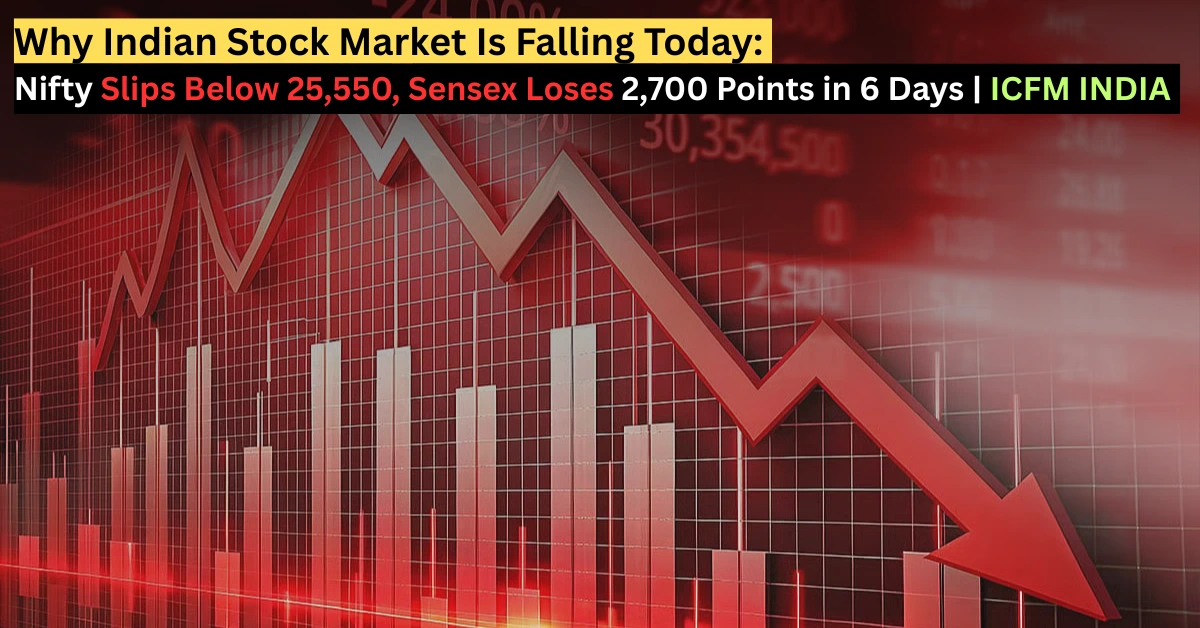
The Indian stock market is witnessing one of its sharpest short-term corrections in recent months. Over the last six trading sessions, benchmark indices have remained under sustained selling pressure, pushing the Nifty 50 below the 25,550 mark and dragging the Sensex down by more than 2,700 points. The sell-off has erased nearly ₹18 lakh crore in investor wealth, raising a critical question for traders and investors alike — why is the Indian stock market falling today despite a stable domestic economy?
There is no single factor causing this drop. Instead, it shows how increased risk aversion across stock markets, capital outflows, valuation concerns, and global uncertainty are all coming together.
What Is Happening in the Indian Stock Market Right Now
Indian equities have recorded a sixth consecutive losing streak, chalking up one of the worst year beginnings over the past ten years. Large-cap stocks that had previously led the rally are now being aggressively profit booked.
During this phase, the Nifty 50 has fallen over 3%, while the Sensex has declined nearly 3.2%, confirming that the correction is broad-based rather than sector-specific. The decline can be attributed to banking, IT, metals and capital goods stocks, suggesting this sell-off was motivated by risk mitigation, not stock-specific fundamentals.
Market Damage at a Glance
| Indicator | Recent Movement |
| Sensex | −2,700+ points (6 sessions) |
| Nifty 50 | Below 25,550 |
| Market Cap Loss | ~₹18 lakh crore |
| FII Activity | Continuous net selling |
| Volatility | Rising sharply |
This data clearly shows that the pressure is systematic, not random.
Why the Indian Stock Market Is Falling Despite No Domestic Crisis
The current market correction is largely externally influenced, even though domestic macroeconomic indicators remain relatively stable.
One major area of concern has been global trade uncertainty, particularly vis-a-vis the potential for tariffs and the geopolitical policy risks around the trade of energy. Given India’s reliance on imported crude oil, global movements tend to impact India’s equity markets, and disruptions and/or elevated costs for oil imports impact inflation expectations and corporate margins.
Another major factor is persistent Foreign Institutional Investor (FII) selling. Foreign investors have been net sellers for several weeks, reallocating capital to safer assets amid global uncertainty and relatively high Indian equity valuations. When FIIs sell in large volumes, it creates liquidity pressure that domestic investors alone cannot immediately absorb.
Indian indices have been correcting sharply following the recent valuation troubles. Following a robust multi-month rally, Indian indices were trading at lofty multiples. Following an increase in uncertainty, Indian markets started to price in risk more aggressively which led to sharp corrections instead of a gradual consolidation.
How Global and Domestic Forces Are Driving This Correction
The current sell-off reflects a classic risk-off environment.
Fundamentally, investors across the world are moving their investments to safer assets like gold and sovereign bonds. The price of gold has shot up in the past week. Historically, this is seen more as a sign of caution rather than confidence. Similar volatility in the equity markets across Asia reinforces the thesis that India is not an outlier.
Domestically, caution ahead of the Q3 earnings season is amplifying volatility. Investors are unwilling to take fresh large positions until there is clarity on corporate earnings growth, especially in banking and IT sectors where margins are under pressure.
Also, increasing volatility becomes self-reinforcing. As indices break important technical levels, short-term traders sell at an accelerating pace, while long-term investors step back to the sidelines to wait for stability.
What This Market Fall Means for Traders vs Long-Term Investors
For short-term traders, there is price oscillation highlighted by emotional trading decisions. Unplanned intraday fluctuations heightened risk on a daily basis.
For long-term investors, however, the correction does not automatically signal a structural breakdown. India’s long-term economic drivers — consumption growth, infrastructure spending, and financialization — remain intact. What is changing is short-term market sentiment, not long-term fundamentals.
The key distinction lies in approach. Traders require precise risk management and technical clarity, while investors need patience and disciplined capital deployment.
What Should Market Participants Do Next
Markets do not fall endlessly, but timing the exact bottom is neither realistic nor necessary. What matters most is preparation and skill, not prediction.
In the past, volatility cycles are where the most informed participants who understand the market structure, risk management, and price action get rewarded. Emotional traders often end up crystallizing multiple losses, while rules-based traders shield their capital and tactically spot the opportunity.
This phase highlights an uncomfortable truth — most losses occur not because markets fall, but because participants lack proper trading education and discipline.
Why Market Education Matters More During Corrections
Market corrections reveal the difference between speculation and skill. If indices climb, the erroneous tend to get away with it. During bull market corrections, weaknesses in strategy, psychology, and risk control get exposed.
Understanding price action, derivatives behavior, and capital protection strategies becomes critical during such phases. This is where professional market education plays a decisive role, not to predict markets, but to navigate them responsibly.
ICFM INDIA Insight: Learn to Trade Volatility, Not Fear It
At ICFM – Institute of Career in Financial Market, we train traders to operate confidently in both rising and falling markets. Our programs focus on real market behavior, live trading psychology, and risk-controlled execution, especially during volatile phases like the one currently unfolding.
Whether markets are making new highs or correcting sharply, traders equipped with the right skills don’t panic — they adapt.
👉 If you want to understand why markets move the way they do, how FIIs influence trends, and how professionals manage risk during corrections, structured market education is not optional — it is essential.
Final Takeaway
The Indian stock market’s recent fall is not a crisis, but a reality check driven by global uncertainty, valuation reset, and capital flow dynamics. While headlines focus on point losses, informed participants focus on learning, preparation, and discipline.
Markets will stabilize — they always do. The question is whether participants are ready when that happens.
Learn the market before the market tests you.
Frequently Asked Questions: Indian Stock Market Fall Today
Why is the Indian stock market falling today?
The Indian stock market is falling due to a combination of global uncertainty, sustained foreign investor selling, and profit booking after a strong rally. Rising geopolitical risks, trade-related concerns, and cautious sentiment ahead of corporate earnings have increased risk aversion, leading to broad-based selling across sectors.
Why did the Nifty 50 fall below 25,550?
The Nifty 50 slipped below 25,550 as selling pressure intensified in large-cap stocks, especially banking, IT, and capital goods. Foreign institutional investors reducing exposure and traders unwinding leveraged positions caused the index to break key support levels, accelerating the decline.
Why has the Sensex fallen more than 2,700 points in six days?
The Sensex has dropped over 2,700 points due to continuous selling over six sessions driven by global risk-off sentiment, valuation concerns, and heavy profit booking. The fall reflects a market-wide correction rather than weakness in a single sector or company.
Is this stock market fall a crash or a correction?
This move is best described as a market correction, not a crash. A crash typically involves panic selling triggered by systemic financial stress, while the current decline is driven by sentiment, capital flows, and global uncertainty despite stable domestic fundamentals.
Are FIIs responsible for the current market fall?
Yes, foreign institutional investors have played a major role. Continuous FII selling has increased supply pressure in the market, and domestic investors alone have not been able to fully offset these outflows, leading to sustained weakness in benchmark indices.
Will the Indian stock market fall further from here?
Short-term volatility may continue as markets respond to global developments and upcoming earnings results. However, further downside will depend on factors such as FII flows, geopolitical clarity, and corporate performance rather than panic-driven selling.
Should investors panic during this market fall?
Panic is usually the worst response during market corrections. Volatility is a normal part of equity markets. Investors should focus on risk management, asset allocation, and long-term goals rather than reacting emotionally to short-term price movements.
Is this a good time to invest in the stock market?
For long-term investors, corrections often improve entry valuations, but timing should be gradual and disciplined. For traders, this phase requires strict risk control and a clear strategy, as volatility can amplify both gains and losses.
Which sectors are most affected by the current market fall?
Banking, IT, metals, and capital goods have seen the most pressure due to profit booking and global uncertainty. Mid-cap and small-cap stocks have also corrected as risk appetite weakened across the board.
How long does a market correction usually last?
Market corrections do not follow a fixed timeline. Some resolve within weeks, while others take longer depending on global cues and earnings clarity. What matters more than duration is how participants manage risk and position themselves during the volatility.
What should traders learn from this market correction?
This correction highlights the importance of understanding market structure, capital flows, and risk management. Markets reward discipline, not prediction. Traders who rely on education and strategy tend to survive volatility better than those driven by emotions.