How the Best Stock Market Course in Delhi Teaches Derivatives and F&O Trading

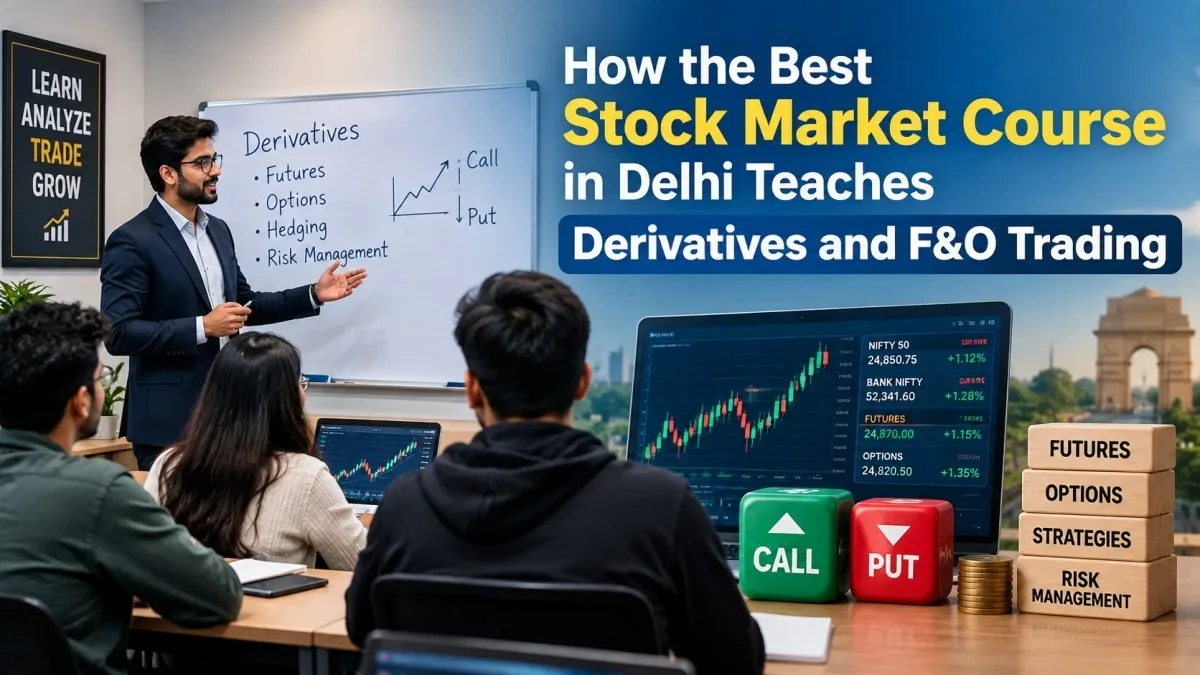
F&O trading course Delhi — instructor teaching call, put, futures, options and risk management in stock market class
Apply Now

Quick Answer: A quality derivatives course covers four essentials: F&O contract mechanics, options pricing including premiums, strikes and expiry cycles, option-chain reading using volume, open interest and implied volatility, and integrated risk management — including the Options Greeks that determine how option prices actually move. If a course skips any of these four areas, that gap will show up in your trading.

Why Derivative Analysis Matters When Choosing a Course

The simplest way to understand an option is through an insurance analogy. When you buy car insurance, you pay a fixed premium for the right — not the obligation — to make a claim if something goes wrong. You are not forced to claim; you simply have the option to. Stock market options work identically. The buyer pays a premium for the right to buy or sell an asset at an agreed price, without being compelled to act if conditions do not favour it.

Futures are fundamentally different. A futures contract creates a binding obligation on both parties to settle at the agreed price on expiry — regardless of where the market has moved. No choice involved on either side.

That distinction between the conditional right of an option and the binding obligation of a futures contract is the first concept any serious derivatives curriculum should establish clearly, because most beginner confusion in F&O traces back to treating these two instruments as variations of the same thing.

What SEBI's Data Tells You — and Why It Should Shape How You Choose a Course

SEBI's study of individual F&O traders over FY2022–FY2024 found that 93% incurred losses, with aggregate losses exceeding ₹1.8 lakh crore. The profitable 7% were not simply better at picking market direction. Available evidence consistently points to systematic risk management, clear entry and exit criteria, and consistent position-sizing discipline as the distinguishing factors.

This is not a regulatory footnote. It is the central argument for what a derivatives curriculum needs to be built around. A course that teaches option-chain reading without position sizing prepares you for the mechanics of F&O without the discipline of F&O. A course that teaches call and put definitions without Theta decay teaches you what options are called without teaching you why they behave the way they do. That gap accounts for a significant share of that 93%.

Before enrolling anywhere, ask this directly: given SEBI's data on individual trader losses, how is your curriculum specifically structured to address that? A specific answer tells you something important about the institute's thinking. A generic one tells you something equally important.

What the Best Stock Market Course in Delhi Should Cover

A structured curriculum moves in this sequence, and the order matters as much as the content itself.

Equity market fundamentals, futures mechanics including lot sizes and margin requirements, options basics covering calls, puts, premiums and expiry, time value and implied volatility, Options Greeks, open interest and volume analysis, option-chain reading, technical analysis as an F&O decision input, risk management, and trading psychology.

A course that jumps to option-chain analysis before teaching implied volatility creates students who can look at a chain but cannot actually interpret what the premium levels mean. That sequencing error is more common than it should be.

Futures vs. Options: The Core Distinction

FuturesOptions
Binding obligation on both partiesRight for the buyer, obligation for the seller
Both sides must settle at expiry regardless of price movementBuyer can choose not to exercise; maximum loss is the premium paid
P&L moves directly with the underlying assetPremium is affected by price, time remaining, and implied volatility
No premium concept — only margin and daily mark-to-marketBuyer pays premium upfront; seller maintains margin

Most beginner losses in options come from approaching them with a futures mindset — expecting a direct relationship between market movement and profit, without accounting for time decay or volatility. These are not secondary considerations. They frequently determine whether a correct directional call produces a profit or a loss.

Call vs. Put Options — With a Worked Example

Call OptionPut Option
Buyer gets the right to purchase the underlying at the strike priceBuyer gets the right to sell the underlying at the strike price
Profitable when the underlying rises above strike plus premium paidProfitable when the underlying falls below strike minus premium paid
Maximum loss for buyer: the premium paidMaximum loss for buyer: the premium paid
Click Now

A practical example. Nifty 50 is at 24,000. You buy a 24,200 call option — slightly out of the money — at a premium of ₹80. The current Nifty 50 lot size is 75 units. Your total outlay is ₹80 × 75 = ₹6,000.

Three outcomes at expiry:

Nifty expires at 24,350 — your option is in the money. Profit = (24,350 − 24,200 − 80) × 75 = ₹5,250.

Nifty expires at 24,200 — your option expires at the money. You recover nothing. Full loss of ₹6,000.

Nifty expires at 23,900 — your option expires worthless. You lose the full ₹6,000, no more.

For Scenario A to be profitable, Nifty needed to move 350 points in your favour — covering the gap to the strike price and the premium paid. A course that uses this kind of arithmetic produces students who genuinely understand options, not students who simply know the terminology.

Options Greeks: Three You Cannot Trade Without Understanding

Greeks are the sensitivity measures that explain why options behave the way they do. Most beginner courses mention them briefly. A serious F&O curriculum treats them as core content, because traders who do not understand Greeks are consistently surprised by their positions in ways that Greeks would have predicted.

Delta tells you how much an option's price moves per ₹1 move in the underlying. A call option with Delta of 0.50 gains approximately ₹0.50 for every ₹1 Nifty rises. Delta also functions as a rough probability estimate — a Delta of 0.70 implies roughly a 70% chance the option expires in the money. This makes it useful for strike selection, not just sensitivity measurement.

Theta is daily time decay. An option with Theta of –₹5 loses ₹5 in value every single day purely from time passing, all else equal. Options are wasting assets from the buyer's perspective. This is why traders who buy cheap out-of-the-money options during sideways markets watch them expire worthless — even when the market eventually moves in the right direction. Time ran out first.

Vega measures sensitivity to implied volatility. When a major event approaches — Union Budget, RBI policy decision, quarterly earnings — implied volatility rises and option premiums inflate. After the event, implied volatility collapses sharply. This is called volatility crush. Premium prices fall even when the market moves in the predicted direction. Traders who buy options before high-volatility events without understanding Vega regularly lose money despite being correct about direction.

A derivatives course that does not cover these three Greeks with practical examples is leaving students without the basic tools needed to understand their own positions.

How to Read an Option Chain: Five Steps

Step 1: Identify the underlying index or stock, the current spot price, and the specific expiry you are analysing. Near-expiry chains behave differently from far-expiry chains because Theta is accelerating.

Step 2: Locate the at-the-money strike — the one closest to the current spot price. This is your reference point. Calls above ATM are out of the money; calls below ATM are in the money. Reverse for puts.

Step 3: Read premium levels across strikes. Sharp concentration of put premium at a specific strike suggests participants have positioned around that level as potential support. The same logic applies to call premiums and resistance levels.

Step 4: Analyse open interest and volume separately. Open interest shows cumulative outstanding contracts — where real positions are committed. Volume shows today's activity. They measure different things and should be read independently before combining them.

Step 5: Interpret in context, not in isolation. High OI at a call strike does not confirm the market will stop there. It tells you where sellers have positioned themselves. What happens next depends on broader market conditions, price action, and how participants manage those positions into expiry.

Risk Management Is the Curriculum's Foundation, Not a Final Chapter

Position sizing, predefined stop-losses, total exposure management, and trading psychology are not advanced concepts for experienced traders. They are the reason 93% of individual F&O participants lose money. A course that introduces risk management in the final module has the curriculum inverted.

Before capital is risked, students need to understand at minimum: how much of their capital is appropriate for a single position, how to define an exit level before entering a trade rather than during it, and why holding a losing position beyond a stop-loss because recovery feels possible is the most documented pattern in retail trading losses.

Any course worth its fee also includes a structured paper trading phase — tracking real F&O positions with real entry and exit prices but no real capital — before students move to live markets. Most preventable early losses happen in the transition between course completion and live trading. A paper trading period closes that gap.

What Is NISM Series VIII?

NISM Series VIII — Equity Derivatives — is the certification prescribed by SEBI for individuals working in equity derivatives markets. It covers Indian derivatives market structure, F&O contract specifications, settlement mechanics, and regulatory requirements.

For students and professionals considering careers in broking, advisory, or fund operations, NISM VIII is widely expected by employers. For retail traders, it is a rigorous and independently verifiable knowledge benchmark.

Before enrolling in any derivatives course in Delhi, confirm whether the curriculum explicitly aligns with NISM VIII content and whether the institute is an accredited examination centre.

Why Consider ICFM – Stock Market Institute?

ICFM – Stock Market Institute has been providing stock market education from its campus in Laxmi Nagar, East Delhi, with a curriculum that covers equity markets, technical analysis, futures and options, Options Greeks, and risk management as an integrated subject — not an afterthought.

The program is structured for learners who want to understand how markets actually work, not just what instruments are called. That means the Greeks are covered with practical examples, option-chain analysis is taught alongside implied volatility rather than in isolation, and risk management runs through the curriculum from early modules rather than appearing at the end.

Courses are available in classroom and online formats, with batch options for both students and working professionals. The curriculum covers content aligned with NISM Series VIII — Equity Derivatives — giving learners a benchmark against which their knowledge can be independently verified.

For current batch timings, course details, and fee structure, visit ICFM India or contact the Laxmi Nagar campus directly.

The Gap Between Knowing and Understanding

Most learners who walk into an F&O course know what a call option is. Fewer understand why a correct directional call can still produce a loss. That gap — between knowing the terminology and understanding the mechanics — is what this article, and a well-designed curriculum, exist to close.

If you want to work through these subjects in a structured setting, ICFM's Laxmi Nagar campus offers courses covering everything from equity fundamentals to Options Greeks and NISM Series VIII preparation. Speak to the team directly to review the syllabus and find the right format for your schedule.


Frequently Asked Questions

1. What is the best stock market course for learning derivatives and F&O?

A course designed for genuine F&O education teaches four things in sequence: futures and options mechanics including contract structure, lot sizes, and margin requirements; options pricing including premiums, strike selection, time value, and expiry cycles; option-chain reading that integrates OI, volume, and implied volatility; and risk management including position sizing, stop-loss discipline, and Options Greeks. Verify that all of these are explicitly in the syllabus before enrolling — not implied by the course title.

2. What is F&O trading and how is it different from equity trading?

F&O (Futures and Options) trading involves derivative contracts whose value is derived from an underlying asset — typically Nifty 50, Bank Nifty, or individual stocks in the F&O segment. Unlike equity trading where you buy and hold shares, F&O involves time-bound contracts that expire on a fixed date. Options give the buyer the right — not the obligation — to buy or sell at a specific price. Futures create a binding obligation on both parties. Both are traded in standardised lot sizes, require margin, and need a separate F&O segment enabled by your broker.

3. Is derivative analysis difficult for beginners?

Derivatives feel difficult initially because they introduce multiple variables simultaneously — price, strike, premium, expiry, and volatility — and the relationship between these variables is not always intuitive. The most effective learning path isolates these variables and teaches each individually before combining them. The biggest conceptual shift for most beginners is understanding that options are not leveraged equity positions — they are time-valued contracts where being correct about direction is necessary but frequently not sufficient for profitability.

4. What are Options Greeks and why do they matter?

Options Greeks are the four sensitivity measures that explain how an option's price responds to market changes. Delta tells you how much the option moves with the underlying asset. Theta tells you how much value the option loses each day due to time passing. Vega tells you how sensitive the option is to changes in implied volatility — which is why option premiums inflate before major events and collapse sharply after them. Gamma tells you how quickly Delta itself is changing, which becomes critical near expiry for at-the-money options. Any serious F&O participant who does not understand at least Delta and Theta will regularly be surprised by their positions in ways that were entirely predictable.

5. What is Delta in options trading?

Delta measures how much an option's price moves for every ₹1 movement in the underlying asset. A call option with a Delta of 0.50 gains approximately ₹0.50 for every ₹1 Nifty rises. Delta also indicates the approximate probability of the option expiring in the money — a Delta of 0.70 implies roughly a 70% chance. This makes Delta useful for strike selection, not just measuring position sensitivity.

6. What is Theta in options trading?

Theta is the daily time decay of an option's premium. An option with a Theta of –₹5 loses ₹5 in value each day purely from time passing, regardless of what the market does. This is why cheap out-of-the-money options frequently expire worthless even when the market eventually moves in the expected direction. Time ran out before price did.

7. What is NISM Series VIII and should I pursue it?

NISM Series VIII — Equity Derivatives — is the SEBI-prescribed certification for individuals working in or entering equity derivatives markets. It covers Indian derivatives market structure, F&O contract specifications, trading and settlement mechanics, and regulatory requirements. For students and professionals considering financial careers in broking, advisory, or fund operations, it is widely expected. For retail traders, it serves as a rigorous and structured knowledge benchmark. When evaluating stock market courses in Delhi, confirm whether the curriculum explicitly aligns with NISM VIII content.

8. What does SEBI's data about F&O trader losses actually mean?

SEBI's FY2022–FY2024 study found 93% of individual traders lost money in equity F&O over three years, with aggregate losses exceeding ₹1.8 lakh crore. This does not mean derivatives cannot be traded profitably. It means most retail participants enter derivatives markets with insufficient preparation in risk management, position sizing, and market mechanics. The profitable 7% were not smarter — they were more systematic. That is what a serious curriculum should be designed around.

9. Is paper trading useful and should I do it before live F&O trading?

Paper trading is not a perfect simulation because it removes the emotional dimension of real capital at risk. But it serves a specific and irreplaceable function: it internalises the mechanics before they cost you money. Most first-time F&O traders are caught off guard by how quickly Theta erodes long option positions during sideways markets, by how much implied volatility collapses after anticipated events, and by how lot sizes translate to rupee amounts when positions move against them. Paper trading removes those specific surprises before they become losses. A minimum of four to six weeks of real-time paper trading after completing a course, before committing live capital, is a reasonable threshold.

10. What should I verify before choosing a stock market institute in Delhi?

Check the detailed syllabus, faculty market background for the derivatives module, NISM Series VIII alignment, whether paper trading is included, current batch schedule, and how the institute answers SEBI's finding that 93% of individual F&O traders lose money. That last answer tells you more than any brochure.

11. Can a course guarantee profits in derivatives?

No, and any course that implies this should be treated as a red flag about everything else they tell you. Market outcomes are uncertain, and derivatives — particularly options — can be affected by factors that no analytical framework consistently predicts. What a well-designed course delivers is a structured understanding of how these instruments are priced, how risk compounds across positions, and how the profitable minority of F&O participants approach decision-making. That understanding does not guarantee results. The absence of it makes poor results significantly more likely.

12. What is the difference between learning about the stock market and learning to trade?

Learning about the stock market involves understanding how markets function, how instruments are priced, how to read and interpret market data, and how risk operates across different instruments. Trading education focuses more specifically on decision-making processes, entry and exit frameworks, and the discipline of executing a plan under live market conditions. A well-designed program introduces both, but maintains a deliberate emphasis on market understanding and risk before moving to active trading application. Jumping to trading patterns before understanding market mechanics is among the most common and most expensive sequencing errors in retail financial education.

Disclaimer: This content is educational and informational only. Nothing in this article constitutes financial or investment advice. F&O and derivatives trading carry substantial risk of loss. SEBI data referenced is sourced from published regulatory reports. Always consult a qualified financial professional before trading.

Read by 0 Visitors
Lakshay Jain
About author

Mr. Lakshay Jain is a professional trader and Director – Operations with experience in US equity and proprietary trading. Through stock market blogs and news updates, he shares practical insights on market trends, trading discipline, risk awareness and real-time market updates, helping serious readers understand trading with clarity, confidence and discipline.

Comments

Happy with us?


Download ICFM APP

Stock Market courses App