Market behaviour after expiry is an important concept for traders and investors who actively participate in the derivatives market. Expiry refers to the last trading day of futures and options contracts, after which the contracts are settled. The period immediately after expiry often brings noticeable changes in price action, volatility, and trading volumes.
During expiry, large institutional traders, hedge funds, and market participants adjust or close their positions. This process often causes increased volatility and sharp price movements. Once expiry is over, the market starts absorbing the impact of these settlements, leading to a change in market behaviour.
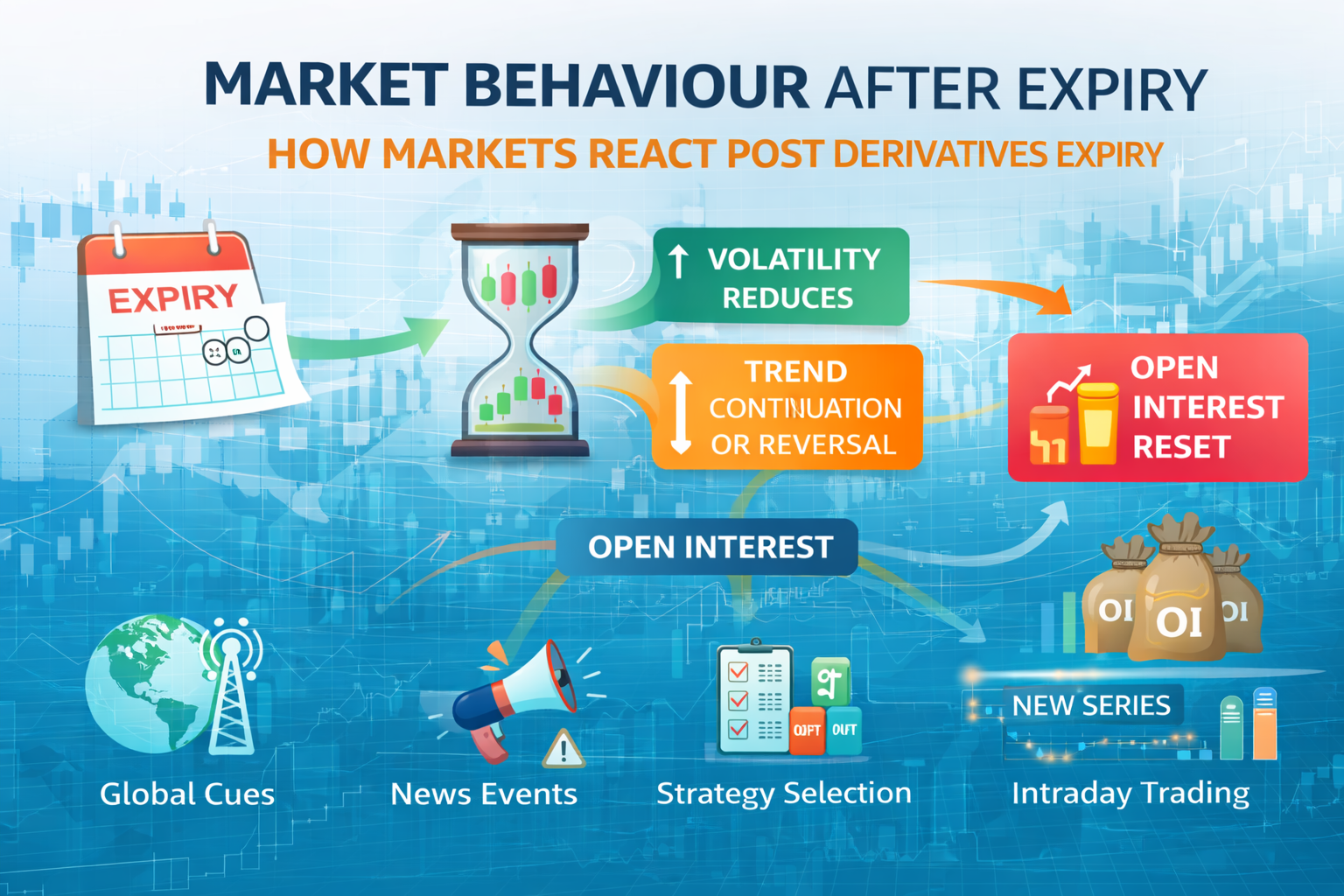
One of the most common things that happens after an expiration is that volatility goes down. On the day of expiration, there is usually a lot of volatility because positions are unwinding and rolling over. The market often settles down after contracts expire because new ones are made and there is less uncertainty. This calmer setting makes it easier for traders to spot clearer trends.
Trend continuation or reversal is another important part of behavior after expiration. If a strong trend was supported by new positions being built before the expiration date, the market usually keeps going in the same direction after the expiration date. However, if the trend was driven mainly by short-term positions or option writers, the market may reverse once those positions are settled.
Open interest reset plays a key role after expiry. Since old contracts expire, open interest drops sharply and then gradually increases as new positions are created in the next series. Tracking how open interest builds after expiry helps traders understand whether fresh money is entering the market or if the move lacks strength.
Market behaviour after expiry also depends heavily on global cues and news events. If important economic data, central bank announcements, or geopolitical news occur near expiry, the post-expiry market reaction can be strong and directional. In such cases, expiry acts as a base for the next major move.
For options traders, post-expiry behaviour is crucial for strategy selection. After expiry, option premiums are usually lower due to reduced implied volatility. This phase is often suitable for option buying strategies if volatility is expected to rise, or for carefully planned selling strategies once fresh trends are confirmed.
Understanding what happens after an expiration is also helpful for intraday traders. Prices move more technically than they do because of expiration in the new contracts, and liquidity usually gets better. This lets traders depend more on chart patterns, levels of support and resistance, and volume analysis.
From an investor's point of view, what happens in the market after expiry makes things clearer. The noise from derivative adjustments goes down, and price action shows real demand and supply. This helps long-term investors make better entry decisions.
In conclusion, market behaviour after expiry is a critical phase that offers valuable insights into future market direction. By observing volatility, open interest buildup, trend strength, and price action after expiry, traders can position themselves more confidently. Knowing how people act after an option expires can help you time the market better and trade less emotionally.