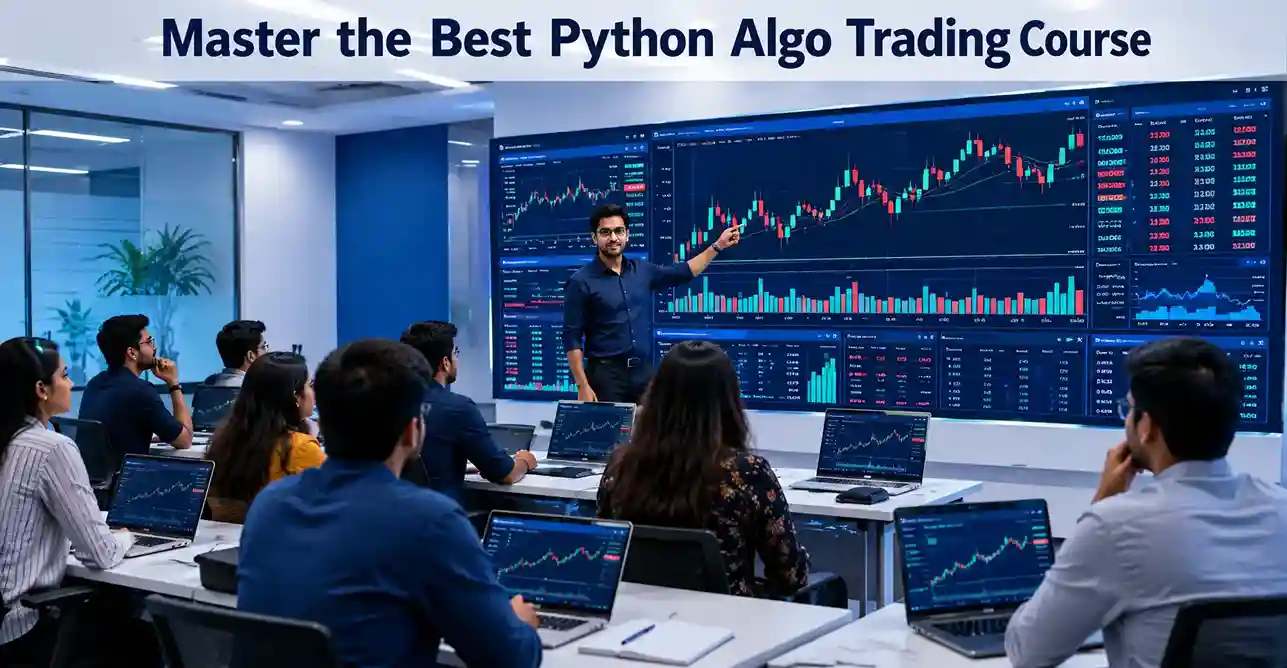
If you've typed "best Python algo trading course" into a search bar, you're probably past the "is algo trading interesting?" stage. You already know it's interesting — what you actually want to know is where to learn it properly, what a good course should teach, and whether it's realistic for someone like you to pick up Python and start building trading strategies from scratch.
That's exactly what this guide is for: No hype, no vague promises — just a clear look at what algorithmic trading with Python actually involves, and what separates a genuinely useful course from a surface-level one.
What Is Algorithmic Trading Really?
Algorithmic trading — algo trading, for short — is simply the practice of using code to execute trades automatically, based on pre-defined rules, instead of manually clicking "buy" or "sell" every time. Instead of watching a chart and reacting emotionally to every price move, you write a strategy once, test it thoroughly, and let the system execute it consistently.
Python has become the language of choice for this for a fairly simple reason: it's readable, has a massive ecosystem of data and finance libraries, and doesn't require a computer science degree to get productive with. That combination is exactly why "Python algo trading course" searches have grown so much among traders who are comfortable with markets but new to coding.
Why Are So Many Traders Searching for This Right Now?
A few things are driving this shift:
Manual trading has emotional limits. Even experienced traders make impulsive decisions under pressure. Algorithms don't get scared or greedy.
Markets move fast. Certain opportunities exist for seconds, not minutes — far too quick for manual execution.
Backtesting removes guesswork. With code, you can test a strategy against years of historical data before ever risking real money.
Python is genuinely approachable. Unlike older, more rigid programming languages, Python reads almost like plain English once you get past the basics.
If you're reading this, there's a good chance you fall into one of two camps: a trader who wants to stop trading on gut feeling, or someone with a bit of coding curiosity who wants to apply it somewhere concrete. Either way, a good course should meet you where you are.
Click NowWhat a Genuinely Good Python Algo Trading Course Should Cover
Not every course billed as "the best" actually earns that label. Here's what a solid curriculum should realistically include:
If a course leaves out backtesting or risk management and goes to advanced strategies that is usually a sign that the course is more about sounding good than actually teaching the student something that they can use. The course on strategies is not really focused on teaching the student, the advanced strategies course is trying to make itself sound impressive.
Do You Need to Be a Programmer to Start?
No — and this is probably the most common misconception holding people back. You don't need prior coding experience to begin learning Python for algo trading. What really makes a difference is
being comfortable with thinking in a way
actually wanting to learn about markets and how different plans work
having the patience to keep practicing all the time because coding and trading are things you get better at by doing them over and over, not just by memorizing things.
A good Python course for algo trading takes this into account by teaching you the basics of programming before it even gets to the trading part instead of assuming you already know a lot about technology.
A Simple Example of How This Comes Together
Let's say you have an idea for a strategy: buy a stock when its price goes above its 50-day moving average and sell when its price goes below that average again.
In trading you would have to look at the chart every single day yourself. In trading you write a short Python script that:
Pulls the stocks daily price data automatically
Calculates the 50-day moving average
Checks whether today's price crossed above or below the average
Places a buy or sell order automatically when the condition is met
Once written and tested with past data this same logic can run over and over again without you having to watch a chart all day. And more importantly, without feelings affecting the decision.
Steps to Start Learning Python Algo Trading
If you're serious about this, here's a realistic path:
Learn Python basics first. Don't skip this step even if you're eager to trade — shaky fundamentals cause frustration later.
Understand core market concepts. Order types, market data, and how exchanges function matter just as much as the code itself.
Practice with historical data. Get comfortable pulling and analyzing past price data before writing any live strategy.
Build simple strategies first. Start with something like a moving average crossover before attempting anything complex.
Backtest thoroughly. Never trust a strategy that hasn't been tested against real historical performance.
Paper trade before going live. Simulate the strategy with fake capital to catch execution issues before real money is involved.
Start small with real capital. Once confident, begin with limited capital and scale gradually as the strategy proves consistent.
Common Mistakes Beginners Make
A few patterns show up again and again among people newer to this space:
Overfitting strategies to past data. A strategy that looks perfect on historical data can fail badly in live markets if it was too finely tuned to that specific dataset.
Skipping risk management in code. A strategy without built-in stop-losses or position limits can compound losses quickly, especially when running unsupervised.
Jumping to complex strategies too soon. Advanced concepts like machine learning-based trading sound exciting, but they're far less useful without first mastering simpler, rule-based systems.
Ignoring transaction costs and slippage. A backtest that looks profitable can turn unprofitable once real-world costs are factored in.
Why Learn This Through a Structured Course Instead of Alone?
It's entirely possible to self-teach Python and algo trading through scattered tutorials and forums. Plenty of people do. But a structured course helps save a lot of time by:
Arranging ideas in an order instead of learning things in a random disconnected way
Giving guidance from a teacher on your code and how you think about problems finding errors before they turn into bad habits
Putting together coding skills and knowledge, about the market instead of looking at them as two separate things
Letting you work with real market data in practice instead of just using theoretical examples
This is the way ICFM India's Python-based algo trading program is built. Looking at coding and understanding the market as two parts of the same ability taught together instead of separately so students leave with strategies they really understand, not just code they copied.
Frequently Asked Questions
Do I need to know a lot about money to learn algo trading?
Not knowing about money helps. It is not necessary. A good course will teach you about the market and how to write code so anyone can learn, no matter what they did before.
Is Python the computer language for algo trading?
Python is a language for algo trading because it is easy to understand and there are many tools available to help you work with money and numbers.
How long will it take to learn Python algo trading?
Most people can learn the basics of Python algo trading in a month if they practice every day but it takes longer to become really good at creating trading plans and managing risk.
Can algo trading be used for intraday trading specifically?
Yes algo trading is often used for trading during the day because it can make trades faster and more consistently than a person can.
Is backtesting enough to guarantee a strategy will work?
No testing of a trading plan shows how it worked in the past but the market is always changing. There is no way to know for sure if it will work in the future.
Do I need to know how to write code before I take a Python algo trading course?
No, most courses will teach you the basics of Python so you do not need to know how to write code before you start even if you have never written code before.
Final Thoughts
Learning Python for trading is not about becoming a professional software developer. It is about getting enough coding ability to turn trading ideas into systems that work consistently and can be tested instead of being based on emotions. The traders who get the most out of this are not always the technically skilled; they are the ones who learned the basics properly, practiced every day and always paid attention to managing risk.
If you're ready to build this skill set with structured, mentor-guided learning rather than piecing it together from scattered tutorials, ICFM India's Python algo trading course is designed to take you from the basics of coding all the way to building and testing your own trading strategies with real market data.
Disclaimer: The information here is meant to help people learn. It is not meant to be taken as advice on how to invest or manage your money. Trading with computers can be risky. There is no way to be sure you will make money. You should always look into things on your own before you sign up for a class or make decisions about trading.