
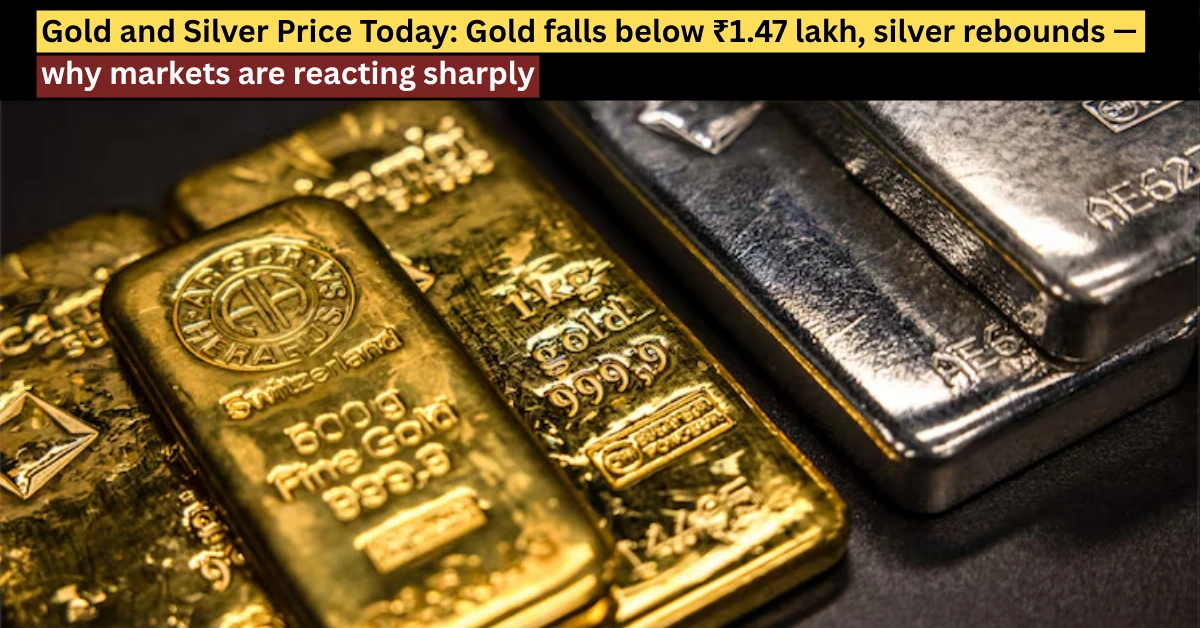
Gold price today in India (30 March 2026) has sharply corrected, with MCX gold price falling below ₹1.47 lakh and losing nearly 16% this month — the steepest fall since 2008. Today's silver prices are recovering attempts and remain volatile as rising crude oil prices due to Middle East tensions, strong US dollar, and US Fed rate cut expectations are driving the decline.
What Is Happening in Gold Price Today — Latest Market Update
Gold price today opened under pressure and continued to weaken in early trade, reflecting strong global selling cues. MCX gold rate for June expiry slipped below the crucial ₹1.47 lakh level and touched an intraday low near ₹1,44,212, confirming that the current move is not a minor dip but a strong corrective phase.
Simultaneously, today's silver prices exhibited a different structure. Following an initial drop, silver regained ground and moved higher during the session, demonstrating that while the sentiment for bullion remains weak, emerging selective buying interest at lower levels.
Live Gold and Silver Price Data (30 March 2026):
| Indicator | Value | Market Insight |
| MCX Gold (June) | ₹1,46,850 | Trading below ₹1.47 lakh |
| Gold Intraday Low | ₹1,44,212 | Sharp selling pressure |
| MCX Silver | ₹2,28,829 | Recovery after early dip |
| Spot Gold | ~$4,439/oz | Global weakness persists |
| Spot Silver | ~$68–69/oz | Volatile recovery |
This confirms that gold price today in India is reacting directly to global macro signals rather than local demand.
Why Is Gold Price Falling Today Despite US–Iran War
The biggest question right now is clear: why gold is falling even during geopolitical tension. Traditionally, gold rises during war or crisis, but the current market is behaving differently.
Increased global inflation concerns have bee as a result of the ongoing US–Iran conflict and rise of crude oil prices. Importantly, this situation has not supported gold. Instead, the conflict has shifted expectations towards central bank policies. The US Federal Reserve is expected to maintain interest rates higher for longer, with a lower probability of rate cuts.
Additionally, the US dollar has increased in value, reducing global gold demand and making gold more expensive. As a result of interest rates, there is an increase in the attractiveness of yield-generating assets. Gold is a non-yielding asset, so higher interest rates diminish the attractiveness of investing in gold.
This combination of war-driven inflation + strong dollar + high interest rates is the core reason why gold price today is falling despite global uncertainty.
How Gold Price Behavior Has Changed From Past to Present
During difficult periods in the economy, such as crises, inflation, and global unrest, gold has proven itself time and again as a safe-haven asset, recording price increases in such times. Gold tends to spike in price in times of geopolitical conflict and economic downturns and has done so in previous market cycles.
However, the current situation in March 2026 shows a structural shift. Gold prices have fallen nearly 16% in a single month, marking the biggest decline since 2008. This indicates that monetary policy expectations are now dominating traditional safe-haven demand.
Past vs Present Gold Market Behavior:
| Phase | Gold Trend | Key Drivers |
| Historical Trend | Bullish in crises | Safe-haven demand, inflation hedge |
| March 2026 | ~16% fall | Strong dollar, high interest rates |
| Current MCX Price | ₹1.46–₹1.47 lakh | Breaking key support |
This clearly shows that gold market dynamics in 2026 are different from previous cycles.
Who Is Driving Gold Price Movement Right Now
The current movement in gold price today is being driven primarily by global institutions, currency markets, and central bank expectations rather than retail investors.
The strength of the US dollar, the changing outlook of the Federal Reserve, and the increasing price of crude oil are impacting the gold market. Large institutional flows in response to these macros are keeping gold prices under pressure.
This is why the current market feels different — it is driven by global macro forces rather than traditional demand patterns.
How Other Markets Are Reacting — Bitcoin, Rupee & Global Signals
This is not just a gold story. The entire financial market is reacting to the same macro triggers.
Currently, Bitcoin prices are trading near a technically sensitive area of $66,000–$67,000, where a ‘death cross’ presents a short-term weakness scenario, but also a potential for large moves due to extreme short positioning.
At the same time, following regulations in position limits in foreign exchange, the Indian rupee has also appreciated, going toward 93.58 per US dollar, which adds complexity to the layers of relationships among currencies and commodities.
Global markets are adjusting to:
- Higher inflation expectations
- Reduced chances of Fed rate cuts
- Rising energy prices
This multi-asset reaction is what makes the current situation a complete market shift, not just a commodity correction.
Where Are Key Levels for Gold Price and Silver Price
From a structural perspective, MCX gold price is currently trading near a crucial support zone. The ₹1,44,000–₹1,47,000 range is now critical for short-term direction.
Key Levels to Watch:
| Asset | Support | Resistance | Outlook |
| Gold (MCX) | ₹1,44,000 | ₹1,49,000–₹1,50,000 | Cautious to bearish |
| Silver (MCX) | ₹2,20,000 | ₹2,32,000 | Volatile recovery |