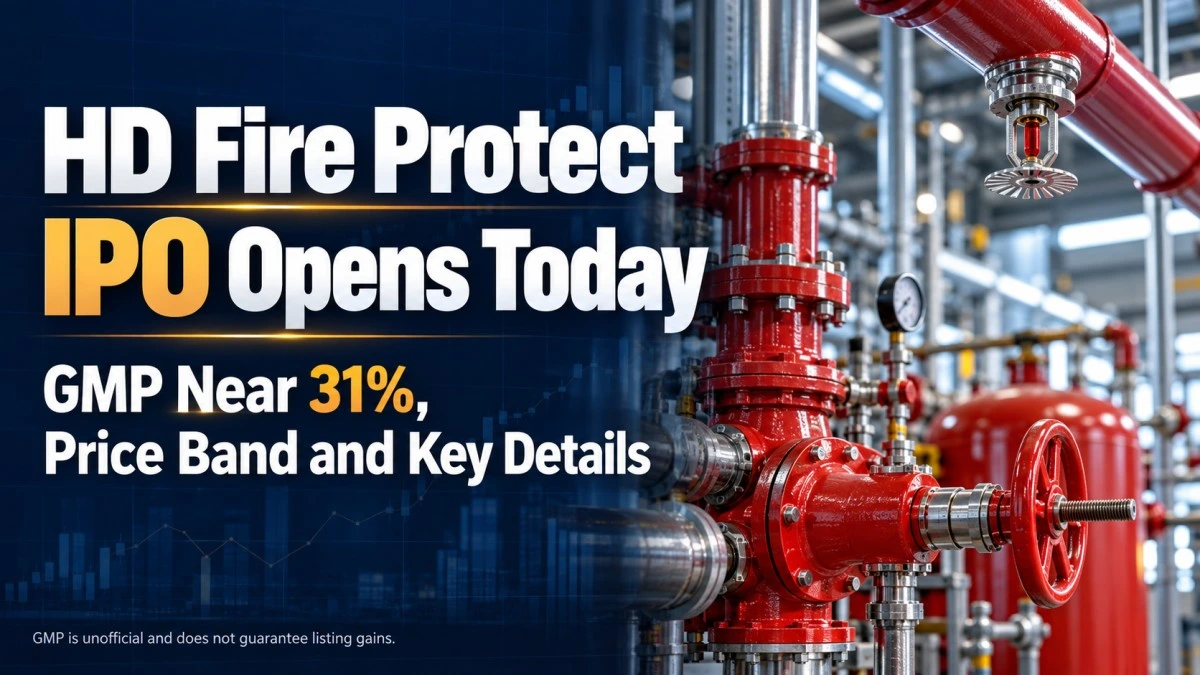
HD Fire Protect's ₹712.31 crore initial public offering opened for subscription today, October 13, 2026, at a price band of ₹258–₹271 per share, and closes on October 15. InvestorGain's grey market tracker showed a premium of ₹85, or 31.37%, at 9:37 a.m. IST today, down from ₹86. That figure is unofficial and can change by the hour. Because the issue is entirely an offer for sale by the promoters, the company receives none of the money raised.
HD Fire Protect IPO in brief (as of 11:30 a.m. IST, October 13, 2026)
- Dates: opens October 13, closes October 15; listing expected October 21 on BSE and NSE
- Price and lot: ₹258–₹271 per share; 55 shares, or ₹14,905, per lot at the upper band
- Size and structure: ₹712.31 crore, entirely an offer for sale by the promoters
- GMP: ₹85 (31.37%) at 9:37 a.m., per InvestorGain; unofficial and not a forecast
- Valuation: about 40.7 times FY2026 earnings at the upper band
What are the HD Fire Protect IPO key details?
All figures below come from the Red Herring Prospectus (RHP) dated October 5, 2026, as reported by brokerages and IPO trackers. Dates after October 15 are tentative.
| Detail | Information |
| Subscription window | Tuesday, October 13 to Thursday, October 15, 2026 |
| Price band | ₹258–₹271 per share (face value ₹5) |
| Lot size | 55 shares |
| Minimum retail application | ₹14,905 at the upper band (₹14,190 at the lower band) |
| Maximum retail application | 13 lots, or 715 shares (₹1,93,765 at the upper band) |
| Shares offered | 2,62,84,500 equity shares |
| Issue size | ₹678.14 crore at the lower band; ₹712.31 crore at the upper band |
| Issue structure | 100% offer for sale (OFS) by the promoters; no fresh issue |
| Selling shareholders | Harish Narshi Dharamshi (89,83,700 shares) and Kusum Harish Dharamshi (1,73,00,800 shares) |
| Reservation | QIB up to 50% of the net offer, NII at least 15%, retail at least 35%; employee portion up to ₹1.75 crore at a ₹25 discount |
| Anchor book | ₹213.11 crore raised on October 12: 78.64 lakh shares at ₹271 |
| Market capitalisation at upper band | ₹4,748.73 crore |
| Promoter holding | 100% before the IPO; about 85% after |
| Lead managers | Ambit, Anand Rathi Advisors, IIFL Capital Services |
| Registrar | MUFG Intime India |
| Listing | BSE and NSE; expected Wednesday, October 21, 2026 |
On the issue size. Some reports, including copy circulated before the opening, put the issue at ₹712.1 crore or ₹712.13 crore. The ₹712.31 crore figure is the product of 2,62,84,500 shares and ₹271, and it is the figure Groww, Chittorgarh and IPO Ji attribute to the RHP. The basis of the lower figure is not stated; the gap of about ₹0.18 crore is close to the cost of the ₹25 employee discount, but we could not confirm that. This article uses ₹712.31 crore.
On the listing date. Several sources, including Zerodha, Chittorgarh and IPO Ji, list October 21. A few trackers show October 20. The RHP timetable governs; treat any date after the issue closes as tentative.
Click NowWhat are the key takeaways for investors?
- The money goes to the promoters, not the company. The entire ₹712.31 crore is an offer for sale, so HD Fire Protect raises no new capital.
- The grey market premium is high but unofficial. InvestorGain showed ₹85 (31.37%) at 9:37 a.m. on October 13. Grey market quotes are unregulated and have often diverged from listing prices.
- Growth is steady, margins are strong, profit growth slowed. FY2026 revenue from operations rose 13% to ₹489.28 crore, while profit after tax rose 6.4% to ₹116.79 crore.
- The price is not cheap on paper. At ₹271, the issue values the company at about 40.7 times FY2026 earnings and 12.6 times book value.
- The risks are specific and disclosed. Exports to the Middle East, supplier concentration, two plants in one state and product liability are among the risks listed in the RHP.
What is the HD Fire Protect IPO GMP today, and what does it mean?
At 9:37 a.m. IST on October 13, InvestorGain showed a grey market premium (GMP) of ₹85 per share, or 31.37% over the ₹271 upper band. That implies an indicative listing price of about ₹356 and a notional gain of ₹4,675 per 55-share lot. The previous reading, ₹86 (31.73%), was logged at 8:02 a.m., before bidding began. The “nearly 32%” figure in some pre-opening reports reflects that earlier ₹86 quote.
| Date (IST) | InvestorGain GMP | Premium over ₹271 |
| Oct 13, 9:37 a.m. | ₹85 | 31.37% |
| Oct 13, 8:02 a.m. | ₹86 | 31.73% |
| Oct 12, end of day | ₹86 | 31.73% |
| Oct 11, end of day | ₹86 | 31.73% |
| Oct 10, end of day | ₹75 | 27.68% |
| Oct 9, end of day | ₹74 | 27.31% |
| Oct 8, end of day | ₹63 | 23.25% |
| Oct 7, end of day | ₹80 | 29.52% |
Source: InvestorGain GMP history. The 9:37 a.m. entry is as reported on InvestorGain's page on the morning of October 13; GMP pages update through the day, so check the timestamp before quoting it.
Three cautions apply. First, GMP is a quote in an informal, unregulated market, not an exchange price, and it has no regulatory standing. Second, it moves fast: InvestorGain logged quotes as low as ₹50 and as high as ₹90 within a single day on October 8. Third, trackers disagree. IPO Ji's page, for example, last showed ₹60 as of 6:00 a.m. on October 9. A premium today says something about short-term sentiment; it does not predict or guarantee the listing price, which depends on subscription demand and market conditions on October 21.
For a recent example of how far apart GMP readings can sit, see our analysis of the 14.87-point GMP gap between the SRIT India and Shah Investor's Home IPOs.
What does HD Fire Protect do, and who buys from it?
HD Fire Protect is a Mumbai-based maker of fire suppression equipment that uses water, foam or gas. Incorporated in April 1997, it sells across eight categories: sprinklers, alarm valves, deluge valves and systems, foam equipment, monitors and nozzles, water spray nozzles, custom-engineered systems and gas suppression systems.
Its customers are largely industrial and infrastructure buyers in oil and gas, refining, power, heavy engineering, aerospace, pharmaceuticals, data centres and warehousing. Both manufacturing plants are in Maharashtra, at Jalgaon and Thane, and house a fire test laboratory and an R&D unit.
A CRISIL report cited in the offer documents ranks it as India's second-largest fire protection equipment maker by revenue in FY2024 and the largest exporter in the segment. The same report projects the Indian fire protection equipment market at ₹16,500–17,500 crore by FY2030.
| Business metric (from the RHP) | Figure |
| Export share of revenue | 34.69% in FY2026; 32.78% in Apr–Jun 2026 |
| Countries served | 90+ since inception; 49 in Apr–Jun 2026 |
| Customers served in FY2026 | 2,066 |
| Revenue from repeat customers | Over 86% (FY2025) |
| Order book | ₹158.60 crore (June 30, 2026) |
| Product certifications | 21 UL Listed and 87 FM Approved, plus CE and ASME |
| Employees | 279 permanent and 253 contractual (June 30, 2026) |
The UL and FM approvals matter because refineries, insurers and export project buyers often require them before a product can be used. The company has also said it plans local manufacturing and trading in Saudi Arabia within one to two years with a shortlisted partner, subject to approvals.
How has HD Fire Protect performed financially from FY2024 to June 2026?
Revenue from operations grew at about 14.5% a year between FY2024 and FY2026, and profit after tax at about 15.3% a year. Growth was uneven, though: profit rose 24.8% in FY2025 but only 6.4% in FY2026.
| ₹ crore | FY2024 | FY2025 | FY2026 | Apr–Jun 2026 (3 months) |
| Revenue from operations | 372.95 | 432.80 | 489.28 | about 109 |
| Total income | 392.02 | 450.68 | 505.12 | 114.07 |
| EBITDA | 106.63 | 138.01 | 150.46 | 29.73 |
| EBITDA margin | 28.6% | 31.9% | 30.8% | about 27% |
| Profit after tax | 87.92 | 109.72 | 116.79 | 23.87 |
| Net worth | 342.19 | 396.01 | 375.93 | not disclosed in sources reviewed |
Source: restated financials in the RHP dated October 5, 2026, as compiled by IPO Ji and Chittorgarh. Margins for FY2024, FY2025 and Apr–Jun 2026 are our calculations on revenue from operations; the RHP states the FY2026 EBITDA margin as 30.75%.
Three points are worth a closer look in the RHP:
- Margins dipped in FY2026. EBITDA margin eased from about 31.9% to 30.8%, which is why profit grew more slowly than revenue.
- Other income is meaningful. The gap between total income and revenue from operations was ₹15.84 crore in FY2026, equal to about 14% of that year's profit after tax.
- Net worth fell in FY2026 by about ₹20 crore even though the company earned ₹116.79 crore. That implies distributions or other reductions of roughly ₹137 crore during the year. The sources we reviewed do not explain the movement; the RHP's financial statements should.
The Apr–Jun 2026 figures cover one quarter and should not be multiplied by four, since project-based order flow can make quarters uneven. The RHP reports FY2026 return on equity of 30.17% and return on capital employed of 40.33%.
How can you learn to read an IPO before you apply?
The questions this article raises, such as why net worth fell, how much of profit comes from other income and whether 40 times earnings is reasonable, are answered in the RHP. The document runs to hundreds of pages, but reading one well takes practice, not a finance degree.
ICFM India has trained stock market learners in Delhi since 2010. Its programmes teach the skills an IPO application calls for: reading financial statements, comparing valuations with listed peers, understanding issue structures and managing risk.
- Certificate in Fundamental Analysis: balance sheets, profit and loss statements and valuation basics, the core of reading an offer document.
- Super Share Samrat (SSS): a full foundation across equity, derivatives, currency and commodity markets.
- Certified Pro Trader (CPT): advanced training with a live-market internship for those who want to trade professionally.
Classes run at the Laxmi Nagar centre in East Delhi and online, with weekend batches for working professionals. Courses are educational; ICFM does not give investment advice or promise returns. Book a free one-on-one session to find the course that fits your level.
How expensive is the HD Fire Protect IPO at ₹271 a share?
At the upper band, the IPO values HD Fire Protect at ₹4,748.73 crore. Because no new shares are issued, the share count stays at about 17.52 crore and earnings per share do not change after listing.
| Metric | At ₹258 | At ₹271 |
| Market capitalisation | ₹4,520.93 crore | ₹4,748.73 crore |
| P/E on FY2026 EPS of ₹6.66 | 38.7x | 40.7x |
| Price-to-book on FY2026 NAV of ₹21.45 | 12.0x | 12.6x |
No listed Indian company is a pure fire protection business, so the RHP compares HD Fire Protect with industrial equipment makers:
| Company | P/E in RHP |
| Azad Engineering | 145.65x |
| KSB | 55.68x |
| Ingersoll-Rand (India) | 51.39x |
| Elgi Equipments | 44.70x |
| HD Fire Protect (at ₹271) | 40.7x |
| Kirloskar Pneumatic | 17.18x |
Peer P/E figures are as stated in the RHP, based on September 30, 2026 closing prices and FY2026 diluted EPS (calendar 2025 for KSB), per IPO Ji's RHP summary.
On this set, HD Fire Protect is priced below four of five peers. The comparison is loose, though: these companies make pumps, compressors and aerospace parts, and their multiples reflect different growth rates and end markets. A fairer test is whether 6.4% profit growth in FY2026, or about 15% a year over two years, supports a multiple above 40. That judgement is for each investor to make after reading the RHP's basis for offer price section.
Why does the offer-for-sale structure matter?
In a fresh issue, the company creates new shares and keeps the money to repay debt, build capacity or fund growth. In an offer for sale, existing shareholders sell their own shares and take the proceeds. HD Fire Protect's IPO is entirely the second kind: promoters Harish Narshi Dharamshi and Kusum Harish Dharamshi are selling 2,62,84,500 shares, and their combined holding falls from 100% to about 85%.
An OFS is common and not a warning sign by itself. Promoters often sell part of a stake to list a company and create a public market for its shares. It does mean three things for an applicant:
- The IPO does not fund any expansion, including the planned Saudi Arabia venture. Growth has to come from the company's own cash flows or future borrowing.
- Existing shareholders' earnings per share are not diluted, which is why the P/E above is the same before and after listing.
- The price is set by sellers who know the business far better than buyers do. That makes the valuation question more important, not less.
Institutional demand gives one outside view. On October 12, the company allotted 78.64 lakh shares at ₹271 to anchor investors for ₹213.11 crore, with domestic mutual funds taking about 71.88% of the anchor book, Goodreturns reported from the exchange circular. Half of the anchor shares are locked in for 30 days after allotment and the rest for 90 days.
What risks does HD Fire Protect disclose in its RHP?
The RHP's risk factors section begins on page 21. The risks below are drawn from it, as summarised by IPO Ji, with the reason each one matters.
| Risk | Why it matters |
| Product liability | Equipment that fails during a fire could lead to claims for loss of life or property, warranty costs and lasting damage to reputation. |
| Export and Gulf exposure | About a third of revenue comes from abroad, mainly the Middle East and the rest of Asia, so currency moves, conflict and trade curbs can hit results. |
| Supplier concentration | The ten largest suppliers accounted for 59.28% of total expenses in Apr–Jun 2026, with no long-term supply contracts. |
| Plant concentration | Both plants are in Maharashtra; a local disruption could halt output. |
| Certification renewals | Losing UL or FM approvals would restrict access to export and refinery customers. |
| Cyclical demand | Orders depend on capital spending in oil and gas, power and heavy industry. |
| Order visibility | The ₹158.60 crore order book equals roughly four months of FY2026 revenue, and sales run on short-term purchase orders. |
| Governance disclosure | The RHP notes that a former statutory auditor has become chief financial officer. |
Outstanding litigation is listed separately, from page 356 of the RHP.
What should you check before applying for the HD Fire Protect IPO?
- Read the basis for offer price (page 122 of the RHP) and decide whether 40.7 times FY2026 earnings fits a company whose profit grew 6.4% last year.
- Check the cash flow statement to see why net worth fell in FY2026 and how much of profit turned into cash.
- Weigh the export risk against your own view of the Gulf region and the rupee.
- Watch subscription by category on the NSE and BSE websites. Qualified institutional buyer demand, often concentrated on the final day, is a more direct signal than grey market quotes.
- Size the bid to your plan. One lot costs ₹14,905. Decide in advance whether you would hold the shares if they list below the issue price.
When are the allotment, refund and listing dates?
| Event | Date (2026) |
| Anchor bidding | Monday, October 12 (completed) |
| Issue opens | Tuesday, October 13 |
| Issue closes; UPI mandate cut-off 5 p.m. | Thursday, October 15 |
| Basis of allotment | Friday, October 16 (expected) |
| Refunds and demat credit | Monday, October 19 (expected) |
| Listing on BSE and NSE | Wednesday, October 21 (expected) |