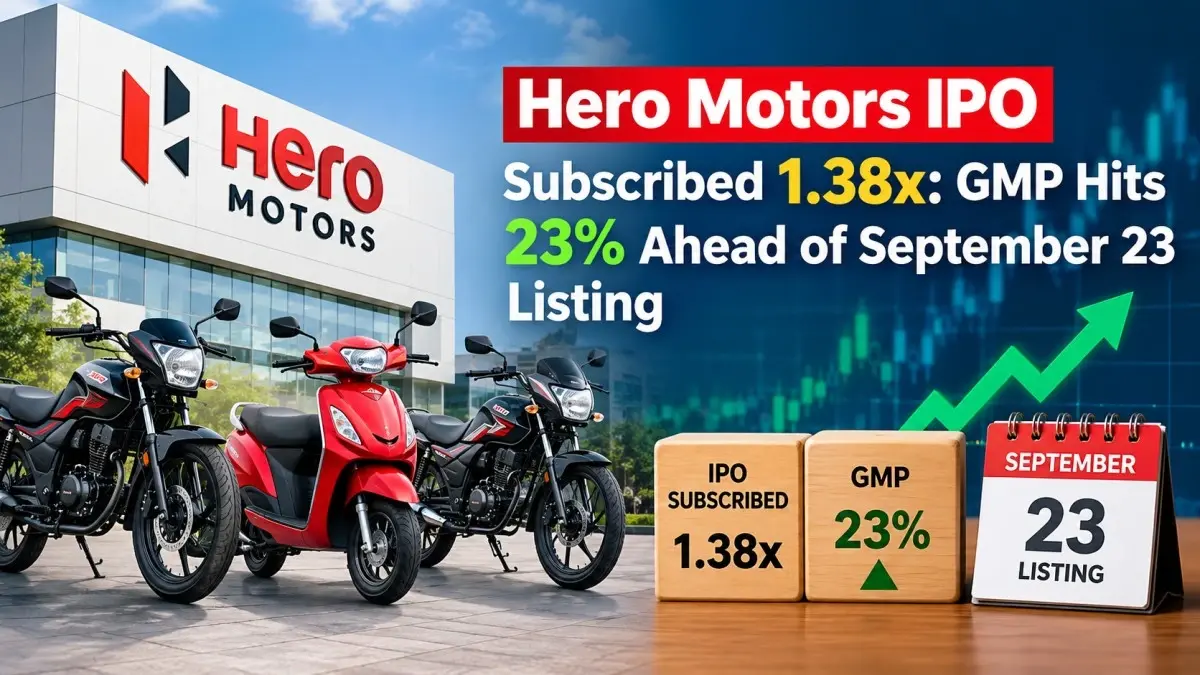
Hero Motors' ₹1,000-crore IPO closed oversubscribed at 1.38 times. Retail investors and non-institutional investors both came in at 2.23x. Grey market premium is at 23%. Listing is September 23.
Those are the headlines. What do the numbers actually mean for someone holding an allotment — or watching from the sidelines? Here's the full picture.
What 1.38x Subscription Really Tells You
The overall subscription of 1.38x will disappoint anyone expecting the fireworks that accompany a consumer tech listing. It shouldn't.
Hero Motors is a B2B precision components manufacturer. Its customers aren't retail investors following IPO buzz on Telegram groups. They're OEM procurement teams at BMW and Ducati. The investor audience for this kind of business is narrower, more deliberate, and less susceptible to subscription-day momentum trading.
So when the retail category comes in at 2.23x and NII matches that exactly, the correct read isn't modest demand. It's genuine, considered demand. Both groups, independently, landed at the same number. That doesn't happen by accident.
Here's the mechanical part: 1.38x overall means bids covered 138% of the shares on offer. The issue is oversubscribed — all categories that crossed 1x will see allotment proceed normally. The lower overall figure relative to retail and NII is explained by the QIB (qualified institutional buyer) quota, which represents the largest portion of most issues and follows its own subscription dynamic separate from the public portions.
A 23% GMP the Night Before Listing
The grey market is pricing Hero Motors shares at roughly ₹103 against an issue price of ₹84. That's a 23% premium — and while the grey market carries no regulatory status and zero legal protection, it's telling you something worth hearing.
What it's saying: the people willing to bet money in the unofficial market believe this stock lists above the issue price on September 23. They're not running for the exits. Sellers aren't capitulating at discounts. That absence of panic is actually as informative as any enthusiasm figure — in IPOs where the listing will disappoint, grey market sellers start moving aggressively in the days before listing.
How much weight should you put on 23% GMP? Directional weight, not definitive weight. Stocks with GMP in the 15–25% range before listing have historically shown better-than-average odds of listing near that mark. But the Nifty on September 23, FII activity that morning, and broader sentiment will ultimately price the opening. GMP sets the expectation. The market decides.
The Subscription Table Warrants a Second Look
| Category | Subscription |
| Retail Individual Investors (RII) | 2.23x |
| Non-Institutional Investors (NII) | 2.23x |
| Anchor Investors (pre-issue) | ₹300 crore raised |
| Overall | 1.38x |
Two categories, structurally different investor profiles, identical multiples. That's the unusual part.
Retail and NII don't naturally track each other. Different ticket sizes, different information access, different risk frameworks. NII — covering HNIs, family offices, and corporate treasuries — typically applies different logic than a retail applicant placing an ₹14,000 bid. When they arrive at the same multiple, it tends to mean the IPO made sense to both groups on its own merits, not because of narrative momentum or category-specific incentives.
Who Put ₹300 Crore In Before Anyone Else Could
Societe Generale, ICICI Prudential AMC, and 3P India Equity Fund anchored ₹300 crore before the issue opened to the public. That's 3.57 crore shares at ₹84 per share.
Anchor investors don't make allocation decisions lightly. Societe Generale is a French global investment bank with active India equity operations. ICICI Prudential AMC manages hundreds of thousands of crores in AUM. These aren't momentum traders. They're institutions with independent research teams, financial models, and allocation mandates they need to justify internally.
They're also locked in for 30 days post-listing, so there's no quick exit option. That lock-in is precisely why the pre-issue commitment carries signal value — it can't be a short-term flip.
The Business That Makes This IPO Different
BMW doesn't add a new transmission component supplier the way you'd add a vendor on a purchase order platform. The qualification process runs over months, sometimes years, covering quality audits, production capacity assessments, delivery track records, and engineering capability evaluations. Fail any part of it and the relationship doesn't start.
Hero Motors passed that process. For BMW, Ducati, Enviolo, Formula Motorsport, and HWA AG.
What the company makes — powertrains, e-drive systems, precision transmission components — sits inside some of the most demanding machines in the automotive world. These aren't commodity parts that get swapped between suppliers on price. And once you're qualified, switching costs are high on both sides: the customer doesn't rebuild its supply chain casually, and the supplier has invested substantially in understanding that customer's specifications.
For investors, that's the most attractive structural feature of this business. No advertising budget to manage. No dealer network margins under pressure. No domestic consumer sentiment to read every quarter. Revenue that flows from OEM contracts with companies that don't change suppliers on a whim.
The risk profile is different too, and worth understanding before comparing this to any consumer auto name. OEM production cycles, global demand for premium vehicles, and currency movements on export revenue all matter here in ways that don't apply to a domestic two-wheeler or passenger vehicle business.
IPO Structure at a Glance
| Parameter | Detail |
| Total Issue Size | ₹1,000 crore |
| Fresh Issue | ₹600 crore |
| Offer for Sale (OFS) | ₹400 crore |
| Price Band / Issue Price | ₹84 per share (anchor price)* |
| Anchor Shares Allotted | 3.57 crore |
| Anchor Capital Raised | ₹300 crore |
| Overall Subscription | 1.38x |
| Grey Market Premium (GMP) | ~23% |
| Listing Date | September 23 |
*₹84 is the anchor allocation price, typically set at the upper end of the price band. Verify the full floor-to-ceiling range from the company's DRHP filed with SEBI.
The split worth noting: the ₹600 crore fresh issue goes to Hero Motors for actual business use. The ₹400 crore OFS goes to selling shareholders, likely promoters or early-stage investors taking partial exits. That money doesn't touch the company's balance sheet.
Where the ₹600 Crore Is Actually Going
| Use of Proceeds | Allocation (₹ Crore) |
| Debt Repayment | 190 |
| Capital Expenditure (Gautam Buddha Nagar Expansion) | 200 |
| M&A and Strategic Acquisitions | Remaining balance |
| General Corporate Purposes | Remaining balance |
The ₹190 crore debt repayment is the least exciting line item and arguably the most important one. Every crore retired is a crore that stops accruing interest. The finance cost reduction flows directly to net profit margins, making the post-listing business immediately more profitable on paper than the pre-listing one. That matters for anyone running a valuation model.
The ₹200 crore capex is where the growth signal lives. Gautam Buddha Nagar is the company's primary manufacturing base. Expanding capacity here, at this scale, requires demand visibility that management must already have — contracted OEM order volumes, pending agreements, or credible pipeline commitments. Companies don't build factories speculatively when their customers are BMW and Ducati.
The remaining balance for M&A is optionality. It might mean a bolt-on acquisition in the next 18 months. It might sit on the balance sheet doing nothing for a year. Either way, preserving flexibility is standard practice for a newly listed company that wants to move quickly when the right opportunity surfaces.
Thinking About IPO Investing? Start With the Right Foundation.
Understanding the Hero Motors IPO requires more than reading subscription numbers. It requires knowing how to read a red herring prospectus, interpret GMP signals, evaluate anchor investor quality, assess use-of-proceeds disclosures, and place a company's financials in sector context.
ICFM India — India's Institute of Capital and Financial Market — teaches exactly these skills through structured programs in equity research, IPO analysis, derivatives, and financial markets. Their curriculum is built for the Indian market, taught by practitioners, and available at their Laxmi Nagar campus in Delhi and online.
Explore ICFM India's Programs → | Batches available in Delhi and online Click Now
Key Takeaways
- Overall subscription: 1.38x. Oversubscribed, with both retail and NII at 2.23x — a symmetry that reflects consistent, independent demand across investor types.
- GMP at 23%. Grey market pricing implies ~₹103 per share going into the September 23 listing.
- Anchor investors committed ₹300 crore pre-issue. Societe Generale, ICICI Prudential AMC, and 3P India Equity Fund are locked in for 30 days.
- ₹190 crore retires debt. Immediate balance sheet improvement from listing day.
- ₹200 crore funds the Gautam Buddha Nagar expansion. Signals forward demand commitments from existing OEM customers.
- Customer roster: BMW, Ducati, Enviolo, Formula Motorsport, HWA AG. B2B supply contracts with Europe's most demanding OEMs.
- This is not a consumer auto story. Different revenue drivers, different risk factors, different investor calculus.