What Just Happened to Infosys Share Price?
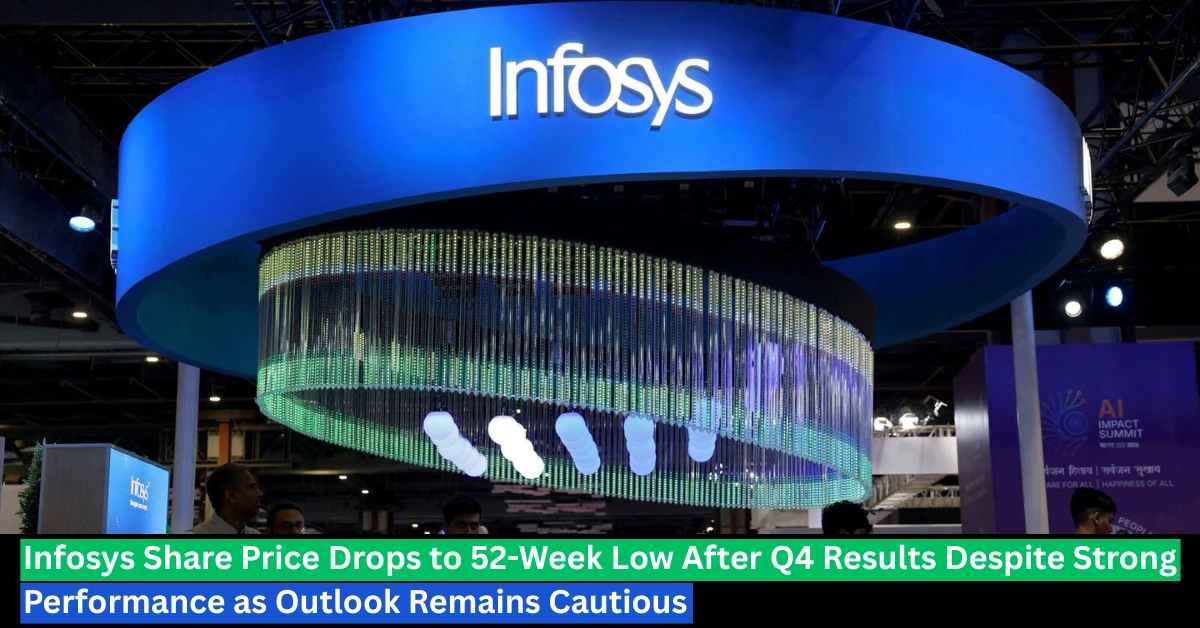
Infosys declined by nearly 3.5% and slipped to a 52-week low of around ₹1198 immediately after announcing its Q4FY26 results. The move was sharp, but more importantly, it came despite a quarter that did not show operational weakness.
Headline numbers are seldom focal when it comes to these kinds of reactions. More often, these are understood as a change in the market's interpretation of forward visibility. In this instance, the decline is a revision of growth expectations and not a reaction to current performance.
Not even the Indian markets were immune to this trend. During US trading, the company's ADR also fell, further demonstrating that this concern is structural and recognized globally, as opposed to being local and sentiment- driven.
What Did Infosys Deliver in Q4 and FY26?
Infosys went through Q4FY26 with a stable and disciplined quarter. Net profit grew year-on-year from last quarter to reach a record high of ₹8,501 crore. Revenues expanded to ₹46,402 crore. Furthermore, Segment profitability remained steady with improved margins at 21% year-on-year.
For the full financial year FY26, Infosys reported net profit of ₹29,440 crore. Furthermore, revenues grew to ₹1,78,650 crore. There was sustained growth with balance sheet stability and Evidence of stress execution was at the minimum.
A closer look, however, reveals early signals of moderation. Large deal wins for the quarter were reported at $3.2 billion, within the guided range but positioned toward the lower end. This does not indicate weakness, but it does suggest that demand is stable rather than accelerating.
Infosys Reported Performance (Key Numbers)
| Metric | Q4FY26 | Q4FY25 | YoY Change |
| Net Profit | ₹8,501 Cr | ₹7,033 Cr | +21% |
| Revenue | ₹46,402 Cr | ₹40,925 Cr | +13.4% |
| EBIT Margin | ~21% | ~21% | Stable |
| Large Deal Wins | $3.2 Bn | $2.6 Bn | Moderate |
The data confirms that execution remains intact. The issue, therefore, lies beyond the reported numbers.
Why Did the Market React Negatively?
The primary trigger was Infosys’ guidance for FY27, which projected revenue growth of 1.5% to 3.5% in constant currency terms. For a company of this scale, such guidance signals a phase of slower expansion.
Companies are appraised by the market based on the potential of their future earnings. Valuations are adjusted to the extent of the visibility of future growth. In this situation, the guidance stated there has been a cautious demand, therefore, expectations have adjusted.
Also, demand recovery has been slow. Spending has not collapsed, but there has been slower recovery. Clients have been slow to commit, deals have been converted slower, and discretionary spending has remained under pressure.
Market Interpretation vs Reported Reality
| Indicator | Reported Data | Market Interpretation |
| Profit Growth | Strong | Already factored in |
| Revenue Growth | Stable | Lacks acceleration |
| FY27 Guidance | 1.5–3.5% | Moderation in growth |
| Deal Wins | Lower range | Demand not expanding |
| Global Sentiment | ADR decline | Broad-based concern |
This gap between performance and expectation explains the price correction.
What Structural Shift Is Happening in the IT Sector?
The reaction to Infosys is not an isolated event. It reflects a broader structural transition within the IT services industry.
Increasingly rapid technological progress means that artificial intelligence is going to become even more prevalent. Though artificial intelligence reduces costs of delivery and increases efficiency, it shrinks traditional revenue models that scaled on labor. This leads to a paradox where companies are able to achieve efficiency but are constraint by slow growth.
Simultaneously, client behavior is changing. Global companies are focusing more on optimization of their businesses as opposed to growth. Businesses have started to focus more on a set delivery outcome as opposed to growth. This leads to lengthened time of delivery as well as lower technological budgets.
Increased competitive pressure falls more apparent on pricing. Focusing more on the value as well as the specific businesses being optimized forces companies to be more selective of which businesses they will pursue. This leads to a more constrained growth, as there is a lack of new contracts being added to the company’s portfolio. This is in conjunction with a strategic shift to more higher-margin contracts.
Structural Shift in IT Services (Data-Driven Insight)
| Factor | Current Trend | Business Impact |
| AI Adoption | Rapid | Lower billing intensity |
| Client Spending | Conservative | Slower deal closures |
| Pricing Dynamics | Competitive | Margin pressure |
| Deal Strategy | Selective | Better quality, lower volume |