
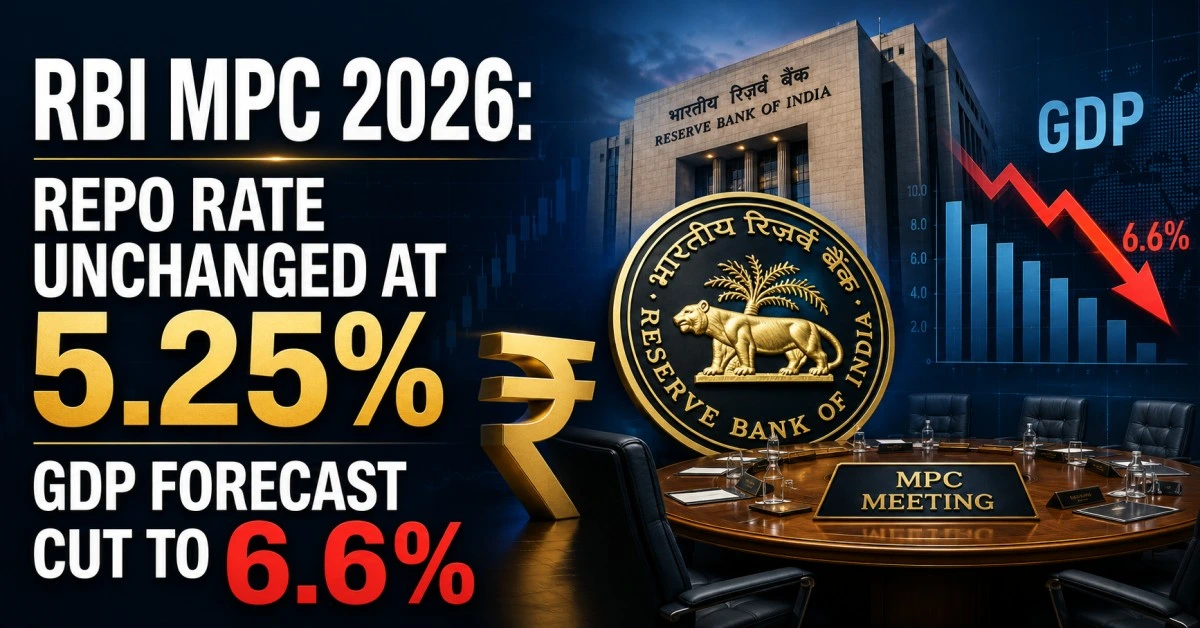
The Reserve Bank of India’s June 2026 Monetary Policy Committee meeting has become a key milestone for Indian stock market participants, including banks, borrowers, and investors. The RBI kept the repo rate unchanged at 5.25%, and maintained its policy stance at neutral. However, the more important aspect of this meeting was the central bank’s revisions regarding its outlook on growth and inflation.
RBI cut India’s FY27 GDP growth forecast to 6.6% from 6.9% earlier. At the same time, it raised the FY27 CPI inflation forecast to 5.1% from 4.6%. This shows that the central bank is now becoming more careful about inflation, crude oil prices, rupee pressure and global uncertainty.
The June 2026 RBI MPC meeting took place amidst a more difficult macroeconomic setting. There are multiple reasons this time. The tensions in West Asia, high crude oil prices, rupee depreciation as a result of foreign fund withdrawals, concerns of heatwaves and weak monsoons have all created even more uncertainty for the Indian economy.
What Happened in RBI MPC Meeting 2026?
RBI’s Monetary Policy Committee chose to keep repo rates at 5.25%, with all members in agreement. RBI chose to keep their neutral stance. This means that the central bank is not moving towards either rate cuts or rate hikes.
Choosing a neutral stance provides RBI with a choice of options. If inflation does rise abruptly, RBI has the option of taking a stricter view. If inflation drops and growth requires aid, RBI would have the option of implementing a softer policy stance.
The meetings took place between June 3rd and June 5th, with the policy decision announced on June 5th, 2026. RBI Governor Sanjay Malhotra stated that the RBI would remain dependent on the data and continue to observe inflation, growth, liquidity and the conditions on a global level.
Why Did RBI Keep Repo Rate Unchanged?
RBI opted to maintain the repo rate due to the need for stability in the present environment. The repo rate hike impact on inflationary expectations and the rupee’s exchange rate may have made the option attractive, but the increase would have made the cost of some loans and business borrowing higher.
The repo rate decrease option was also unattractive due to the risks which inflation poses. The prices of crude oil and the depreciation of the rupee and LPG and rising base metal, plastic, rubber and other input costs also add pressurized inflation, for example.
RBI’s pause was an appropriate response. The central bank will monitor and assess before determining the appropriate next course of action.
How Did RBI Change GDP and Inflation Forecasts?
The most important part of the June 2026 RBI policy was the change in growth and inflation estimates. RBI lowered its FY27 GDP growth forecast and raised its inflation projection.
| RBI MPC June 2026 Update | Earlier Estimate | Latest Estimate |
| Repo Rate | 5.25% | 5.25% |
| Policy Stance | Neutral | Neutral |
| FY27 GDP Growth | 6.9% | 6.6% |
| FY27 CPI Inflation | 4.6% | 5.1% |
| Forex Reserves | — | $682.3 billion |
| System Liquidity | — | ₹2.63 lakh crore surplus |
This revision suggests that RBI anticipates the Indian economy will remain steady, albeit with increased inflation and global-risk-related pressures. While a GDP projection of 6.6% suggests robust growth, a reduction from 6.9% indicates a more conservative approach from the central bank.
Why Are Inflation Risks Rising?
Multiple systems are now reaching breaking points which means the risk of inflation continues to grow. The price of crude oil is on the rise due to the conflicts currently affecting the West Asian region. As India is a country that needs to import large quantities of crude oil, the costs of fuel, transportation and importing overall will increase.
If the rupee continues to fall, the buying power is further reduced and the cost of imports will rise. This will directly influence all sectors of the economy, especially those that rely on the imported raw materials and other inputs.
Forecasting changes in weather patterns is complicated. Heatwaves, the developing El Niño and below-average rain during the Monsoons will all impact food prices. RBI is most concerned with food price inflation as it will have the most immediate impact on the household budgets of consumers. As such, he will closely monitor the progress of the Monsoons and food supply.
How Can This RBI Policy Affect the Stock Market?
The RBI policy presents a mixed bag for the stock market. The pause in the repo rate is a positive development since the cost of borrowing will not increase. It is expected that rate-sensitive sectors such as banking, real estate, autos, consumer durables and infrastructure will benefit.
The forecast downgrade in GDP with an upward revision in inflation may keep the investing community on edge. Crude oil prices, rupee fluctuations, bond yields and foreign institutional investor behavior and earnings will take precedence. Click Now
Banking stocks will be in focus since a change in interest rate and liquidity will affect credit growth and margins. Real estate and auto stocks will also be in focus since stable rates would sustain demand. Other sectors will suffer if the rupee weakens or commodity prices increase since they depend on imported inputs.
Learn Market Reactions with ICFM India
Market volatility can be influenced by various factors such as RBI policies, inflation data, repo rate changes, and global signals. However, assessing the reasoning behind stock market movements extends beyond simply reading the papers. It is vital for traders and aspiring professionals to have an understanding of price action, chart patterns, and market psychology along with sector movements and risk management.
At ICFM India, we focus on helping our students build real and practical stock market knowledge. We have developed a systematic approach to teaching Technical Analysis, Chart Reading, and Market Behavior. Our courses can teach you how to interpret market movements based on RBI MPC decisions to gauge the effect on Nifty, Bank Nifty, and how other market sectors will respond.
How Can RBI Policy Affect Bank Nifty?
After the RBI policy, Bank Nifty could experience further volatility. A repo rate pause could be seen positively in banking, as borrowers won’t feel an immediate rate hike. Constant rates could improve credit as well.
However, the inflation forecast rises, and the RBI would be slow to consider a decreasing rate policy. Should inflation continue to rise, the market would likely expect a hawkish RBI.
For traders, Bank Nifty should be particularly noted along with bond yield, the rupee-dollar trends, crude prices, and FPI. These factors would be greater determinants for market direction rather than the repo rate headline.
What Does This Mean for Home Loan and EMI Borrowers?
For home loan, car loan, and personal loan borrowers, the repo rate pause offers some temporary positive effects. Since the repo rate has not gone up, we may not see an uptick of EMIs for loans which are associated with external benchmark rates.
However, just because the repo rate has not gone up, does not mean that interest rates are going down. The RBI has held a neutral stance and raised the inflation outlook which means that interest rates will follow the inflation, crude prices, steadiness of the rupee, and the state of the economy.
It is best to keep some level of financial safety net and not take out huge loans, assuming that interest rates will be going down.
What Measures Were Announced to Attract Dollar Inflows?
The RBI and the government made additional announcements regarding support to dollar inflows and for the external sector. With the rupee under pressure and net outflows of foreign portfolio investors for FY27 to date, these announcements come at an important juncture.
The government announced the exemption of eligible foreign institutional investors and the Bank for International Settlements from capital gains tax for interest income from and the sale of government securities, subject to certain conditions. The exemption comes into effect from 1 April 2026.
The RBI also announced measures to enhance the attractiveness of Indian government securities to foreign investors. New issuances of 15-year, 30-year and 40-year government securities will be routed under the Fully Accessible Route. The RBI also announced the relaxation of some of the existing limits on FPI investments in government securities under the General Route.
The central bank also announced an increase in the investment limits for NRIs and OCIs and extended the same to natural persons residing outside India. The RBI also announced a preferential forex swap facility up to 30 September 2026 to promote external commercial borrowings by public sector undertakings.
RBI’s measures indicate a multi-pronged approach with regard to interest rates and foreign inflows, in addition to the stability of the currency and the management of external sector inflation.
Why Are Forex Reserves Important Now?
RBI Governor Sanjay Malhotra has maintained that India’s foreign exchange reserves provide a solid cushion against external volatility. On May 29, 2026, India’s forex reserves were noted to be at $682.3 billion.
Strong foreign reserves give the RBI the ability to manage volatility as well as external pressure on the balance of payments. As crude oil prices rise and foreign investments exit, strong foreign reserves give the RBI the ability to manage the market.
This becomes more important when the rupee is under pressure and there is high uncertainty in the world.
Who Should Watch This RBI Policy Closely?
Stock market investors must monitor this policy since it impacts liquidity, anticipated interest rates, and sector shifts. Banking, real estate, auto, FMCG, infrastructure, oil, aviation, and logistics stocks may behave differently based on the interaction of inflation and oil price trends.
Loan borrowers must monitor this policy, since repo rate decisions will impact EMI. A pause is a relief, and subsequent rate decisions are not predictable.
Business owners must monitor RBI commentary. Input prices, currency, and borrowing costs can impact business planning.
The ranges of Bank Nifty, rupee price, oil price, bond yields, and foreign investors must all be followed. These are more useful after RBI policy.
Click NowWhat Should Investors Watch Next?
Investors must track CPI inflation statistics, crude oil, rupee-dollar valuations, monsoon updates, FPI flows, bond yields, and corporate earnings commentary.
Improving sentiment may be possible with declining crude oil prices, and an appreciating rupee. Further inflation increases may lead to an FS more proactive at coming policy meetings.
An over-reliance on individual news to make an investment decision must be avoided. RBI policy must be analyzed with earnings, valuation, based on the sector and the risk position.
What Is the Final Takeaway from RBI MPC 2026?
The June 2026 RBI MPC decision conveys a message that is both careful and balanced. With the repo rate held at 5.25%, markets and borrowers can expect short-term stability. A reduction in the GDP forecast and a higher inflation forecast indicate that the RBI is preparing for increasingly difficult situations.
From a stock market perspective, the policy creates room for stability in the short-run, particularly in the policy rate-sensitive segments. Taking into consideration inflation, crude oil, the weakening rupee, and the overall global uncertainty, the market will likely experience volatility.
For borrowers, stability in EMIs will continue, but future actions on the rate will be contingent on the level of inflation. For all other stakeholders, the message is clear: data over headlines.
In summary, the policy shows that the RBI does believe there is some room for short-term stability, especially in the more rate-sensitive segments of the market; however, it believes there will be increased volatility in the more inflation-sensitive segments of the market.
Disclaimer: This article is for educational and informational purposes only. It is not investment, trading, loan or financial advice. Stock market trading and investing involve risk. ICFM India provides education only and does not guarantee profit, returns, income, job placement or trading success.
FAQs on RBI MPC Meeting 2026
What was the RBI MPC decision in June 2026?
RBI kept the repo rate unchanged at 5.25% and maintained a neutral policy stance in its June 2026 MPC meeting.
Why did RBI keep the repo rate unchanged?
RBI left the repurchase rate unchanged in striving to achieve a balance between risks to inflation and growth. Increasing the rate may negatively impact demand, and a decreasing the rate is inappropriate in the presence of elevated risks to inflation.
What is RBI’s latest FY27 GDP forecast?
RBI lowered India’s FY27 real GDP growth forecast to 6.6% from 6.9% earlier.
What is RBI’s latest FY27 inflation forecast?
RBI raised its FY27 CPI inflation forecast to 5.1% from 4.6% earlier.
Is the RBI repo rate pause good for the stock market?
Since borrowing costs won’t be increasing in the short term, the repo rate pause can contribute to a more positive market sentiment. Still, markets may remain on the defensive due to the increasing inflation rate and decreasing GDP forecasts.
Will home loan EMIs increase after this RBI policy?
Because the repo rate remains unchanged, there will most likely not be any imminent increase in EMI for loans that are linked to external benchmarking rates. Changes to the EMI in the future will be contingent on the policy decisions made by the RBI and the changes to the rates as decided by the banks.
Why is crude oil important for RBI policy?
Crude oil is vital to India because a sizable quantity of imports is required to fulfill the domestic oil needs. An increase in crude oil prices can lead to high inflation, a higher import bill and greater depreciation of the rupee.
How can RBI policy affect Bank Nifty?
Through interest rates, liquidity, credit growth, deposit costs, and bond yields, Bank Nifty policy will be influenced by the RBI policy. A pause on interest rate hikes might help market sentiment, but inflation will keep banking shares under pressure.
What measures were announced to attract dollar inflows?
RBI and the government announced measures applicable to foreign investments in government securities, including tax concessions to qualified foreign investors, increased investment limits, and forex swap assistance.
What should investors track after RBI MPC 2026?
Investors should pay attention to inflation, crude oil prices, currency exchange rates, interest rates, foreign investments, the monsoon, and corporate earnings.