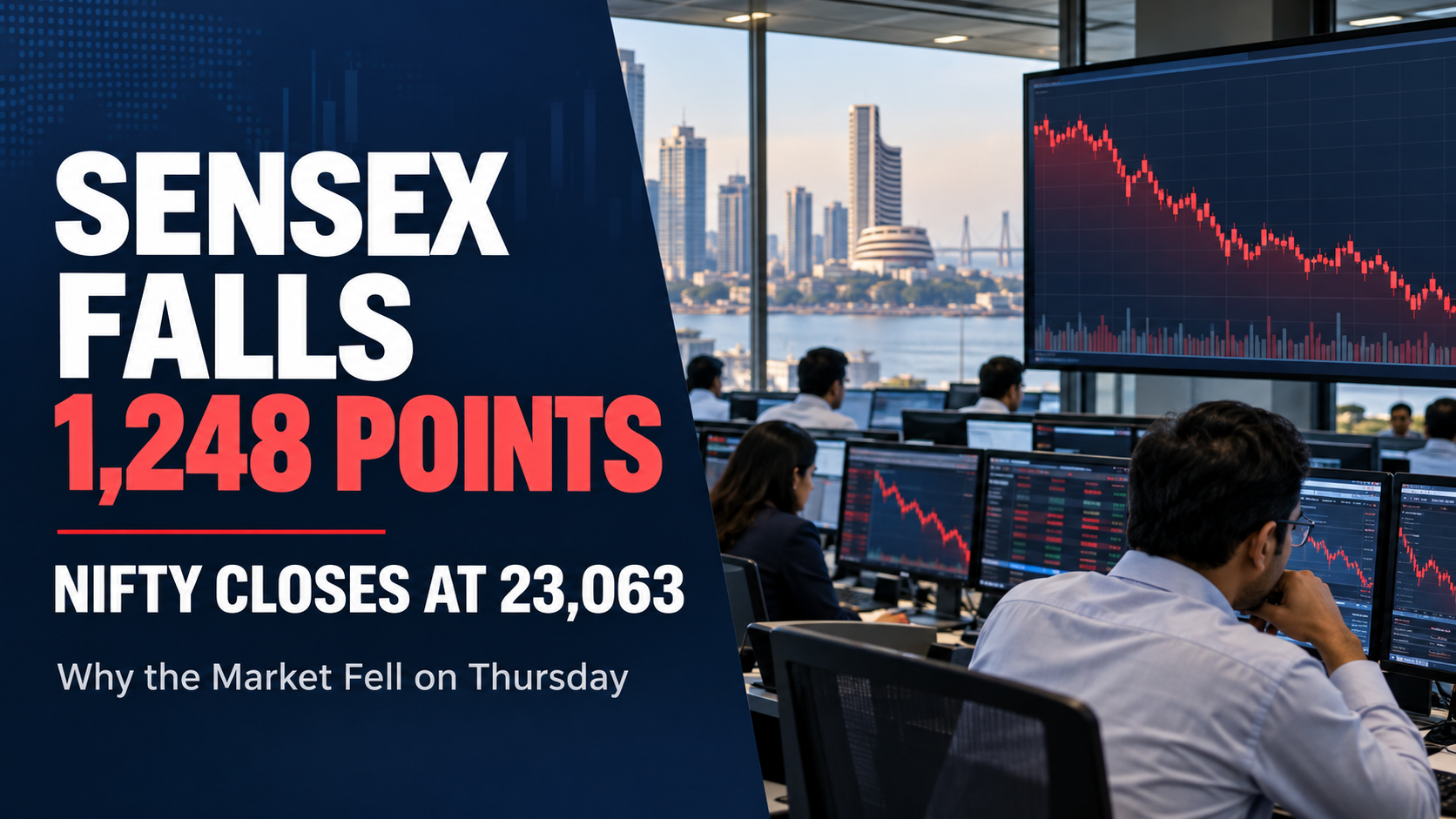
US bond yields near 5.11%, crude oil above $102 and a weaker rupee weighed on Indian stocks. A proposed change to insurance commissions gave investors a further reason to sell financial shares.
By ICFM India | Market close, 24 September 2026
The Sensex closed 1.67% lower at 73,580.54 on Thursday, a fall of about 1,248 points. The Nifty 50 lost 383.70 points, or about 1.6%, to end at 23,063.10. Both indices finished close to their lowest levels of the session.
The selloff was difficult to pin on one announcement. Rising US bond yields made equities less attractive at existing prices. Brent crude remained above $102 a barrel, while the rupee weakened against the dollar. In India, proposed changes to insurance commissions prompted investors to reconsider the outlook for banks, insurers and businesses that sell policies.
Financial stocks faced broad market pressure and a sector-specific concern at the same time.
What happened in the market on Thursday?
| Market measure | Reported figure | What it shows |
| Sensex close | 73,580.54 | Down about 1,248 points, or 1.67% |
| Sensex intraday low | 73,563.92 | The index closed near its low |
| Nifty 50 close | 23,063.10 | Down 383.70 points, or about 1.6% |
| Nifty 50 intraday low | 23,046.15 | The index also closed near its low |
| BSE-listed companies’ market capitalisation | ₹480.99 lakh crore | Down from about ₹485 lakh crore previously |
Using the two rounded market-capitalisation figures in the source report, the decline comes to approximately ₹4.01 lakh crore. That represents a fall in the combined market value of listed shares. It does not mean the same amount of cash was withdrawn from the market.
What are the key takeaways?
- The Sensex fell 1.67%, while the Nifty 50 lost about 1.6%.
- The US 10-year Treasury yield was near 5.11%, adding pressure to equity valuations.
- Brent crude stayed above $102 a barrel after rising 4% in the previous session.
- The rupee weakened 14 paise to 95.87 per US dollar in early trade.
- Proposed IRDAI changes to insurance distribution payouts contributed to sharp selling in financial stocks.
- Bajaj Finance fell around 6%. The source report describes a roughly 28%–30% intraday decline in PB Fintech.
- Most sectoral indices were described as trading sharply lower, with pharma the exception.
Why did the Sensex and Nifty fall?
Thursday brought together two kinds of pressure. Bond yields, oil and the rupee affected the wider market. IRDAI’s proposal raised a more focused question about the future income of insurance-related businesses.
How did US bond yields put pressure on Indian stocks?
The US 10-year Treasury yield was around 5.11% during Asian trading, after rising about 15 basis points in the previous session. The source report describes it as the highest level since 2007. The US 2-year yield briefly crossed 4.9%.
When bonds offer a higher yield, investors may demand a better prospective return before paying the same price for shares. That can put pressure on equity valuations. It also changes the comparison for global investors choosing between US government bonds and shares in emerging markets such as India.
Why was the bond move more than a US story?
Bond yields were also rising elsewhere. The source report says the Japanese government bond yield rose 8 basis points to 3.06%, its highest level since August 1996.
Those moves did not determine the price of every Indian stock. They did, however, create an uncomfortable backdrop for equities before the selling in financial companies intensified.
Why did crude oil remain a concern?
Brent crude eased slightly during Thursday’s trading but remained above $102 a barrel. It had risen 4% in the previous session. For investors, the important question was whether oil would stay expensive, rather than whether it had dipped briefly during the day.
Persistently high crude prices can raise costs for an oil-importing economy such as India. They can also add to inflation concerns and put pressure on the currency.
How did geopolitical developments affect oil?
The source report links oil-market uncertainty to the US-Iran conflict and developments around the Strait of Hormuz. It reports that Iranian security chief Mohsen Rezaei said the strait would remain closed until Iran’s conditions were met. It also cites US Secretary of State Marco Rubio as saying that reaching a deal would take work over time.
Those developments left investors uncertain about the supply outlook. Thursday’s slight easing in crude did not settle that concern.
How did the weaker rupee add to the problem?
The rupee fell 14 paise to 95.87 per US dollar in early trade. A currency analyst quoted in the source report described it as moving in a 95.60–95.95 range, with continued foreign investor selling keeping sentiment cautious.
Crude oil is priced internationally in dollars. If oil remains expensive while the rupee weakens, buying it can cost more in rupee terms. That link made the oil and currency moves particularly relevant to India’s market on Thursday.
What did IRDAI propose?
The Insurance Regulatory and Development Authority of India proposed changes to payments involved in selling insurance. As described in the source report, the proposed framework seeks tighter caps on commissions and distribution payouts, links payments to product complexity, and would extend certain life-insurance commission payments beyond a policy’s first year.
The proposal also raised questions about remuneration under bank-led insurance distribution arrangements, particularly multiple tie-ups. Investors began assessing how a change could affect banks, insurers and platforms that sell policies.
These are proposals, not final rules. Thursday’s share-price moves reflect concern about possible effects. They do not establish how much any individual company’s earnings will change.
How can readers make sense of a day like this?
On a sharply falling day, an index move can make unrelated concerns appear to be the same problem. Thursday’s global pressures affected the broad market. The proposed insurance changes called for a closer look at particular businesses and how they earn distribution income.
Learning to separate those questions is useful well beyond one trading session. ICFM India’s practical stock-market courses cover market analysis, sector movements and risk management through live market learning.
Want to understand what is moving the market before reacting to a price change? Enquire with ICFM India about its stock-market courses and live training.
Which sectors and stocks led the decline?
Banking and financial services stocks carry the highest sector weightage in the Nifty 50, according to the source report. When several large financial stocks fall together, they have a substantial effect on the index.
The insurance proposal added to that effect. A bank may receive income for selling policies; an insurer may pay distribution costs; a platform may earn money by connecting customers with insurers. Those are different businesses, even though their shares can fall on the same news.
Which stocks were among the biggest losers?
The source describes some intraday moves, gives approximate ranges for groups of stocks and names other losers without individual percentages. These figures should not be treated as a complete list of closing returns.
| Stock or group | Business connection | Movement described in the source |
| PB Fintech (Policybazaar) | Insurance distribution | Roughly 28%–30% lower intraday |
| Bajaj Finance | Financial services | Around 6% lower; named as the leading Sensex loser |
| HDFC Life, Bajaj Finance, Axis Bank and Bajaj Finserv | Insurance, banking and financial services | Losses of as much as 8.5% across the named group; the source does not assign that figure to one stock |
| Axis Bank, Bajaj Finance and Bajaj Finserv | Banking and financial services | Described together elsewhere in the report as falling around 3%–5% |
| IndiGo and Trent | Aviation and retail | Named among Sensex losers; individual percentages were not supplied |
| IndusInd Bank | Banking | Named among Nifty losers; an individual percentage was not supplied |
ICICI Bank was reported as the only Sensex stock in the green. Pharma was the exception among sectoral indices described as trading sharply lower.
ICICI Bank was reported as the only Sensex stock in the green. Pharma was the exception among sectoral indices described as trading sharply lower.
What are the potential opportunities and risks after the fall?
A lower market price gives investors a reason to review a company. It does not, by itself, show that the pressures on its earnings have ended.
| What investors may be able to assess | What remains uncertain |
| Whether lower prices change the valuation of companies they already follow | Whether global yields, crude and the rupee will remain under pressure |
| Whether a portfolio has too much exposure to financial stocks | Whether several holdings depend on the same source of insurance distribution income |
| How different banks, insurers and platforms earn from selling policies | What IRDAI’s final rules will say and how they will affect each business |
| Which concerns are global and which are specific to a company | Whether an improvement in one indicator will be enough to support a broader recovery |
That is the practical distinction Thursday’s selloff offers: an opportunity to examine exposure is not a forecast that prices will rebound.
What should investors watch next?
Which global indicators matter most?
US bond yields and Brent crude were the two global pressures singled out in the source report. Dr V K Vijayakumar, Chief Investment Strategist at Geojit Investments, identified Brent above $102 and the US 10-year yield near 5.11% as headwinds to a strong market recovery.
The rupee is another indicator to watch alongside oil. A change in one may ease part of the pressure, but it will not necessarily resolve the others.
US bond yields and Brent crude were the two global pressures singled out in the source report. Dr V K Vijayakumar, Chief Investment Strategist at Geojit Investments, identified Brent above $102 and the US 10-year yield near 5.11% as headwinds to a strong market recovery.
The rupee is another indicator to watch alongside oil. A change in one may ease part of the pressure, but it will not necessarily resolve the others.
What matters for banks and insurance-related stocks?
The question is how IRDAI’s proposed distribution changes develop and how dependent each business is on the payments under review.
Thursday’s price moves show investors’ immediate concern. They cannot establish the effect of rules that have not been finalised, or substitute for company-specific information about insurance distribution income.
The question is how IRDAI’s proposed distribution changes develop and how dependent each business is on the payments under review.
Thursday’s price moves show investors’ immediate concern. They cannot establish the effect of rules that have not been finalised, or substitute for company-specific information about insurance distribution income.
How do Fed expectations fit into the outlook?
The source report says the CME FedWatch tool indicated a 69% probability of a rate hike at the next meeting, up from 44% a month earlier. That is a measure of market expectations at the time reported, not a Federal Reserve decision.
It helps explain why investors paid close attention to US bond yields. The report gives no reliable date for a change in those expectations or a recovery in Indian equities.
The source report says the CME FedWatch tool indicated a 69% probability of a rate hike at the next meeting, up from 44% a month earlier. That is a measure of market expectations at the time reported, not a Federal Reserve decision.
It helps explain why investors paid close attention to US bond yields. The report gives no reliable date for a change in those expectations or a recovery in Indian equities.
What is the conclusion from Thursday’s selloff?
Thursday’s fall reflected several pressures meeting in one session. Higher bond yields, expensive oil and a weaker rupee challenged the wider market. IRDAI’s proposal added uncertainty for financial companies, whose large index weight made their decline especially important for the Nifty.
For investors, the useful work now is to follow those pressures separately and examine how each company earns its income. An index move shows how the market reacted on Thursday. It cannot, on its own, tell investors what the final insurance rules will be or when the wider market will recover.
Thursday’s fall reflected several pressures meeting in one session. Higher bond yields, expensive oil and a weaker rupee challenged the wider market. IRDAI’s proposal added uncertainty for financial companies, whose large index weight made their decline especially important for the Nifty.
For investors, the useful work now is to follow those pressures separately and examine how each company earns its income. An index move shows how the market reacted on Thursday. It cannot, on its own, tell investors what the final insurance rules will be or when the wider market will recover.
What are investors asking after Thursday’s fall?
Q1. Why did the Sensex fall on Thursday?
The Sensex closed at 73,580.54, down about 1,248 points or 1.67%. The US 10-year Treasury yield near 5.11%, crude oil above $102 a barrel and a weaker rupee weighed on Indian equities. Selling in financial stocks intensified after IRDAI proposed changes to insurance distribution payouts. Several pressures arrived together, so the decline cannot be explained solely by the insurance proposal or by one global market development.
The Sensex closed at 73,580.54, down about 1,248 points or 1.67%. The US 10-year Treasury yield near 5.11%, crude oil above $102 a barrel and a weaker rupee weighed on Indian equities. Selling in financial stocks intensified after IRDAI proposed changes to insurance distribution payouts. Several pressures arrived together, so the decline cannot be explained solely by the insurance proposal or by one global market development.
Q2. What caused the “Thursday Tank” in Indian stocks?
The phrase describes the broad decline in which the Nifty 50 ended 383.70 points lower at 23,063.10. Higher US bond yields challenged equity valuations, while expensive oil and rupee weakness raised concerns about India’s costs. IRDAI’s proposal added a question about future income for insurance-related businesses. Financial stocks carry substantial weight in the Nifty, so their losses had a pronounced effect on the benchmark.
The phrase describes the broad decline in which the Nifty 50 ended 383.70 points lower at 23,063.10. Higher US bond yields challenged equity valuations, while expensive oil and rupee weakness raised concerns about India’s costs. IRDAI’s proposal added a question about future income for insurance-related businesses. Financial stocks carry substantial weight in the Nifty, so their losses had a pronounced effect on the benchmark.
Q3. How much market value was lost on Thursday?
The source report places the combined market capitalisation of BSE-listed companies at about ₹485 lakh crore in the previous session and ₹480.99 lakh crore on Thursday. The difference between those rounded figures is approximately ₹4.01 lakh crore. That measures a decline in the value of listed shares at prevailing prices. It does not mean investors withdrew ₹4.01 lakh crore in cash during the session.
The source report places the combined market capitalisation of BSE-listed companies at about ₹485 lakh crore in the previous session and ₹480.99 lakh crore on Thursday. The difference between those rounded figures is approximately ₹4.01 lakh crore. That measures a decline in the value of listed shares at prevailing prices. It does not mean investors withdrew ₹4.01 lakh crore in cash during the session.
Q4. What is the proposed IRDAI insurance rule change?
As described in the source report, IRDAI proposed tighter limits on insurance commissions and distribution payouts, with payments linked to product complexity. It also proposed extending certain life-insurance commission payments beyond a policy’s first year and questioned remuneration under bank-led insurance tie-ups. These are proposals, so Thursday’s trading does not establish the final rules or their effect on individual companies. Investors reacted to the possibility that distribution income could change.
As described in the source report, IRDAI proposed tighter limits on insurance commissions and distribution payouts, with payments linked to product complexity. It also proposed extending certain life-insurance commission payments beyond a policy’s first year and questioned remuneration under bank-led insurance tie-ups. These are proposals, so Thursday’s trading does not establish the final rules or their effect on individual companies. Investors reacted to the possibility that distribution income could change.
Q5. How do rising US bond yields affect Indian stocks?
The US 10-year Treasury yield was around 5.11% during Asian trading. A higher bond yield gives investors a better return from bonds than they could obtain before, which can make shares less appealing at existing prices. Global investors may also reconsider their emerging-market exposure. The yield move was a significant backdrop to Thursday’s decline, though oil, the rupee and the insurance proposal added separate pressures.
The US 10-year Treasury yield was around 5.11% during Asian trading. A higher bond yield gives investors a better return from bonds than they could obtain before, which can make shares less appealing at existing prices. Global investors may also reconsider their emerging-market exposure. The yield move was a significant backdrop to Thursday’s decline, though oil, the rupee and the insurance proposal added separate pressures.
Q6. Which sectors and stocks were hit hardest?
Banking, financial services and insurance stocks were central to the decline. The source report names Bajaj Finance, HDFC Life, Axis Bank, IndusInd Bank and Bajaj Finserv among prominent Nifty losers. It says Bajaj Finance fell around 6%, while PB Fintech declined roughly 28%–30% intraday. Most sectoral indices were described as trading sharply lower, with pharma the exception. The report does not provide a verified closing percentage for every named stock.
Banking, financial services and insurance stocks were central to the decline. The source report names Bajaj Finance, HDFC Life, Axis Bank, IndusInd Bank and Bajaj Finserv among prominent Nifty losers. It says Bajaj Finance fell around 6%, while PB Fintech declined roughly 28%–30% intraday. Most sectoral indices were described as trading sharply lower, with pharma the exception. The report does not provide a verified closing percentage for every named stock.
Q7. How did rupee weakness affect the market?
The rupee weakened 14 paise to 95.87 per US dollar in early trade. That mattered alongside Brent crude above $102 a barrel because internationally traded oil is priced in dollars. A weaker rupee can make the same quantity of imported oil more expensive in domestic currency. The source report also describes persistent foreign investor selling as a source of caution. It does not isolate how many index points the currency move caused.
The rupee weakened 14 paise to 95.87 per US dollar in early trade. That mattered alongside Brent crude above $102 a barrel because internationally traded oil is priced in dollars. A weaker rupee can make the same quantity of imported oil more expensive in domestic currency. The source report also describes persistent foreign investor selling as a source of caution. It does not isolate how many index points the currency move caused.
Q8. Why was crude oil above $102 a barrel?
Brent crude had risen 4% in the previous session and remained above $102 a barrel, despite easing slightly during Thursday’s trade. The source report links oil-market uncertainty to the US-Iran conflict and developments around the Strait of Hormuz. It cites an Iranian official saying the strait would remain closed until Iran’s conditions were met. Investors were concerned that continued uncertainty could keep oil expensive and add to India’s import-cost pressures.
Brent crude had risen 4% in the previous session and remained above $102 a barrel, despite easing slightly during Thursday’s trade. The source report links oil-market uncertainty to the US-Iran conflict and developments around the Strait of Hormuz. It cites an Iranian official saying the strait would remain closed until Iran’s conditions were met. Investors were concerned that continued uncertainty could keep oil expensive and add to India’s import-cost pressures.
Q9. What should investors make of the fall in bank stocks?
The fall shows concern about both the wider market outlook and proposed changes to insurance distribution income. It does not reveal the eventual impact on any one bank. The source report does not state how much each bank earns from the arrangements under review, and IRDAI’s proposals are not final rules. Banks, insurers and distribution platforms play different roles in selling a policy, so their earnings exposure needs to be assessed individually.
The fall shows concern about both the wider market outlook and proposed changes to insurance distribution income. It does not reveal the eventual impact on any one bank. The source report does not state how much each bank earns from the arrangements under review, and IRDAI’s proposals are not final rules. Banks, insurers and distribution platforms play different roles in selling a policy, so their earnings exposure needs to be assessed individually.
Q10. When could the market recover?
The source report gives no recovery date. It identifies Brent crude above $102 and the US 10-year yield near 5.11% as major global headwinds. It also reports a 69% market-implied probability of a Fed rate hike, up from 44% a month earlier. Financial stocks face the additional uncertainty of proposed insurance changes. An improvement in one condition would not necessarily resolve the others.
Source and calculation note: Market figures and reported developments in this article are drawn solely from the news report supplied for this assignment. That report describes the market-capitalisation decline as nearly ₹5 lakh crore, while its stated previous and closing figures imply approximately ₹4.01 lakh crore. Intraday stock moves are identified as such.
The source report gives no recovery date. It identifies Brent crude above $102 and the US 10-year yield near 5.11% as major global headwinds. It also reports a 69% market-implied probability of a Fed rate hike, up from 44% a month earlier. Financial stocks face the additional uncertainty of proposed insurance changes. An improvement in one condition would not necessarily resolve the others.
Source and calculation note: Market figures and reported developments in this article are drawn solely from the news report supplied for this assignment. That report describes the market-capitalisation decline as nearly ₹5 lakh crore, while its stated previous and closing figures imply approximately ₹4.01 lakh crore. Intraday stock moves are identified as such.