
What Is Happening in the Stock Market Today?
The Indian equity market is trading with a measured, slightly negative bias, indicating caution rather than stress. The BSE Sensex is near 77,100, while the Nifty 50 is holding just above the 24,000 threshold. The magnitude of the move is modest, but the tone is important: liquidity is selective, follow-through is limited, and intraday volatility has increased.
Generally, this arrangement indicates a phase of fluctuation. Markets embrace and react to external shocks although they do not establish a conclusive trend. For those tracking, “sensex today live” or “why market is falling today” at present shows a macro-led consolidation and not a structural fall.
Why Is the Stock Market Soft Today?
Why Is Crude Oil Driving Market Pressure?
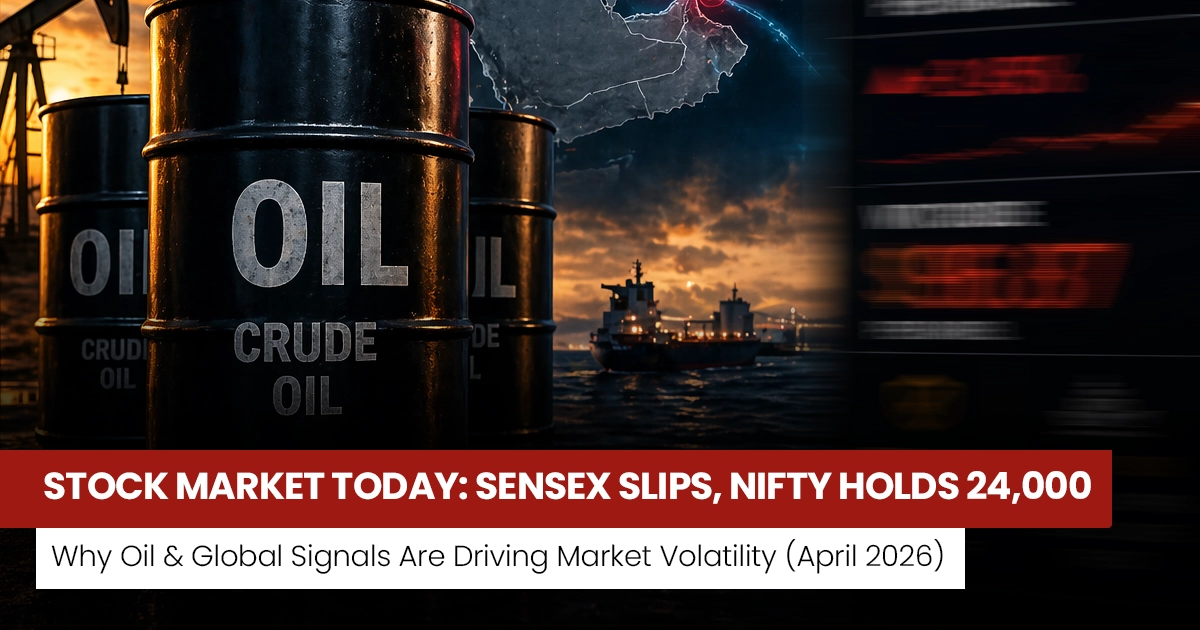
The main variable is crude oil, priced between $109 and $110 per barrel, as tensions between the U.S. and Iran continue. India, as an oil-importing economy, experiences the reality of high oil prices, which raises the cost of production, creates a ripple effect on inflation, and in turn, puts pressure on the Indian Rupee.
This macroeconomic reality has an effect on investment valuation by influencing equity valuation of firms as a result of a compression of profit margins in terms of the cost of production for energy-linked industries, and in terms of the postponement of expected policy relaxations. This, in turn, affects the level of investment, and a rise in investment, domestic financial and economic fundamentals will remain as is.
What Is the Global Market Context?
The current softness is consistent with broader global positioning. Asian benchmarks are trading lower, reinforcing a risk-off backdrop.
Global Market Snapshot (Indicative Data)
| Index | Level | Change | Bias |
| BSE Sensex | ~77,100 | -0.26% | Mildly Negative |
| Nifty 50 | ~24,065 | -0.11% | Range-bound |
| Nikkei 225 | ~59,796 | -1.22% | Weak |
| SSE Composite Index | ~4,069 | -0.42% | Soft |
Synchronized weakness across regions typically dampens risk appetite, encouraging lighter positioning and shorter holding periods.
Who Is Influencing Market Direction Right Now?
Behavior of indexes is affected by institutional flows and sectoral weightage. With heavy weightage Bank and financials are causing a pull effect due to incremental profit booking and provisioning. Lack of strong follow-through buying suggests institutions are waiting for better macro signals to park money.
In the short term trading, profit booking, and intraday swings are reinforced through the headline news. Durable trends are however not established.
What Is Supporting the Market Despite Headwinds?
What Is Preventing a Deeper Drawdown?
The main stabilizing factor is prices accepted beyond Nifty 24,000, which is an important psychological and technical milestone. The broader market breadth has not meaningfully declined, and specific sectors are still absorbing supply, which demonstrates underlying demand at certain levels.
The combination of selling into strength and buying at support levels suggests it is consolidation and not distribution.
How Important Are Current Market Levels? (Data Framework)
Near-term structure is well-defined and offers a clear decision matrix.
| Indicator | Level | Interpretation |
| Nifty Support | 24,000 | Demand zone; loss would weaken structure |
| Nifty Resistance | 24,100–24,150 | Immediate supply band |
| Crude Oil | $109–110 | Primary macro overhang |
| USD/INR | ~₹94.5 | Currency pressure channel |
| India VIX | Elevated | Volatility regime remains high |
A decisive move below support would likely invite momentum selling, while sustained trade above resistance could restore near-term confidence.
A decisive move below support would likely invite momentum selling, while sustained trade above resistance could restore near-term confidence.
What Are FII and DII Doing Today?
Institutional flows remain a critical factor in interpreting short-term market direction. Today’s data reflects a divergent but stabilizing pattern, where foreign investors are cautious while domestic institutions continue to provide support.
| Category | Net Flow (₹ Cr) | Market Signal |
| FII (Foreign Institutional Investors) | -₹1,200 Cr (approx) | Selling Pressure |
| DII (Domestic Institutional Investors) | +₹950 Cr (approx) | Market Support |
This difference warrants attention. Selling by foreign institutional investors demonstrates global risk aversion. This is often seen in rising crude prices and geopolitical tension. A similar contrast is seen in domestic institutional investors buying. This buying demonstrates domestic confidence and absorbs pressure from selling.
In a more structural sense, this balance is the reason the markets are not showing a steep decline despite external pressure. It supports the idea that the current stage is a consolidation of macro factors, not a structural weakness.
This difference warrants attention. Selling by foreign institutional investors demonstrates global risk aversion. This is often seen in rising crude prices and geopolitical tension. A similar contrast is seen in domestic institutional investors buying. This buying demonstrates domestic confidence and absorbs pressure from selling.
In a more structural sense, this balance is the reason the markets are not showing a steep decline despite external pressure. It supports the idea that the current stage is a consolidation of macro factors, not a structural weakness.
What Will Stock Market Do Tomorrow?
The future of the market remains uncertain but dependent on global indicators, including crude oil prices and geopolitical developments.
Greater stability or a decrease in crude oil prices could lower inflation, allowing for a gradual recovery in the Nifty and Sensex indices and the world economy. However, along with geopolitical escalations, the Nifty and Sensex indices will be under pressure and may remain in a downward trend.
From a technical standpoint, the expected trading range for the next session is 23,900 to 24,200 on the Nifty, with the 24,000 level acting as a critical pivot zone. Sustaining above this level may keep the structure stable, while a break below could trigger renewed selling pressure.
Overall, the outlook suggests a range-bound market with elevated volatility, where direction will be influenced more by external triggers than domestic fundamentals.
The future of the market remains uncertain but dependent on global indicators, including crude oil prices and geopolitical developments.
Greater stability or a decrease in crude oil prices could lower inflation, allowing for a gradual recovery in the Nifty and Sensex indices and the world economy. However, along with geopolitical escalations, the Nifty and Sensex indices will be under pressure and may remain in a downward trend.
From a technical standpoint, the expected trading range for the next session is 23,900 to 24,200 on the Nifty, with the 24,000 level acting as a critical pivot zone. Sustaining above this level may keep the structure stable, while a break below could trigger renewed selling pressure.
Overall, the outlook suggests a range-bound market with elevated volatility, where direction will be influenced more by external triggers than domestic fundamentals.
How Should Investors Respond?
How Should You Approach the Market Today?
In externally driven markets, process discipline outweighs prediction. Position sizing, risk limits, and patience are more valuable than trading frequency. The current tape is reaction-driven, meaning moves are contingent on incoming macro cues rather than endogenous strength.
Not overtrading, being patient with trade confirmations and trading with risk adjustments, is a better approach compared to chasing intraday movements.
In externally driven markets, process discipline outweighs prediction. Position sizing, risk limits, and patience are more valuable than trading frequency. The current tape is reaction-driven, meaning moves are contingent on incoming macro cues rather than endogenous strength.
Not overtrading, being patient with trade confirmations and trading with risk adjustments, is a better approach compared to chasing intraday movements.
What Is the Near-Term Outlook?
The market should probably continue to be range bound but with large volatility. As for directional clarity for the market, it rests on the path of crude oil as well as the developing geopolitical tensions. If oil stabilizes, risk premia will probably lower and help equities, but if it stays at the current levels, it will most likely continue consolidating.
The market should probably continue to be range bound but with large volatility. As for directional clarity for the market, it rests on the path of crude oil as well as the developing geopolitical tensions. If oil stabilizes, risk premia will probably lower and help equities, but if it stays at the current levels, it will most likely continue consolidating.
Final Insight
This is not a market crash—it is a macro-driven adjustment. Domestic structure remains intact, while external variables are temporarily dictating price behavior. Recognizing this distinction helps avoid misclassification of risk and supports more rational decision-making.
This is not a market crash—it is a macro-driven adjustment. Domestic structure remains intact, while external variables are temporarily dictating price behavior. Recognizing this distinction helps avoid misclassification of risk and supports more rational decision-making.
How Do Professional Traders Interpret This Phase?
Professional traders de-risk into uncertainty. Their focus is on maintaining capital, rather than funding an opportunity. Professional traders focus on price levels, vol, and cross-asset signals. They do not engage with risk based on results. When their conditions change, engagement is reinstated. This attitude is what separates reactive trading from consistent execution.
Professional traders de-risk into uncertainty. Their focus is on maintaining capital, rather than funding an opportunity. Professional traders focus on price levels, vol, and cross-asset signals. They do not engage with risk based on results. When their conditions change, engagement is reinstated. This attitude is what separates reactive trading from consistent execution.
How Can Market Understanding Be Strengthened?
For those looking to build a structured understanding of how macro variables such as oil, currency, and volatility influence equity markets, formal study can add clarity. Exploring NISM examination preparation through ICFM India can help develop a deeper perspective on market mechanics, risk frameworks, and disciplined decision-making. This is an educational pathway designed to improve understanding, not a promise of outcomes.
For those looking to build a structured understanding of how macro variables such as oil, currency, and volatility influence equity markets, formal study can add clarity. Exploring NISM examination preparation through ICFM India can help develop a deeper perspective on market mechanics, risk frameworks, and disciplined decision-making. This is an educational pathway designed to improve understanding, not a promise of outcomes.
Disclaimer
This article is intended solely for educational and informational purposes and reflects general market observations based on publicly available data at the time of writing. It does not constitute investment advice, trading recommendations, or financial planning guidance.
This article is intended solely for educational and informational purposes and reflects general market observations based on publicly available data at the time of writing. It does not constitute investment advice, trading recommendations, or financial planning guidance.
FAQs: Stock Market Today LIVE, Nifty 24,000 & Market Outlook (April 2026)
Why is the stock market falling today in India?
The stock market is under pressure mainly due to rising crude oil prices near $109–$110 per barrel and ongoing geopolitical tensions between the United States and Iran. These factors are increasing inflation concerns, weakening the rupee, and reducing investor confidence, leading to cautious trading in indices like the BSE Sensex and Nifty 50.
The stock market is under pressure mainly due to rising crude oil prices near $109–$110 per barrel and ongoing geopolitical tensions between the United States and Iran. These factors are increasing inflation concerns, weakening the rupee, and reducing investor confidence, leading to cautious trading in indices like the BSE Sensex and Nifty 50.
Why is Nifty holding above 24,000 important?
The 24,000 level on Nifty is where psychological and technical support coincide. Nifty staying above 24,000 shows that active buyers are doing their part to prop up the structure of the market. Selling pressure will be triggered below 24,000, whereas staying above 24,000 will indicate that the structure is recovering.
The 24,000 level on Nifty is where psychological and technical support coincide. Nifty staying above 24,000 shows that active buyers are doing their part to prop up the structure of the market. Selling pressure will be triggered below 24,000, whereas staying above 24,000 will indicate that the structure is recovering.
How do crude oil prices impact the Indian stock market?
As India's crude oil imports account for a large portion of the country's crude oil imports globally, rising prices for crude oil increase India's import cost, fuel inflation, and further depreciate the Indian Rupee. This has a direct negative impact on corporate profitability and market sentiment, eventually leading to a downturn of the stock indices.
As India's crude oil imports account for a large portion of the country's crude oil imports globally, rising prices for crude oil increase India's import cost, fuel inflation, and further depreciate the Indian Rupee. This has a direct negative impact on corporate profitability and market sentiment, eventually leading to a downturn of the stock indices.
What are FII and DII doing today and why does it matter?
Foreign Institutional Investors (FIIs) are showing selling pressure, while Domestic Institutional Investors (DIIs) are buying to support the market. This balance between FII selling and DII buying is preventing a sharp fall and indicates that the market is in a consolidation phase rather than a crash.
Foreign Institutional Investors (FIIs) are showing selling pressure, while Domestic Institutional Investors (DIIs) are buying to support the market. This balance between FII selling and DII buying is preventing a sharp fall and indicates that the market is in a consolidation phase rather than a crash.
Is this a stock market crash or just a correction?
Currently, there is a macro-driven correction, not a structural market crash. The primary global factors affecting the market include the price of oil, and geopolitical tensions, while the domestic fundamentals tend to be more stable.
Currently, there is a macro-driven correction, not a structural market crash. The primary global factors affecting the market include the price of oil, and geopolitical tensions, while the domestic fundamentals tend to be more stable.
Why are global markets also falling today?
Emerging geopolitical concerns and higher commodity prices are impacting global markets, including the Nikkei 225 and SSE Composite Index. This global slowdown is affecting the Indian markets, too.
Emerging geopolitical concerns and higher commodity prices are impacting global markets, including the Nikkei 225 and SSE Composite Index. This global slowdown is affecting the Indian markets, too.
What is the stock market outlook for tomorrow?
The market is expected to remain volatile and range-bound. If crude oil prices stabilize, the market may recover. However, if oil prices continue to rise, selling pressure may persist. The expected Nifty range for the next session is around 23,900 to 24,200.
The market is expected to remain volatile and range-bound. If crude oil prices stabilize, the market may recover. However, if oil prices continue to rise, selling pressure may persist. The expected Nifty range for the next session is around 23,900 to 24,200.
Which factors will decide the next market move?
Key elements consist of crude oil price fluctuations, US–Iran geopolitical landscape, FII/DII flows, rupee fluctuations, and international market movements. Among other external factors, these will have higher importance than domestic factors for the time being.
Key elements consist of crude oil price fluctuations, US–Iran geopolitical landscape, FII/DII flows, rupee fluctuations, and international market movements. Among other external factors, these will have higher importance than domestic factors for the time being.
Should investors worry about current market volatility?
Short-term stability is common, particularly in these uncertain times. While some caution is warranted, global uncertainty should not be interpreted as a market-wide, long-term structural concern.
Short-term stability is common, particularly in these uncertain times. While some caution is warranted, global uncertainty should not be interpreted as a market-wide, long-term structural concern.