What Happened to Trent Shares?
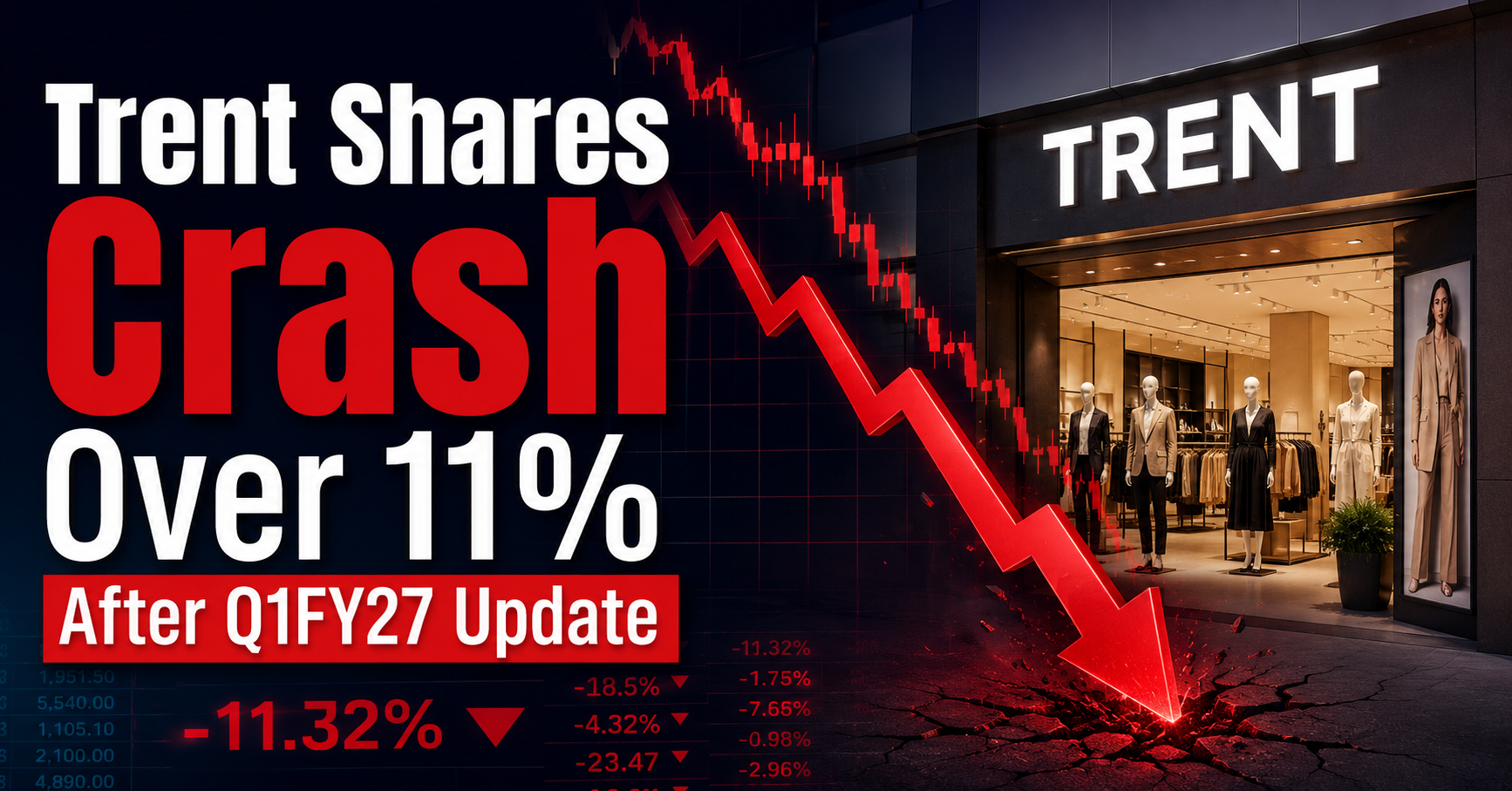
Trent shares witnessed a sharp fall on Tuesday, 7 July 2026, after the Tata Group retail company released its Q1FY27 business update. The stock crashed over 11% in intraday trade, snapping its recent positive momentum and raising a key question among investors: why did Trent shares fall despite reporting 19% revenue growth?
At first glance, the company’s numbers did not look weak. Trent reported standalone revenue from operations of ₹5,666 crore for Q1FY27, compared with ₹4,781 crore in the same quarter last year. This means the company delivered 19% year-on-year revenue growth.
However, the stock market does not react only to whether a company is growing. It reacts to whether the company is growing faster or slower than market expectations. In Trent’s case, the growth was positive but below what investors were expecting from a premium retail stock.
Why Is This News Important?
This news is important because Trent has been one of India’s most closely watched retail growth stories. The company’s value-fashion brand Zudio has expanded rapidly, while Westside continues to remain a key lifestyle and apparel format.
Because of this strong growth profile, Trent stock had already built in high expectations. When the company reported 19% revenue growth, the market saw it as lower than expected. This triggered selling pressure in the stock.
The fall also gives an important stock market lesson: a company can report good revenue growth and still see its share price fall if the numbers fail to match market expectations.
What Are the Key Highlights?
- Trent shares crashed over 11% intraday after the Q1FY27 business update.
- The stock came under pressure after revenue growth missed market expectations.
- Trent reported standalone revenue from operations of ₹5,666 crore.
- Revenue grew 19% year-on-year, but the growth rate failed to impress investors.
- Investors were concerned about same-store sales growth, store productivity and revenue per square foot.
- Zudio remains Trent’s biggest growth driver, but the market is watching whether it can maintain strong productivity after rapid expansion.
- Trent operated 1,312 stores as of 30 June 2026, including 982 Zudio stores and 301 Westside stores.
- The sharp fall shows how high-valuation growth stocks can react when numbers fail to meet expectations.
What Are Trent’s Q1FY27 Key Numbers?
| Metric | Q1FY27 Update |
| Standalone revenue from operations | ₹5,666 crore |
| Year-on-year revenue growth | 19% |
| Revenue in same quarter last year | ₹4,781 crore |
| Total store count | 1,312 stores |
| Westside stores | 301 |
| Zudio stores | 982 |
| Other lifestyle stores | 29 |
Trent’s revenue growth was supported by its retail expansion, especially through Zudio and Westside. As of 30 June 2026, the company had 1,312 stores, including 982 Zudio stores, 301 Westside stores and 29 stores under other lifestyle concepts.
Click Now
Why Did Trent Shares Fall Despite Revenue Growth?
Trent shares fell because the company’s revenue growth came below market expectations. A 19% growth number may look strong in isolation, but for a high-growth and high-valuation stock, investors often expect stronger performance.
The market was not only looking at revenue growth. It was also looking at the quality of that growth. Investors were concerned about whether Trent’s growth was coming mainly from new store additions or from stronger performance of existing stores.
For a retail company, this difference is important. If revenue rises mainly because more stores are opened, but existing-store performance slows down, investors may become cautious.
How Did Market Expectations Impact Trent Stock?
Market expectations played a major role in Trent’s fall. Trent has delivered strong growth in the past, mainly due to Zudio’s rapid expansion. Because of this, investors expected the company to continue growing at a very strong pace.
When the Q1FY27 update showed 19% revenue growth, it was seen as lower than what the market had already priced in. For a stock trading at premium valuation, even a moderate miss can lead to a sharp correction.
This is why Trent’s fall was not just about the revenue number. It was about the gap between actual performance and expected performance.
How Can ICFM Learners Understand This Case?
At ICFM, real market examples like Trent help learners understand how stock market reactions work beyond headlines. This case shows why investors should not depend only on one number such as revenue growth.
Learners can study this example to understand how quarterly updates, valuation, price action, investor expectations and business performance are connected.
It also teaches why traders and investors should study company fundamentals, technical charts, market sentiment and risk management before forming any market view.
What Is the Case Study From Trent’s Fall?
Trent’s share price fall is a useful case study for stock market learners and retail investors. It shows that stock prices do not move only because numbers are good or bad. They move because numbers are better or worse than expectations.
A company can report revenue growth, but if investors expected higher growth, the stock can still fall. This is especially true for high-valuation stocks where the market has already priced in strong future performance.
Trent’s case shows why investors should not focus only on headline revenue growth. They should also study same-store sales growth, revenue per square foot, margins, valuation and future growth visibility.
Why Does Growth Quality Matter More Than Headline Growth?
Growth quality matters because it shows whether a company’s expansion is sustainable. For a retail business, revenue can increase because the company opens more stores. But that does not always mean existing stores are performing strongly.
Investors usually prefer growth that comes from both new store expansion and strong existing-store performance. This is where same-store sales growth and revenue per square foot become important.
In Trent’s case, the market is now watching whether Zudio can continue delivering strong productivity even after aggressive expansion. Investors also want to know whether Westside can maintain stable performance and whether margins can remain healthy.
Who Is Driving Trent’s Growth?
Zudio is currently one of Trent’s biggest growth drivers. The brand has become a strong name in India’s value-fashion segment and has expanded quickly across the country.
Westside also remains an important part of Trent’s retail business. It operates in the lifestyle and fashion category and supports the company’s broader retail presence.
However, fast expansion also brings pressure. As the store base becomes larger, maintaining the same pace of growth becomes more difficult. This is why investors are now watching Zudio’s productivity, customer demand and store-level performance more closely.
How Are Investors Reading Zudio’s Expansion?
Investors still see Zudio as a strong brand, but expectations are now higher. The market is not questioning whether Zudio is popular. The real question is whether Zudio can keep growing fast enough to justify Trent’s premium valuation.
If Zudio continues to deliver strong footfall, repeat customers, revenue productivity and healthy margins, it can remain a major growth engine for Trent. But if store productivity slows down, the market may continue to question the pace of expansion.
This is why Zudio’s future performance will remain a key factor for Trent stock.
What Should Retail Investors Learn From This Fall?
Retail investors should learn that positive company updates do not always lead to positive stock movement. The stock market reacts to expectations, valuations and future outlook.
A stock can fall even after reporting revenue growth if:
- Growth is below market expectations.
- The stock is already trading at expensive valuation.
- Same-store sales growth is slowing.
- Revenue per square foot is under pressure.
- Store productivity is weaker than expected.
- Competition is rising.
- Investors expected stronger future growth.
This is why investors should study business updates carefully instead of reacting only to headline numbers.
What Should Investors Watch Next?
Investors should now watch Trent’s full Q1FY27 financial results and management commentary. The business update gives revenue details, but the full results will give a clearer picture of margins, profitability and overall financial health.
Important factors to watch include:
- Same-store sales growth
- Revenue per square foot
- Zudio store productivity
- Westside performance
- EBITDA margin trend
- Future store expansion plan
- Competition in India’s value-fashion market
- Management commentary on demand and profitability
These factors will help investors understand whether the recent fall was only a short-term reaction or a sign of deeper growth moderation.
How Should Traders Look at Trent Stock Now?
For short-term traders, Trent may remain volatile because the stock has reacted sharply to the Q1FY27 update. The next few sessions may depend on market sentiment, brokerage views, volume action and overall trend in the retail sector.
Traders should avoid emotional decisions after a sharp fall. Instead, they should look at price action, support and resistance levels, volume behaviour and broader market conditions.
This article is not giving any buy or sell recommendation. It is only explaining the reason behind the stock movement and the key factors investors should track.
Why Is This a Good Stock Market Learning Example?
Trent’s fall is a strong learning example because it connects fundamental analysis with market psychology. The company reported revenue growth, but the stock fell because the growth was lower than expectations.
This shows that investors need to understand both numbers and sentiment. A stock’s movement depends on many factors, including revenue growth, valuation, expectations, margins, competition, price trend and investor confidence.
For learners, this case explains why the market sometimes reacts negatively even when the company reports positive business growth.
What Is the Final View on Trent’s Q1FY27 Update?
Trent’s Q1FY27 update was not weak, but it was not strong enough for a stock that was already priced for high growth. The company continues to benefit from Zudio and Westside expansion, but investors are now focusing more on growth quality, store productivity and sustainable performance.
The key question for Trent is no longer just whether the company is growing. The real question is whether Trent can continue growing fast enough, profitably enough and efficiently enough to meet high market expectations.
Trent’s sharp fall is a reminder that in the stock market, expectations often matter as much as actual numbers.
Disclaimer
This article is for educational and informational purposes only. It is not investment advice, stock recommendation or a buy/sell call. Stock market investments are subject to market risks. Investors should consult a certified financial advisor before making any investment decision.
FAQs
Why did Trent shares crash today?
Trent shares crashed after the company’s Q1FY27 revenue growth came below market expectations. Although revenue grew 19% year-on-year, investors were expecting stronger performance.
What was Trent’s Q1FY27 revenue?
Trent reported standalone revenue from operations of ₹5,666 crore for Q1FY27, compared with ₹4,781 crore in the same quarter last year.
Why did Trent stock fall if revenue increased?
The stock fell because revenue growth was lower than market expectations. Investors were also concerned about same-store sales growth, revenue per square foot and store productivity.
What is Zudio’s role in Trent’s growth?
Zudio is one of Trent’s biggest growth drivers. The brand has expanded rapidly in India’s value-fashion market and had 982 stores as of 30 June 2026.
What should investors watch next in Trent?
Investors should watch the full Q1FY27 results, same-store sales growth, revenue per square foot, margin trend, Zudio productivity and management commentary.
Is Trent a good stock to buy after the fall?
This article is only for educational and informational purposes. Investors should study the full quarterly results, valuation, risk factors and consult a certified financial advisor before making any investment decision.