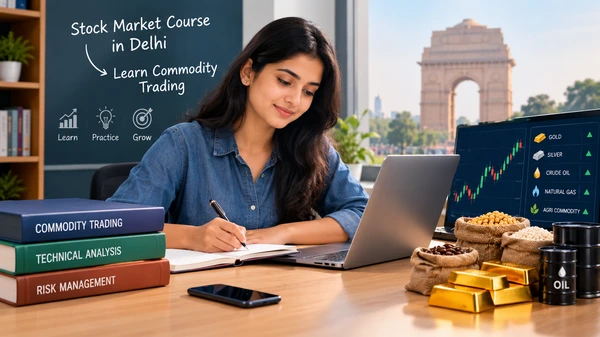
Gold, silver, crude oil, cotton etc. Most of us deal with these every day without thinking about how their prices get set. Commodity trading is the market where that happens, and it moves for reasons that are easy to follow once someone explains them properly. If you're looking at a stock market course in Delhi and wondering whether it will actually teach you about commodities, this guide covers what to look for, what you should expect to learn.
What Is Commodity Trading, and Why Should Beginners Learn It?
Commodity trading means buying and selling contracts linked to raw materials, through recognised exchanges. Prices swing for plenty of reasons like global demand and supply, weather, economic data, currency moves and political tension. A drop in crude oil supply can push oil prices up. Economic uncertainty and industrial demand can shake up precious metals.
If you're new, don't rush to place a trade. Start by understanding how the market works. Get comfortable with futures contracts, contract specifications, expiry dates and margins, and learn why prices jump around the way they do. That groundwork helps you make informed decisions, and it's also where a structured course earns its place, because it explains these ideas step by step and keeps reminding you that risk management matters most in a volatile market.
How Can a Stock Market Course in Delhi Help You Understand Commodity Markets?
A good programme should teach you:
- Market fundamentals: how commodity exchanges and futures contracts operate.
- Technical analysis: reading candlestick charts, spotting trends, and finding support and resistance levels.
- Fundamental analysis: how demand, supply, inventory reports and economic events affect prices.
- Trading psychology: how discipline and emotional control shape your decisions.
- Risk management: how margin, leverage, position sizing and stop-loss planning work in practice.
Which Commodities Can You Study?
Commodity markets cover precious metals, energy products, base metals and some agricultural goods. Each group has its own uses and its own price drivers.
| Commodity | Common Uses | What Moves the Price |
| Gold | Jewellery and investment | Interest rates, currency movements, global uncertainty, demand |
| Silver | Jewellery, electronics, solar technology | Industrial demand, investment activity, supply |
| Crude oil | Fuel and petroleum products | Global production, demand, inventories, geopolitical events |
| Natural gas | Electricity generation, industrial energy | Weather, storage, production, seasonal demand |
| Copper | Construction, electrical equipment | Industrial activity, infrastructure demand, mining supply |
| Aluminium | Transport, packaging, manufacturing | Production costs, energy prices, industrial demand |
| Agricultural commodities | Farming and food industries | Weather, crop yields, seasonal demand, inventories |
Who Can Learn Commodity Trading?
Pretty much anyone willing to put in regular time. Your starting point just changes how you should approach it.
| Learner | A Sensible Way to Start | Topics to Focus On |
| Students | Learn the basics first and practise reading charts alongside your studies. | Commodity fundamentals, gold and silver prices, technical analysis, risk management |
| Working professionals | Build a fixed weekly schedule around your job and study live market examples when you have time. | Futures contracts, crude oil prices, economic news, market analysis |
| Part-time workers | Use classes or study material that fit around your work and build knowledge gradually. | Price trends, demand and supply, trading basics, risk control |
| Complete beginners | Get the terminology right before moving on to charts and futures. | Market fundamentals, contract specifications, margins, leverage |
Why Risk Management Matters So Much
Before you take any position, you should know roughly how much you could lose. That's what risk management is about: setting limits, understanding your exposure, calculating position size and staying away from excessive leverage.
Here's a simple example. Say a futures position has an exposure of ₹2,00,000. If the price moves 2% against you, that's a loss of ₹4,000, before charges and other adjustments. Now suppose the margin you put up was only ₹20,000. That ₹4,000 is 20% of your margin, gone from one small move. This is how leverage makes losses feel bigger than the price change itself.
Why Choose ICFM for Commodity Trading?
ICFM – Stock Market Institute lists a dedicated Certificate in Commodity Trading alongside its other financial market programmes. If you want to study commodities through a specific course instead of picking them up from general stock market lessons, that's worth a closer look.
Here's what the learning experience is built around:
- Market understanding: how commodity prices move and what drives trends.
- Technical analysis: chart reading, support and resistance, and common indicators.
- Risk awareness: margin, leverage and why limiting losses comes first.
- A gentle start: financial market concepts built up step by step, so beginners aren't thrown in at the deep end.
- Career relevance: analytical skills that are useful for understanding financial markets more broadly.
Frequently Asked Questions
1. What is commodity trading?
It's the trading of contracts linked to commodities such as gold, silver, crude oil and natural gas. Prices depend on demand, supply, economic conditions and global events.
2. Which commodities can I learn about?
Typically gold, silver, crude oil, natural gas, copper and eligible agricultural commodities. The exact list depends on the course syllabus and the contracts currently available on the exchanges.
3. Is commodity trading suitable for students and working professionals?
Yes. Both can learn the concepts alongside their other commitments. Just pick a schedule you can stick to, and understand the risks before you trade with real money.
4. What skills matter most?
Chart reading and technical analysis help, as does understanding economic events and price trends. But risk management and disciplined decision-making are what keep traders in the game.
5. Is commodity trading risky?
Yes. Prices can swing sharply, and leveraged futures trading can lead to heavy losses. Good education and risk management help you avoid mistakes, but they never guarantee profits.