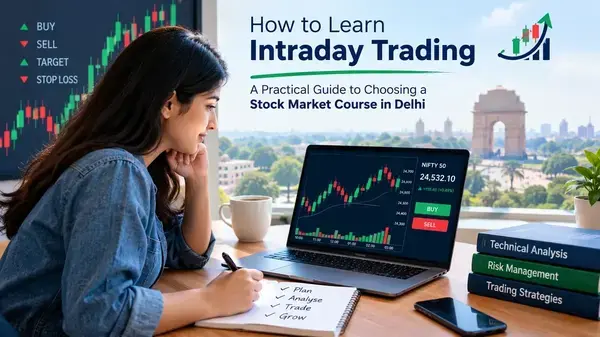
Intraday trading means buying and selling a share on the same day, so you never carry a position overnight. You're trying to profit from small price moves, and those moves can go against you just as quickly.
Say you have ₹50,000 and decide to risk no more than 1% on a single trade. That's ₹500. You plan to buy a share at ₹200 with a stop-loss at ₹195, so you're risking ₹5 per share. ₹500 divided by ₹5 means you can buy 100 shares. If your target is ₹210, you stand to gain ₹10 per share for every ₹5 you risk, a 1:2 risk-to-reward ratio.
That's why the skill matters far more than any tip you'll get online.
If you're looking for the best stock market course in Delhi, this guide covers what to learn, in what order, and what to check before you pay for anything. It's written for students, working professionals, part-time workers and complete beginners. At ICFM – Stock Market Institute, this is the kind of structured, practical approach we believe in: no promises of quick money, just a clear way to build real skills.
What Should a Good Intraday Trading Course Teach You?
Memorising chart patterns isn't enough. Plenty of people can spot a pattern, but far fewer know when it's likely to fail, or how much they're willing to lose if it does. A solid intraday trading course should cover:
- Market basics: how exchanges work, what orders are, and how prices move during the trading session.
- Candlestick charts: how a single candle shows the fight between buyers and sellers, and how to read common patterns.
- Technical analysis: trends, support and resistance, indicators, volume and price action.
- Entry and exit planning: deciding in advance where you'd get in, where you'd get out, and where you'd admit you were wrong.
- Risk management: position sizing, stop-losses and risk-to-reward ratios. This is the part that keeps you in the game.
- Trading psychology: fear, greed and impatience cost traders more money than bad charts do.
- Practice and review: testing ideas on historical charts or in a simulator, then learning from your mistakes.
How to Learn Intraday Trading, Step by Step
You don't need to learn everything at once. This order works well for most people.
Step1. Start with the basics. Learn how shares are traded, how orders work and why prices change. Everything else builds on this.
Step2. Learn to read charts. Study candlesticks, support and resistance, trends and volume. Just as important, learn what these tools can't tell you.
Step3. Build a simple trading plan. Write down what you'd look for before entering a trade, where your exit would be, and the most you're willing to lose.
Step4. Practice without real money. Use historical charts or a simulator. Note why you took each trade and what happened. One lucky win doesn't prove a strategy.
Step5. Keep a trading journal. Record the setup, the risk, why you exited and what you learned. After a few weeks, your repeated mistakes will be obvious.
Step6. Understand the risks before going live. Think about losses, brokerage and other costs, and what a string of bad trades would do to your capital. Never trade with borrowed money or money you need for rent, fees or bills.
How Can Different Types of Learners Learn Intraday Trading?
| Who you are | The usual problem | What helps |
| Student | Balancing studies with learning financial concepts | Learn market basics, practise chart reading, and use a trading simulator. |
| Working professional | Limited time due to office hours and commuting | Follow a fixed study schedule and practise with historical charts. |
| Part-time worker | Changing work schedules and limited free time | Choose suitable batch timings and revise trading concepts regularly. |
| Complete beginner | Understanding technical terms and avoiding unreliable tips | Start with market fundamentals, then learn trading strategies and risk management. |
Picking an institute is a big decision, so ask hard questions. ICFM – Stock Market Institute teaches the stock market in a structured way, starting from fundamentals and moving gradually towards intraday concepts and strategies. The focus is on three things:
- Learning in order: basics first, strategies later, so you're never lost.
- Practical chart work: analysing charts, spotting possible setups and understanding market trends.
- Risk first: stop-loss, position sizing and disciplined decision-making from day one.
Whether you're a student, a professional or working part-time, you can ask ICFM about batch timings and learning formats to find one that fits your routine.
Frequently Asked Questions
1. Which is the best stock market course in Delhi for intraday trading?
Look for a course that covers technical analysis, candlestick patterns, price action, risk management and practical chart work, taught by trainers with real market experience. ICFM – Stock Market Institute offers structured training built around these areas. Whichever institute you consider, compare the syllabus, faculty and fees first.
2. Why should beginners consider ICFM?
Because the learning is step by step. You start with how the market works, then move on to charts, trade planning and risk, so you build a foundation before thinking about live trading.
3. Can students learn intraday trading alongside their studies?
Yes. Follow a manageable schedule, start with market fundamentals, practise chart reading, and use simulated trades so you aren't risking real money while you learn.
4. Can working professionals learn it while keeping their jobs?
Yes, learning is very doable. Check ICFM's class timings and formats, and remember that active intraday trading needs your attention while the market is open.
5. What should I check before enrolling in a course?
Review the syllabus, fees, duration, faculty support, practical training and class formats. Make sure the course matches your experience level and goals.
6. Does an intraday trading course guarantee profits?
No. Prices are unpredictable and losses can happen. A good course builds your knowledge, discipline and risk awareness, but it can never guarantee results.
Look for a course that covers technical analysis, candlestick patterns, price action, risk management and practical chart work, taught by trainers with real market experience. ICFM – Stock Market Institute offers structured training built around these areas. Whichever institute you consider, compare the syllabus, faculty and fees first.
Because the learning is step by step. You start with how the market works, then move on to charts, trade planning and risk, so you build a foundation before thinking about live trading.
Yes. Follow a manageable schedule, start with market fundamentals, practise chart reading, and use simulated trades so you aren't risking real money while you learn.
Yes, learning is very doable. Check ICFM's class timings and formats, and remember that active intraday trading needs your attention while the market is open.
Review the syllabus, fees, duration, faculty support, practical training and class formats. Make sure the course matches your experience level and goals.
No. Prices are unpredictable and losses can happen. A good course builds your knowledge, discipline and risk awareness, but it can never guarantee results.