
Finding a stock market course isn’t hard. Choosing one is. Search for it and you’ll get dozens of options, all promising to teach you the market, and it’s tough to know which one deserves your time and money.
A good course does more than define terms like “bull market” or “dividend.” It should show you how the market actually works, how to read a price chart, how to look at a company’s numbers, and why protecting your capital matters as much as making returns. If a course skips that last part, be careful.
Your situation matters too. A college student, an office employee and someone working shifts all need something different from the same course. ICFM – Stock Market Institute is one place to look if you want structured learning with practical training.
What to Look for Before You Enrol?
Don’t start with the brochure. Start with these questions.
Is the syllabus in a sensible order? You should begin with market basics, then move to technical analysis, then fundamental analysis, with risk management running through all of it..
Will you practise, or only listen? Reading charts, working through real market examples and doing exercises is how the learning sticks. Theory alone won’t help when you’re looking at a live chart.
Does the schedule work for you? Ask about batch timings. Find out whether classes are online, offline or recorded, because a great course is useless if you can’t attend it.
Who helps when you’re stuck? Check for doubt-clearing sessions, revision material, mentorship or some form of guidance during the course.
Does it teach you about losing? A serious course covers stop-loss orders, position sizing, trading psychology and the fact that you can lose money.
What a Best Stock Market Course Should Teach?
A well-planned programme should teach the subjects relevant to its stated learning objectives. These are some important areas to understand when comparing courses.
- Stock market fundamentals: how exchanges work, how orders are placed, and how trading differs from investing.
- Technical analysis: price charts, candlestick patterns, trends, support and resistance, and trading volume.
- Technical indicators: tools like moving averages, the Relative Strength Index (RSI) and MACD.
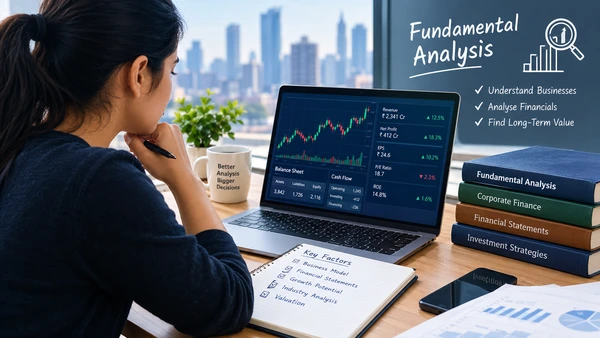
- Fundamental analysis: reading a company’s financial statements, revenue, profitability, debt, ratios and valuation.
- Derivatives and options: futures, calls, puts, strike prices, premiums and expiry dates.
- Risk management: position sizing, stop-loss orders, risk-reward calculations and the chance of loss.
- Trading psychology: how fear, greed and impulsive decisions change the way people trade.
Which Course Fits Your Schedule, Goals, and Experience?
The most suitable course depends on your experience and daily routine. Use this comparison to identify what to prioritise.
| Learner | Main objective | Suitable learning approach | What to check |
| Students | Build foundational knowledge and explore finance-related career options | Start with market basics, followed by guided exercises | Eligibility, fees, duration, and certificate details |
| Working professionals | Learn alongside a full-time job | Look for suitable evening, weekend, or online options | Timings, attendance requirements, and learning support |
| Part-time workers | Study around shifts and other responsibilities | Consider manageable batches and recorded lessons if available | Schedule flexibility, revision resources, and total cost |
| Beginners | Understand the market before studying advanced strategies | Progress from fundamentals to analysis and risk management | Beginner-friendly syllabus and practical exercises |
Why Look at ICFM – Stock Market Institute?
Whether you’re a student curious about financial markets, a professional picking up a new skill or a part-time worker who needs flexibility, learning is easier when the programme builds step by step. ICFM – Stock Market Institute offers courses across several areas, from basic equity trading to specialised market analysis and trading strategies.
Courses Offered at ICFM
ICFM’s published catalogue includes programmes for different interests and skill levels.
- Certificate in Equity Trading: an introduction to stock market fundamentals, equity trading and how the market operates.
- Certificate in Technical Analysis: chart reading, candlestick patterns, trends, support and resistance, indicators and risk management.
- Certificate in Fundamental Analysis: judging companies through financial statements, profitability, ratios and valuation.
- Certificate in Derivatives Trading: futures and options, the key concepts, and why understanding risk matters.
- Certificate in Commodity Trading: an introduction to commodity markets and how commodity trading works.
- Intraday Trading Course: short-term trading concepts, chart analysis and ways to study price movement within a single session.
- Swing Trading Course: approaches based on studying possible price moves over several days.
- A to Z Options Trading: calls, puts, premiums and strategies, with attention to risk management.
- Certified Financial Market Professional (CFMP): broader financial market education across the subjects covered in the programme.