
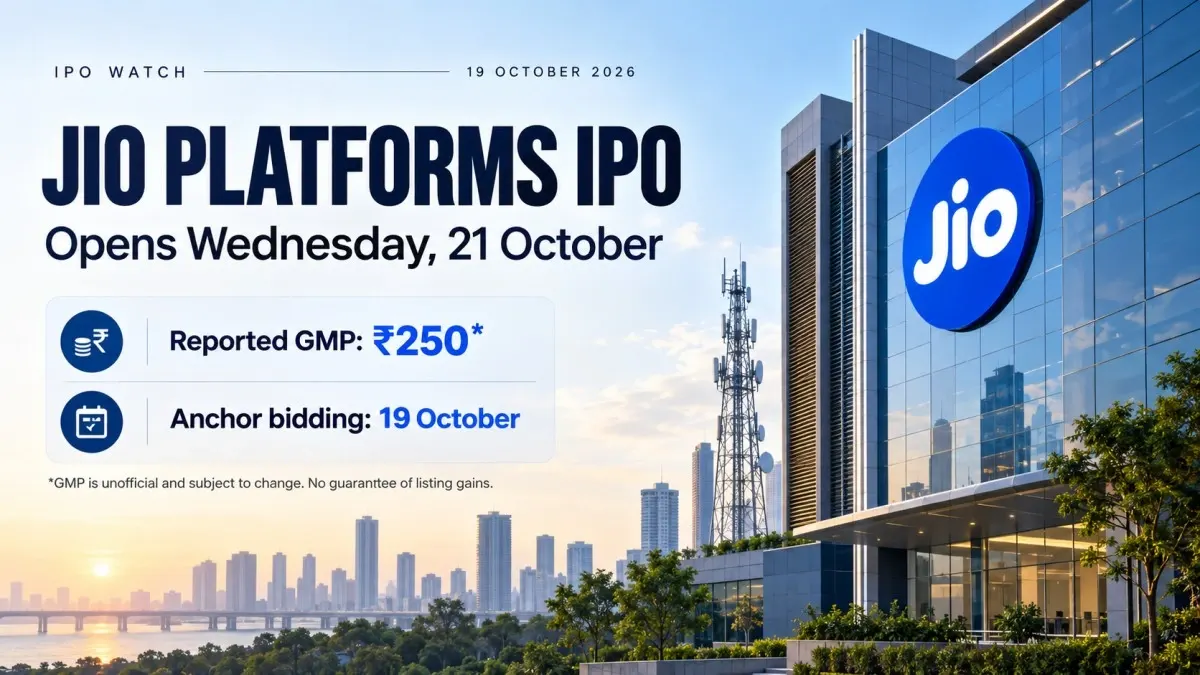
Two days before the bidding window opens, the unofficial market has already placed its bet. Jio Platforms’ shares were quoting a grey market premium (GMP) of about ₹250 on Sunday night, roughly 22% above the upper end of the ₹1,065–1,119 price band. Two weeks ago that number was ₹148.
The anchor book opens today, 19 October. Retail investors get their turn from Wednesday, 21 October, to Friday, 23 October. At roughly ₹30,213 crore, the issue is the largest IPO India has seen.
Key takeaways
- Price band: ₹1,065–1,119 per share. One lot is 12 shares, or ₹13,428 at the upper band.
- Dates: The issue opens 21 Oct and closes 23 Oct. Allotment is on 26 Oct, and the shares list on NSE and BSE on 28 Oct 2026.
- Structure: A 100% fresh issue of 27 crore shares. No existing investor is selling.
- GMP: Around ₹245–250 as of 18 October, implying an indicative listing near ₹1,364–1,369. This is unofficial and can reverse.
- Use of money: Up to ₹27,500 crore goes to prepay debt at Reliance Jio Infocomm.
- Quotas: Up to ₹2,500 crore is reserved for eligible Reliance Industries shareholders. Up to ₹500 crore is reserved for employees, who get a ₹54 discount.
- Valuation: About 33.3 times FY26 earnings at the upper band, against roughly 40.7 times for Bharti Airtel.
What is the Jio Platforms IPO, and why does it matter?
Jio Platforms Ltd is the holding company for Reliance Jio Infocomm, the mobile and broadband operator behind Jio SIMs and JioFiber. It also owns digital businesses such as Haptik and Radisys. It sits under Mukesh Ambani’s Reliance Industries and is run by Akash Ambani.
The company is offering 27 crore new equity shares of ₹10 face value. The price band was disclosed through Reliance's filings to the exchanges on 14 October. At ₹1,119, the issue raises about ₹30,213 crore and values Jio Platforms at roughly ₹10.3 lakh crore after the issue. Only around 2.9% of the company will be in public hands after listing, a thin float for a business of this size.
It matters for three reasons:
- Size. No Indian IPO has raised more.
- Price discovery. It gives the market a listed price for an asset that was previously valued only inside Reliance’s share price.
- Existing investors are staying. Meta, Google, KKR, Saudi Arabia’s PIF, Mubadala and the other investors who put in more than ₹1.5 lakh crore in 2020 are holding on. Bloomberg reported last week that none of them is selling in this offer.
| Issue detail | Figure |
| Price band | ₹1,065–1,119 per share |
| Lot size | 12 shares (₹13,428 at upper band) |
| Issue type | Book-built, 100% fresh issue |
| Shares offered | 27 crore (face value ₹10) |
| Issue size at upper band | ~₹30,213 crore* |
| Reservation: RIL shareholders | Up to ₹2,500 crore |
| Reservation: employees | Up to ₹500 crore (₹54/share discount) |
| Category split | QIB 50%, retail 35%, non-institutional 15% |
| Anchor bidding | 19 October 2026 |
| Subscription | 21–23 October 2026 |
| Allotment | 26 October 2026 |
| Refunds and demat credit | 27 October 2026 |
| Listing | 28 October 2026, NSE and BSE |
| Registrar | KFin Technologies |
| Post-issue public float | ~2.9% |
*Some trackers list ₹30,188 crore. The roughly ₹25 crore gap is consistent with the employee discount being netted off. Confirm the final figure in the RHP.
How has the Jio IPO GMP moved since the dates were announced?
The grey market premium has nearly doubled from its early October reading, though the climb has not been a straight line. IIFL noted intermittent dips between 4 and 16 October before the latest leg higher.
| Date (2026) | GMP | Indicative listing price | Implied gain vs ₹1,119 | Source |
| 4 Oct | ₹148 | ₹1,267* | 13.2%* | IIFL |
| 5 Oct | ₹160 | ₹1,279* | 14.3%* | IIFL |
| 14 Oct | ₹215 | ₹1,334* | 19.2%* | Equentis |
| 16 Oct | ₹221–225 | ₹1,340–1,344 | 19.7–20.1% | IPOji, IIFL |
| 17 Oct | ₹230 | ₹1,349 | 20.6% | IPOji |
| 18 Oct | ₹245–250 | ₹1,364–1,369 | 21.9–22.3% | IPOji, InvestorGain |
*Calculated by ICFM as upper band plus GMP. The price band was announced on 14–15 October, so readings before that date were quoted against an expected price.
What the numbers say, and what they don’t. On one lot of 12 shares, a ₹250 premium works out to a notional ₹3,000. That money exists only if the GMP holds through listing day, and only if you actually get an allotment.
Grey market trades are unregulated and thinly traded. SEBI, the exchanges and the company play no part in them. They reflect sentiment among a small set of dealers, not a forecast. IPOji's day-wise tracker shows how quickly the number moves even within a single day.
Who is backing the issue, and why are global funds lining up?
The anchor book is reported at around ₹8,000 crore. Its list of interested investors reads like a roll-call of the world’s large pools of capital:
- Sovereign funds: the Abu Dhabi Investment Authority, Qatar Investment Authority, GIC of Singapore, Norges Bank Investment Management and Mubadala.
- Global asset managers: BlackRock, Fidelity, Allianz, Capital Group, Goldman Sachs and Amundi.
- Domestic mutual funds: SBI, HDFC, ICICI Prudential, Nippon India, Kotak and Motilal Oswal have reportedly put in indications of interest.
Bloomberg reported bids above $20 billion for the anchor portion. Treat that as indicative until the company files the final anchor allotment with the exchanges, which is expected after today’s bidding.
Half the anchor shares are locked in for 30 days and the other half for 90 days from allotment. That matters for retail investors thinking beyond listing day, because the first lock-in expiry will land in late November.
Want to read an IPO the way fund managers do?
GMP tells you what a few dealers think. The Red Herring Prospectus tells you what the company is actually selling: its debt, its risks, its related-party dealings, and the price you are paying for every rupee of profit.
At ICFM – Institute of Career in Financial Market, Delhi’s market-training institute since 2012, students learn to read offer documents, value businesses against listed peers, and build a disciplined approach to trading and investing.
ICFM’s SSS, CPT and Algo programmes are taught by market practitioners at the Laxmi Nagar, East Delhi campus and the Gurugram center. Students earn BFSI and ICFM certification and get NISM exam preparation.
Book a free counselling session at ICFM India → Click Now
Which numbers in the RHP should investors check first?
Strip away the brand and you have a telecom business that has grown revenue steadily while raising tariffs and adding users. Here is the three-year picture.
| Metric | FY24 | FY25 | FY26 |
| Revenue from operations (₹ crore) | 1,09,558 | 1,28,218 | 1,46,885 |
| Profit after tax (₹ crore) | 21,423 | 26,109 | 30,049 |
| Return on net worth | 8.02% | 8.97% | 9.42% |
| Jio subscribers (million, March) | 482 | 488.2 | 524.4 |
| ARPU (₹/month, Q4) | 181.7 | 206.2 | 214.0 |
| Total borrowings (₹ crore, 31 March) | n/a | 73,060 | 70,781 |
| EPS (₹) | ~24 | n/a | 33.63 |
Source: RHP data as compiled by 5paisa and TradingView News. Subscriber and ARPU figures are for Reliance Jio Infocomm.
A few things stand out on a closer read:
- Revenue grew about 34% in two years, from ₹1.10 lakh crore to ₹1.47 lakh crore. Profit grew faster, by about 40%, so margins improved rather than diluted.
- ARPU did the heavy lifting. A ₹32 rise in monthly revenue per user since FY24 is the tariff hikes showing up. In Q1 FY27 it inched up again to ₹215.6.
- 5G is already the majority. Jio had 284.9 million 5G users by June 2026, about 53% of its 533.3 million customers.
- Debt is the purpose. The ₹27,500 crore prepayment equals roughly 39% of the ₹70,781 crore of borrowings on the books in March 2026 (ICFM calculation). Lower interest cost should flow straight to the profit line. That is why analysts frame the issue as a balance-sheet clean-up rather than a growth-capital raise.
- Return on equity is modest. At 9.42%, it is well below Bharti Airtel’s 20.32%. That is the trade-off behind the cheaper P/E.
If you want to build the skill of reading these numbers yourself, ICFM's Certificate in Fundamental Analysis covers income statements, balance sheets and peer valuation.
Is the Jio IPO valuation reasonable? What analysts say
At the upper band, Jio is priced at about 33.3 times its FY26 earnings per share of ₹33.63. Swastika Investmart pointed out that this is around 18% cheaper than Bharti Airtel’s 40.71 times.
Both Swastika and Emkay Global have a “subscribe” view, citing Jio’s market leadership, pricing power and declining leverage. Emkay highlighted that Jio carries 60% of India’s wireless data traffic.
Emkay also flagged five risks worth reading in full in the RHP:
- Spectrum costs and regulatory changes
- Competitive pressure on ARPU and churn
- Dependence on Reliance Group entities
- Concentration among passive-infrastructure and equipment vendors
- Leverage and foreign-exchange exposure
There is a valuation history here too. Bankers had pitched $200–240 billion earlier in the process, and estimates of $180 billion circulated this year. The final band puts Jio closer to ₹10.3 lakh crore.
Earlier in 2026, Reliance slowed preparations as the Iran war rattled Indian markets. One concern reported at the time was pricing Jio below Airtel’s market value. The final band suggests Reliance chose to leave something on the table for new investors.
When and how can retail investors apply for the Jio IPO?
The window is short: 21 to 23 October. UPI mandates need to be approved before the cut-off on the last day, and bank and broker cut-offs are often earlier than the exchange deadline.
Step by step:
- Log in to your broker app or your bank’s net-banking ASBA facility.
- Search for “Jio Platforms” under IPOs.
- Choose your category: individual investor, RIL shareholder, or employee if eligible.
- Enter a quantity in multiples of 12 shares. Bid at the cut-off price so your bid is valid at whatever final price is set.
- Enter your UPI ID and approve the mandate in your UPI app.
- Check allotment status on the KFin Technologies site or the NSE/BSE portals on 26 October.
Who can use the Reliance shareholder quota? Investors who held Reliance Industries shares in their demat account on or before 13 October 2026 can apply under the shareholder reservation, worth up to ₹2,500 crore. That date is the cut-off given in the offer document. Those who qualify can apply in both the shareholder and retail categories, which improves allotment odds. Check the exact eligibility rules in the RHP before bidding.
A reality check on allotment. Even before reservations are carved out, 35% of 27 crore shares works out to no more than about 78 lakh minimum lots for retail investors (ICFM calculation). If retail applications run well past that number, as they often do in large, high-profile issues, allotment goes by lottery and many applicants receive nothing.
Where does this leave investors before Wednesday?
The setup is unusually clean for an Indian mega-issue. There is no offer-for-sale, the use of funds is known, institutional demand is strong, and the valuation is pitched below the closest listed rival. Those are real positives.
But two things deserve the same attention as the GMP:
- The low float. At around 2.9%, it can amplify price swings in both directions after listing.
- Anchor lock-in expiries. The lock-ins end at 30 and 90 days, which can bring fresh supply into the market.
The issue also lands in a nervous month for equities. Our recent piece on whether Q2 results can halt the Sensex and Nifty sell-off explains the backdrop.
For anyone applying, the sensible approach is the old one. Read the RHP's risk section and financial statements, size the bid to money you can leave invested, and treat the grey market as weather, not a map.
Disclaimer: This article is for educational purposes only and is not investment advice. GMP figures are unofficial. Investments in securities markets are subject to market risks; read the RHP before investing.
Frequently asked questions
1. What is the Jio IPO price band and lot size?
The Jio Platforms IPO price band is ₹1,065 to ₹1,119 per equity share, with a face value of ₹10. Retail investors must bid for a minimum of one lot of 12 shares, which costs ₹13,428 at the upper end of the band. Bids can be placed in multiples of 12 shares. Eligible Jio Platforms employees get a discount of ₹54 per share, so they effectively pay ₹1,065 at the upper band. The price band was disclosed through Reliance Industries’ filings with the stock exchanges on 14 October 2026.
2. What is the Jio IPO GMP today?
As of the morning of 19 October 2026, IPO grey market trackers showed the Jio Platforms IPO GMP at about ₹250 per share. Added to the ₹1,119 upper price band, that points to an indicative listing price of roughly ₹1,369, a premium of about 22%. The GMP has risen from ₹148 on 4 October 2026. Grey market premium is an unofficial, unregulated indicator of dealer sentiment. It is not backed by SEBI, the stock exchanges or the company, and it can fall sharply before listing day.
3. What is the Jio IPO date, and when does subscription close?
The Jio IPO, also called the Reliance Jio IPO, opens for public subscription on Wednesday, 21 October 2026, and closes on Friday, 23 October 2026. Anchor investors bid one working day earlier, on Monday, 19 October 2026. Investors applying through UPI must approve the mandate in their UPI app before the cut-off time on the closing day. Many brokers and banks set their own cut-off a few hours earlier than the exchange deadline, so applying on 21 or 22 October avoids last-minute technical issues.
4. What are the Jio IPO allotment date and listing date?
The basis of allotment for the Jio Platforms IPO is expected to be finalised on Monday, 26 October 2026. Refunds to unsuccessful applicants and the credit of shares to demat accounts are scheduled for Tuesday, 27 October 2026. Jio Platforms shares are expected to list on both the National Stock Exchange (NSE) and BSE on Wednesday, 28 October 2026. Investors can check their allotment status on the website of the registrar, KFin Technologies, or on the NSE and BSE IPO status pages.
5. How big is the Jio Platforms IPO, and is it India’s largest IPO?
Yes. The Jio Platforms IPO is the largest initial public offering in Indian stock market history. It is a 100% fresh issue of 27 crore equity shares, worth about ₹30,213 crore at the upper price band of ₹1,119. Some trackers show ₹30,188 crore, a gap consistent with the employee discount being netted off. At the upper band, Jio Platforms will have a post-issue market value of roughly ₹10.3 lakh crore, with only about 2.9% of its shares held by the public after listing.
6. Who can apply under the Reliance Industries shareholder quota in the Jio IPO?
Investors who held Reliance Industries Ltd (RIL) shares in their demat account on or before 13 October 2026 can apply under the RIL shareholder reservation in the Jio Platforms IPO. This quota is worth up to ₹2,500 crore. Eligible RIL shareholders can bid in both the shareholder category and the regular retail category, which improves their chances of getting an allotment. The final eligibility conditions, including bid limits per category, are set out in the Red Herring Prospectus (RHP), which investors should read before applying.
7. How can a retail investor apply for the Jio Platforms IPO?
A retail investor can apply for the Jio Platforms IPO through a stockbroker app or through the ASBA facility in their bank’s net banking. After logging in, the investor searches for “Jio Platforms” in the IPO section, chooses the investor category, enters the quantity in multiples of 12 shares and ticks the cut-off price option. The final step is to enter a UPI ID and approve the mandate in the UPI app. The application amount stays blocked in the bank account, not debited, until allotment is finalised on 26 October 2026.
8. How will Jio Platforms use the money raised from the IPO?
Jio Platforms plans to use up to ₹27,500 crore of the IPO proceeds to prepay or repay borrowings of its main operating subsidiary, Reliance Jio Infocomm Ltd. The remaining amount will go towards general corporate purposes, as detailed in the RHP. As of 31 March 2026, Jio Platforms’ total borrowings stood at about ₹70,781 crore, so the planned prepayment equals roughly 39% of that debt. Lower interest costs after repayment are expected to support future profits, which is why analysts describe the issue as a balance-sheet clean-up.
9. Is Jio Platforms the same company as Jio Financial Services?
No. Jio Platforms Ltd and Jio Financial Services Ltd are two separate companies that share the “Jio” brand. Jio Platforms is the digital and telecom arm of Reliance Industries. It is the parent of Reliance Jio Infocomm, the mobile and JioFiber broadband operator, and also owns businesses such as Haptik and Radisys. Jio Financial Services is a separate financial-services company that is already listed on the stock exchanges. The IPO opening on 21 October 2026 is for Jio Platforms only.
10. Is the Jio Platforms IPO valuation expensive compared with Bharti Airtel?
At the upper band of ₹1,119, the Jio Platforms IPO is priced at about 33.3 times its FY26 earnings per share of ₹33.63. Swastika Investmart noted this is around 18% cheaper than Bharti Airtel’s price-to-earnings ratio of about 40.71 times. However, Jio’s return on net worth for FY26 was 9.42%, well below Airtel’s 20.32%, which partly explains the lower multiple. Brokerages Emkay Global and Swastika Investmart have given a “subscribe” view, citing Jio’s market leadership, pricing power and falling leverage.
11. What are the key risks of investing in the Jio Platforms IPO?
Emkay Global listed five key risks for the Jio Platforms IPO: spectrum costs and regulatory changes, competitive pressure on ARPU and customer churn, dependence on Reliance Group entities, concentration among passive-infrastructure and equipment vendors, and leverage and foreign-exchange exposure. Investors should also note two market-specific risks. The small public float of about 2.9% can magnify price swings after listing, and anchor investor lock-ins expire after 30 and 90 days, which can add selling pressure. The full risk factors are listed in the RHP.
12. Does a high GMP guarantee listing gains in the Jio IPO?
No. A high grey market premium does not guarantee listing gains in the Jio Platforms IPO or any other IPO. GMP reflects informal trades among a small group of dealers and has no legal or regulatory standing. The actual listing price is decided by demand and supply on the stock exchanges on listing day. That depends on subscription levels, the final issue price, broader market conditions and global cues. Past IPOs in India have listed both above and below their grey market estimates.